94% Of Recruitment Agencies Are Losing The AI Race
The Oxford AI School Launches ‘AI for Recruiters’ As 9 Out Of 10 UK Job Seekers Now Use AI On Their Applications.
78% of UK recruitment agencies have adopted AI, but only 6% have embedded it into how they operate. Agencies with significant AI training are fifteen times more likely to report a strong return (43.8% vs 2.9%).
‘AI for Recruiters’ is a half-day, hands-on AI training session for recruitment agencies, executive search firms and in-house talent teams, for up to eight people, from £1,499 (ex VAT).
The Oxford AI School has launched ‘AI for Recruiters’, a half-day, hands-on training module for recruitment agencies, executive search firms and in-house talent teams. It arrives as new industry data suggests most of the sector has bought the tools and skipped the lessons.
Recruitment agencies have bought AI, but skipped the lessons
The Access Group’s AI in Recruitment 2026 Outlook found that 78% of recruitment agencies have adopted AI in some form, yet only 6% have embedded it into their core operating model. Nearly every agency has a ChatGPT login somewhere. Almost none have changed how the desk actually works.
The same research found that training is what separates AI that pays from AI that just sits there. Among agencies with significant AI training, 43.8% reported strong return on investment. Among agencies with minimal training, the figure was 2.9%. Same tools. Fifteen times the payoff.
Bullhorn’s 2026 GRID Industry Trends report, a global survey of around 2,300 recruitment professionals including UK firms, points the same way. Recruitment leaders who felt equipped to guide AI adoption were nearly 40% more likely to have grown revenue in 2025.
| Finding | Figure | Source |
|---|---|---|
| Agencies that have adopted AI in some form | 78% | The Access Group, 2026 |
| Agencies with AI embedded in their core operating model | 6% | The Access Group, 2026 |
| Strong ROI: significant vs minimal AI training | 43.8% vs 2.9% | The Access Group, 2026 |
| Leaders equipped to guide AI more likely to have grown revenue | ~40% | Bullhorn GRID, 2026 |
| Hays consultant headcount / net fees per consultant | −12% / +7% | Hays plc, 2026 |
| UK professionals who use AI somewhere in job applications | 90% | Robert Half UK, 2026 |
| UK employees who have used unapproved AI tools at work | 71% | Microsoft UK, 2025 |
Fewer desks, more fees per desk
The biggest UK players are already running leaner. Hays’ results for the year to June 2026 showed consultant headcount down 12% to 5,194 while net fees per consultant rose 7%, with the group pointing to AI-powered search and matching across a database of more than 10 million CVs. Fewer desks, more fees per desk.
The KPMG and REC UK Report on Jobs for September 2026 showed permanent placements rising for the first time since September 2022. After four lean years the upturn has finally turned up, and it will land on the agencies with the spare capacity to catch it.
Candidates, meanwhile, are already fluent. Robert Half research published this month found that only 10% of UK professionals don’t use AI anywhere in their job applications, and 67% of UK hiring managers say screening for AI-generated material has made hiring slower. The people on the other side of the desk have done their homework.
Untrained AI use is a data protection incident waiting for a date
Untrained use carries its own risks. Microsoft UK research found 71% of UK employees have used unapproved consumer AI tools at work. In recruitment, where the raw material is CVs, salaries and right-to-work documents, that is a data protection incident waiting for a date. In March 2026 the Information Commissioner’s Office reported that many employers are likely relying on solely automated decisions in hiring, with patchy human review, weak bias checks and too little transparency for candidates.
Recruitment is a relationship business buried under a mountain of admin. Job ads, InMails, CV summaries, candidate submissions, client updates – AI will clear most of that mountain before lunch, but only if someone has been shown how to do it. With AI tools, too many agencies have bought a Ferrari but are using it to drive to Lidl. The agencies that trained their people with AI skills are fifteen times more likely to report a strong return.
Harry Lang, Managing Director, The Oxford AI School
What ‘AI for Recruiters’ covers
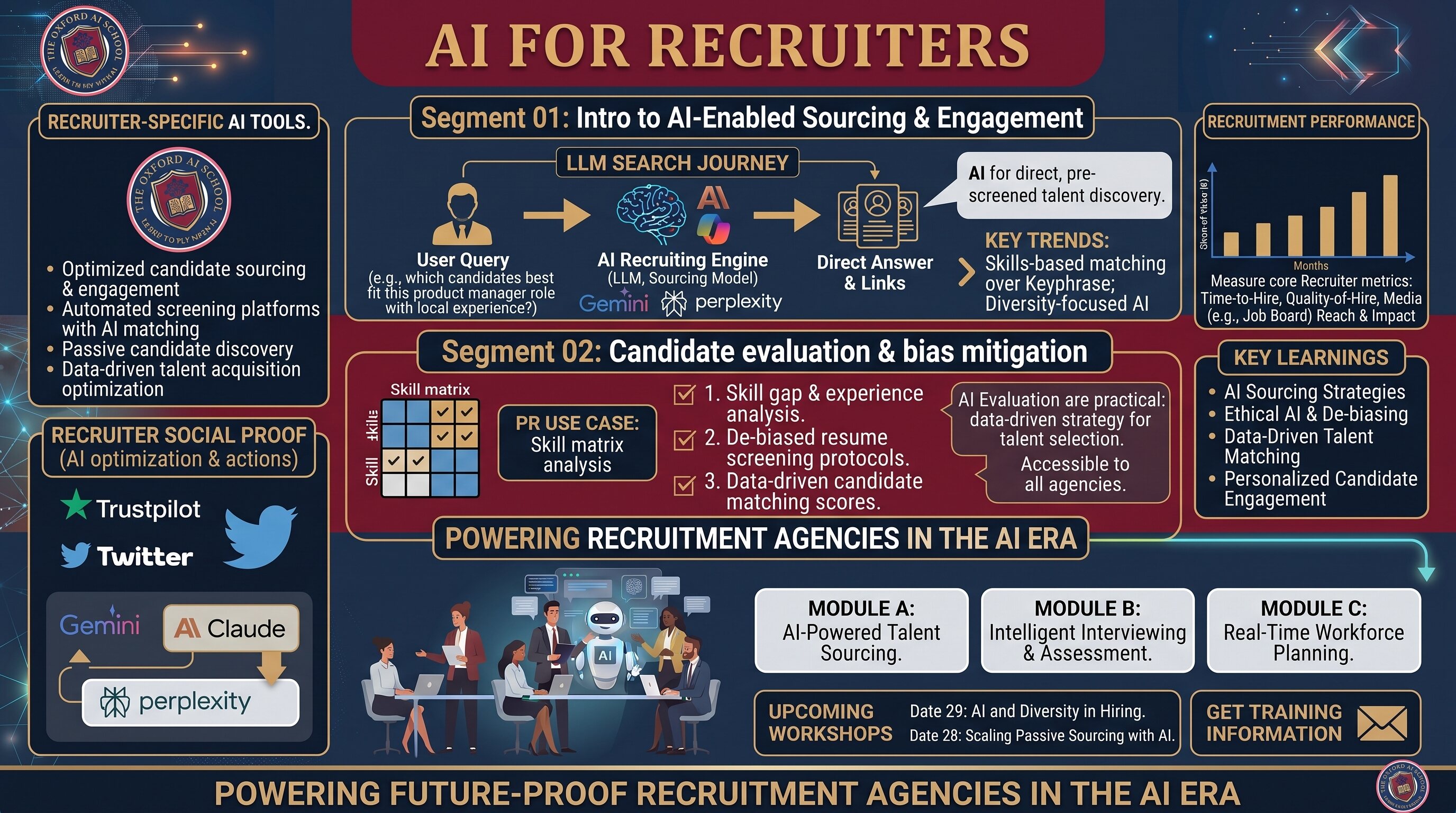
‘AI for Recruiters’ is an easy, practical and fun module built around the real working week of a recruitment professional, whether they bill on permanent placements, run a contract desk, work retained executive search or hire in-house. The half-day session runs for up to eight people and is split into four segments:
- Job adverts, sourcing and candidate attraction. Turning a rushed client brief into a compelling advert, checking wording for exclusionary language, and building Boolean and LinkedIn search strings for hard-to-fill roles.
- Screening, shortlisting and interviews. Summarising CVs against criteria the recruiter sets, building structured interview questions and scorecards, and turning call notes into client-ready submissions.
- Candidate and client communication. Candidate updates, shortlist reports and market insight, plus measured drafts for the awkward conversations, from counter-offers to withdrawn offers.
- Business development, compliance and running the desk. Target client research, BD emails and tender responses, and a written AI policy for candidate data that the whole team follows.
Teams work on their own roles, briefs and templates rather than a generic example, and leave with a folder of saved prompts built around their actual Tuesday morning. The session covers ChatGPT, Microsoft Copilot, Perplexity, Claude and Gemini, plus the AI features now built into ATS and CRM platforms and LinkedIn Recruiter. No technical background is needed.
UK GDPR and fair hiring are referenced, and the module has foundations in one simple truth: AI can inform a hiring decision, but an actual recruiter must actually make it.
AI for executive search: judgement stays human
Recruitment and executive search professionals sell judgement, discretion and an expansive black book. AI goes nowhere near any of that. What it can optimise are the long lists, the research notes, the candidate reports and the client updates. The search firm that hands those hours to AI will end up winning.
Harry Lang, Managing Director, The Oxford AI School
Price, format and booking
The session is delivered virtually at £1,499 or in person at the client’s office at £1,599 (ex VAT), with takeaway materials and 30 days of follow-up support included. Sessions run across Oxfordshire, London and the rest of the UK, and internationally online.
‘AI for Recruiters’ is open for bookings now. Full details are at theoxfordaischool.com/ai-for-recruiters, and the school’s other programmes are at theoxfordaischool.com/programmes. Agencies can book a free 10-minute intro call by emailing Learn@TheOxfordAISchool.com or through the website and social channels.
ENDS
Notes to editors
About The Oxford AI School
The Oxford AI School is an Oxfordshire-based training business founded by Harry Lang in 2026, offering practical, jargon-free and affordable AI education for small businesses, teams and professional services firms. Modules are hands-on and designed to deliver measurable benefits from the first session. Sector programmes cover recruiters, law firms, accountants, IFAs, estate agents, marketing teams, PR agencies, farmers, publicans and schools.
Data sources
- The Access Group, AI in Recruitment 2026 Outlook, 28 July 2026. Survey of 159 recruitment agency leaders across the UK and Australia/New Zealand (78% adopted AI in some form, 6% embedded in core operating model; strong ROI reported by 43.8% of agencies with significant training vs 2.9% with minimal training). theaccessgroup.com
- Bullhorn, GRID 2026 Industry Trends Report, February 2026. Global survey of c.2,300 recruitment professionals (leaders equipped to guide AI adoption nearly 40% more likely to have grown revenue in 2025). bullhorn.com
- Hays plc, Preliminary Report for the year ended 30 June 2026, 20 August 2026 (consultant headcount down 12% to 5,194; consultant net fee productivity up 7%). londonstockexchange.com
- KPMG and REC, UK Report on Jobs, 7 September 2026 (permanent placements rose for the first time since September 2022). kpmg.com
- Robert Half UK, AI in job applications research, September 2026. Survey of 500 UK hiring managers and 1,000 UK professionals, June 2026 (10% of professionals don’t use AI in any part of applications; 67% of hiring managers say screening for AI-generated material has slowed hiring). responsesource.com
- Microsoft UK, research conducted by Censuswide, October 2025. 2,003 UK employees (71% have used unapproved consumer AI tools at work). ukstories.microsoft.com
- Information Commissioner’s Office, Recruitment rewired, 31 March 2026 (employers likely relying on solely automated decisions in recruitment). ico.org.uk
Press enquiries and interviews
For interviews with Harry Lang, contact press@theoxfordaischool.com.
Website and socials
- Web — theoxfordaischool.com
- Module — theoxfordaischool.com/ai-for-recruiters
- X — @oxfordaisch
- LinkedIn — Oxford AI School
- YouTube — @OxfordAISchool
- TikTok — @oxfordaischool
- Facebook — OxfordAISchool
- Instagram — @theoxfordaischool
- All social pages — linktr.ee/TheOxfordAISchool
AI for recruitment agencies and executive search: FAQs
How are recruitment agencies using AI in 2026?
The Access Group’s AI in Recruitment 2026 Outlook found that 78% of recruitment agencies have adopted AI in some form, but only 6% have embedded it into their core operating model. Most agencies have the tools but have not changed how the desk works, and training is what separates agencies that see a return from those that do not.
Does AI training for recruiters actually pay off?
Yes. Among agencies with significant AI training, 43.8% reported strong return on investment, compared with 2.9% of agencies with minimal training: the same tools with roughly fifteen times the payoff.
How can executive search firms use AI?
For long lists, target company research, research notes, candidate reports and client updates, while the judgement, discretion and relationships that clients pay for stay with the search consultant. AI for Recruiters covers retained executive search alongside agency and in-house recruitment.
What does the AI for Recruiters module cover?
Four segments: job adverts, sourcing and candidate attraction; screening, shortlisting and interviews; candidate and client communication; and business development, compliance and running the desk. It covers ChatGPT, Microsoft Copilot, Perplexity, Claude and Gemini, plus the AI features in ATS and CRM platforms and LinkedIn Recruiter.
How much does AI for Recruiters cost?
£1,499 virtually or £1,599 in person at your office (ex VAT) for up to eight people, with takeaway materials and 30 days of follow-up support included.
Is it legal to use AI to screen candidates in the UK?
AI can support screening, but under UK GDPR candidates have rights around solely automated decisions, and the ICO has warned that many employers are likely relying on them in hiring. The module is built on one rule: AI can inform a hiring decision, but a recruiter must make it. For the policy side, see how to write an AI policy and the AI Policy Workshop.
Want to see the full module? Explore AI for Recruiters, browse all programmes, take the free 2-minute AI skills assessment, or book a free 10-minute intro call.