
The short answer
- There is no single best AI book, because three different kinds exist and they do not compete. Work out which of the three jobs you want done first: using AI, understanding AI, or building AI.
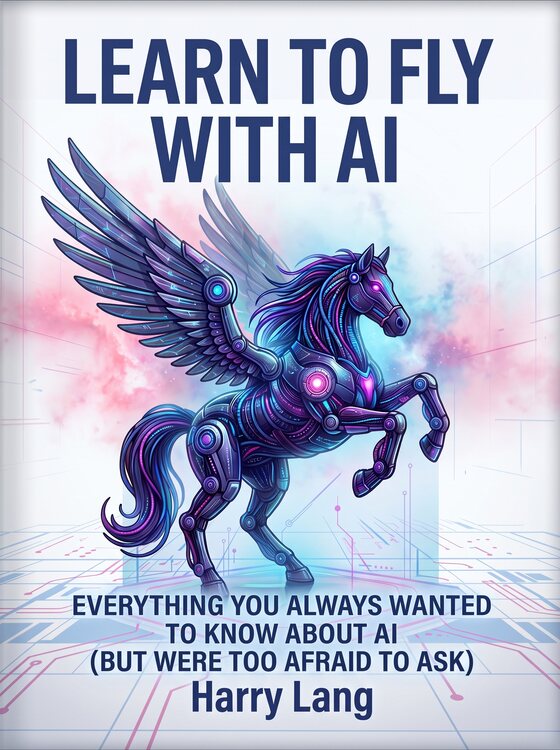
- To use AI at work and at home, buy a practical guide. Learn To Fly With AI (mine, declared) or Co-Intelligence by Ethan Mollick.
- To understand how it works and where it is going, read Melanie Mitchell's Artificial Intelligence: A Guide for Thinking Humans, or The Coming Wave by Mustafa Suleyman.
- To build models yourself, you want Hands-On Machine Learning by Aurélien Géron, and you will need Python. Most people asking this question do not want this book.
- There is no good standalone book for learning ChatGPT, Claude or Copilot specifically. The products change monthly. Buy a book for the thinking and use the vendor documentation for the buttons.
- Declared interest: I wrote Learn To Fly With AI and I give the proceeds to Oxfordshire children's charities. Read this page accordingly.
This is Notes From Harry Note 03, so it is written the way I would answer it in a workshop rather than the way an affiliate site would. There are no affiliate links on this page and nothing here is ranked one to ten, because I do not think a single ranking is an honest way to answer this question.
Why "what's the best AI book?" is almost the wrong question
I get asked this at the end of nearly every session, usually by the person who has been quietest all day. They have decided to go away and sort this out properly on their own, and they want one recommendation they can buy on the train home.
For two years I fumbled the answer, and it took me a while to work out why. It was not that I did not know any AI books. It was that the question has a hidden fork in it. "Best AI book" means at least three incompatible things depending on who is asking, and the reason so many people end up with a disappointing purchase is that nobody asked them which one they meant.
Go and read the one-star reviews on almost any popular AI title. Very few of them say the book is badly written. Nearly all of them say some version of this was not what I thought I was buying: too technical, not technical enough, too much philosophy, not enough practical help. That is a category error, not a quality problem, and it is completely avoidable.
The three kinds of AI book, and who each one is for
The practical guide: "help me use this on Tuesday morning"
This book assumes you have a job, a laptop and about forty minutes. It teaches you which assistant to open, how to brief it, how to catch it inventing things, and what you must never paste into it. Success looks like you doing a real task faster by the end of the week.
- Buy this if you want AI to help with emails, proposals, research, spreadsheets, admin, planning or homework.
- Tell-tale signs: worked examples, prompts you can adapt, screenshots, a chapter on safety and data.
- Warning sign: anything promising to "10x your income". That is not a book, it is a pitch.
The explainer: "help me understand what is actually going on"
This book answers the questions that nag at intelligent people. Why does it make things up? Is it thinking? Where is this heading, and should I be worried? Success looks like you being able to hold your own in an argument about AI without repeating a headline.
- Buy this if you are curious, sceptical, or need to make decisions about AI rather than operate it.
- Tell-tale signs: a named academic or industry author, arguments rather than instructions, endnotes.
- Warning sign: confident predictions about specific years. Nobody knows.
The technical text: "help me build the thing"
This book is a training course in print, with code, maths and exercises. Success looks like a working model on your own machine. It is superb if that is what you want and a waste of money if it is not.
- Buy this if you can already program, or you are committed to learning Python properly.
- Tell-tale signs: code listings in the sample pages, a companion repository, the words "regression" and "tensor".
- Warning sign: none. It is honest about what it is. Just check it is what you are.
Nine times out of ten, the quiet person at the end of my workshop wants category one and is about to buy category two, because category two is what gets reviewed in the weekend papers. That is the single most useful thing on this page.
The five tests a beginner-friendly AI book has to pass
Once you know you want a practical guide, use the "Look inside" preview and apply these five tests. They take about four minutes and they will save you a fortnight of low-level guilt about the unread book on your bedside table.
Test one: is there any code in it?
Search the sample for a code block or a line of Python. If you find one in the first three chapters of a book marketed at beginners, put it down. Using AI well in 2026 requires no programming at all, and a book that reaches for code early has not decided who it is for.
Test two: does it define every term the first time it appears?
Find the first use of "large language model", "token", "context window", "hallucination" or "agent". Is each one explained right there, in the sort of language you would use in a pub, or is it assumed? Those five words cause more confusion in my sessions than everything else put together, and a good book treats them as the reader's first encounter, not as vocabulary they should already own.
Test three: are the examples ordinary work, or demos?
Demo examples are "write me a poem about a sad robot". Real examples are "turn these four meeting notes into a client update my boss will not rewrite". You need the second kind, because the whole difficulty of AI adoption is transfer: getting the skill from the book into the actual job. A book full of party tricks never makes that jump.
Test four: is it honest about the limits?
Flick to the index or contents and look for hallucinations, accuracy, data protection, privacy, energy, water, ethics. If none of them appear, you are holding a sales brochure. Any book that presents AI as unambiguously wonderful is going to get you into trouble, because the first time the tool confidently invents a statistic you will either believe it or lose all faith in the technology. Neither is a good outcome. Our guide to judging the accuracy of AI information is the free version of that chapter.
Test five: how much of it will still be true next year?
This is the one nobody applies, and it is the most important. Skim for model names, prices and menu instructions. Those are the perishable half and they are stale within weeks. The durable half is how these systems behave, how to brief them, how to check them, and what the trade-offs are. A good beginner AI book spends most of its pages on the durable half. A bad one is essentially an outdated manual with a nice cover.
A quick sanity check on age. Anything written before late 2022 predates ChatGPT entirely. That does not make it wrong, and some pre-ChatGPT explainers have aged remarkably well, but it does mean it cannot help you with the tools on your desk. Check the copyright page, not the cover date of the edition you are shown.
The best AI books for beginners, grouped by what you actually want
No ranking, no scores out of ten, no affiliate links. Just what each one is for, so you can buy the right category on purpose. Where a title is available in several editions, check you are getting the most recent.
If you want to use AI at work and at home
| Book | What it is good at | Who should skip it |
|---|---|---|
| Learn To Fly With AI Harry Lang (mine — declared) |
Total beginners who feel behind. No code, no maths, every term defined. Honest roundup of ChatGPT, Claude, Gemini, Copilot and Perplexity, ten rules for prompting, spotting hallucinations, AI at work and at home, GDPR and AI policy. Includes the downsides most AI books skip. | Anyone already running reliable AI workflows daily, and anyone who wants technical depth. |
| Co-Intelligence: Living and Working with AI Ethan Mollick |
How to think about working alongside AI, from a business school professor who runs the experiments in public. Strong on mindset, delegation and where the human still matters. | Anyone who wants step-by-step instructions for specific tasks. It is a way of thinking rather than a manual. |
These two sit together nicely, which is why I recommend them together rather than against each other. Mollick changes how you frame the relationship; mine is more of a driving lesson. If you can only buy one and you have never opened an AI tool in anger, start with the driving lesson.
If you want to understand how AI actually works
| Book | What it is good at | Who should skip it |
|---|---|---|
| Artificial Intelligence: A Guide for Thinking Humans Melanie Mitchell |
A clear-eyed, sceptical explanation of what these systems do and where they fall over, written by a computer scientist who refuses to overclaim. Excellent on why "understanding" is a much harder word than it looks. | Anyone wanting current tool advice. It was written before the ChatGPT era, so the thinking is durable and the examples are not. |
| Human Compatible Stuart Russell |
The control problem, from the co-author of the standard university AI textbook. If you want the serious version of "should we be worried", this is it rather than the newspaper version. | Anyone looking for practical help this week. This is about the shape of the problem, not your inbox. |
If you want to understand where all this is heading
| Book | What it is good at | Who should skip it |
|---|---|---|
| The Coming Wave Mustafa Suleyman |
AI and synthetic biology as a single incoming wave, and what containing it would actually require. Written by someone who co-founded DeepMind, so the view from inside is the point. | Anyone who finds "civilisational stakes" framing exhausting. It is not a tools book at all. |
| Nexus Yuval Noah Harari |
Places AI in the long history of information networks, which is a genuinely useful reframe if you keep hearing that this time is different. | Anyone who wants specifics. This is altitude, deliberately. |
If you want to build AI systems yourself
| Book | What it is good at | Who should skip it |
|---|---|---|
| Hands-On Machine Learning with Scikit-Learn, Keras & TensorFlow Aurélien Géron |
The practical text most people end up with if they are learning to build models properly. Exercises, code, real datasets. | Anyone who cannot already program, or who does not want to. This is a different hobby to the one you are shopping for. |
If you are wondering whether you should be in this category at all, our plain-English explainers on what machine learning is and machine learning models will settle it in ten minutes for free, before you spend forty pounds finding out.
What's the best book to learn ChatGPT, Claude or Copilot?
This is the version of the question I get most often now, and the honest answer disappoints people for about thirty seconds before it saves them money.
There is no good standalone beginner book for any individual AI assistant, and I would be suspicious of one that claimed to be. These products ship changes every few weeks. A book that tells you which menu to click is out of date somewhere between the printer and your doormat. I have watched a whole chapter of my own notes become wrong in a fortnight.
So split the problem in half, and buy accordingly.
| The durable half — get this from a book | The perishable half — get this from the vendor |
|---|---|
| How large language models behave, and why they invent things | Which model is current, and what it is called this month |
| How to write a brief that gets usable work back | Where the buttons are, and what the interface looks like |
| Managing context, and knowing when to start a fresh chat | Current context limits and usage caps |
| How to check accuracy before you trust an answer | Which plan includes which feature |
| What you must never paste in, and why | The current data-retention settings and where they live |
| The ethical and environmental trade-offs | Prices |
ChatGPT
The most-searched-for and the most written-about, which means the most out-of-date books. Learn the prompting method from a general book, then use OpenAI's own help pages for anything involving a menu. Our free guide to using ChatGPT effectively covers the five-part prompt rule, and ChatGPT for Dummies is our plain-English explainer if you want the durable half without buying anything at all.
Claude
There is no well-known beginner book on Claude specifically, and given the pace Anthropic ships at, that is probably for the best. The skills transfer almost entirely from any other assistant, so a general practical book plus the vendor docs is the right combination. If you want the free version, we publish what Claude is, which Claude plan you actually need and Claude versus ChatGPT.
Microsoft Copilot
Copilot is the hardest of the lot to learn from a book, for a reason that has nothing to do with the book. What you can do in Copilot depends on your organisation's licence and what your IT team has switched on. Two people reading the same page will open Word and see different things. Learn the general skills from a practical book, get the specifics from Microsoft's documentation, and if a whole team needs it, get training delivered inside your own tenant with your own licence in front of you. Start with Copilot for Dummies and ChatGPT versus Copilot for business.
Gemini and Perplexity
Same principle, and both are usually better learned inside a broader book that tells you when to reach for them rather than a dedicated volume. Perplexity in particular makes most sense once you understand what it is for, which is research with citations rather than general chat. See Gemini for Dummies, Perplexity for Dummies and using Perplexity for business research.
How to learn AI from a book so that it actually sticks
Buying the right book is maybe a third of the job. I have sold and given away enough copies now to have a decent sense of who gets value out of one and who does not, and the difference is not intelligence or seniority. It is whether the laptop was open.
Learning AI from a book fails in exactly one way: you read it like a novel, enjoy it, feel briefly better informed, and change nothing. Here is the method I give people instead.
- Open the tool before you open the book. A practical AI book is a driving manual, and nobody learnt to drive on the sofa. One window for the book, one for the assistant, and a rule that no chapter ends without you having typed something.
- Bring your own real work. Ignore the book's examples and substitute the email you actually have to send, the spreadsheet you actually have to explain, the proposal that is actually due Friday. Transfer only happens on real tasks, and it is the whole point.
- Steal the structures, not the prompts. Copying a prompt word for word teaches you nothing you can reuse. Learn the shape instead: role, task, audience, constraints, format. Once you have the shape, you can write a good prompt about anything. That is all prompt engineering really is.
- Deliberately catch it getting something wrong. Pick a subject you know inside out and interrogate it until you find a mistake. This is the single most valuable twenty minutes in the whole process. Until you have watched a confident, fluent, completely wrong answer appear on your own screen, you will over-trust the thing.
- Finish with three habits, not thirty notes. Choose three tasks you will now always start with AI, and do them that way for a month. Three habits that stick beat a highlighted book you never open again, every single time.
Four weeks of that will take a nervous beginner further than any single course, including ours. Which brings me to the awkward part of this page.
The one I wrote, and my declared conflict of interest
I could have written this page without mentioning my own book, and it would have been a slightly dishonest omission. So: I wrote Learn To Fly With AI, it is on Amazon in Kindle and print, and I obviously think it is good. Discount my opinion accordingly. Two things that might help you weigh it.
First, the proceeds go to children's charities here in Oxfordshire, because I collaborated heavily with Claude, ChatGPT and Perplexity to research and frame it and did not feel right keeping the money. That is set out in full on the book's own page, along with exactly what the AI did and what stayed human. I would rather you knew and decided than found out later.
Second, it exists because the recommendation gap in this article is real. For two years I had nothing good to hand the quiet person at the back. Every practical book I tried either assumed a technical reader or sold the miracle. So I wrote the one that passes the five tests above, because I had been applying them to other people's books and coming up short.
What it is, in one paragraph
A plain-English book about using AI at work and at home, for total beginners who feel they have missed the boat. No code, no maths. Three parts: getting your head around AI, getting good at it, getting ahead with it. An honest roundup of ChatGPT, Claude, Gemini, Copilot and Perplexity with a clear recommendation on where to start. Ten rules for prompting. How to spot hallucinations. AI for emails, proposals, research, data and meetings, and for meal plans, holidays, admin and homework. GDPR, safety and writing a simple AI policy. And the honest chapter: data risk, the power and water AI data centres drink, and the handful of very large companies sitting at the top of all of it.
Who should not buy it
- Engineers. There is no Python and no linear algebra in it. Buy Géron.
- Anyone already fluent. If you run reliable AI workflows daily you will find the first half slow. Go to the advanced material instead.
- Anyone wanting a forecast. This is about Tuesday morning, not 2040. Read Suleyman or Harari for that.
- Anyone who objects on principle to a book about AI being written with AI. That is a completely reasonable position and I would rather you kept your money.
Get Learn To Fly With AI
Everything you always wanted to know about AI, but were too afraid to ask. Out now on Amazon UK in Kindle and print. Proceeds go to Oxfordshire children's charities.
Get the book on AmazonBy Harry Lang · with Claude (co-author) · illustrated by Google Gemini · opens Amazon.co.uk in a new tab · read the full write-up first
A book, a course, or training for the team?
If you have got this far you are probably deciding between spending twelve pounds and spending rather more. Here is the honest version, from someone who sells the expensive one.
| If you want to… | Start with | Why |
|---|---|---|
| Understand AI at your own pace, on your own | A book | Cheap, complete, and nobody is watching you type |
| Learn structured basics with someone to ask | A beginners' course | Questions answered in the moment, and a reason to finish |
| Change how a whole team actually works | Team training | Adoption is a habit problem, and habits do not change from reading |
| Get everyone to the same starting point first | Book, then training | A session where nobody is lost is a far better session |
| Spend nothing at all yet | The free route | There is more genuinely good free material than most people realise |
| Write the rules before you roll anything out | The AI policy workshop | Policy first avoids unpicking bad habits later |
Books are astonishing value and they cannot make anybody do anything. That is the whole trade. If what you need is for eleven people to work differently by December, no book on this page will do it, and I would be doing you a disservice by pretending otherwise.
Still not sure which one you need?
Tell us what you are actually trying to do and we will tell you honestly whether that is a twelve-pound book, a free guide on this site, or a session with your team. We are quite happy to talk you out of the expensive option.
Book a callPractical AI training for your team
The Oxford AI School delivers plain-English AI training in Oxfordshire and London, across the UK, and live online for international teams. Sessions cover basic and advanced AI skills, policy, marketing, websites and GEO, and they are built on the same material as the book.
Programmes that cover the ground in these books
Basic AI Training
The practical half of any good beginner AI book, hands-on, in a single session.
Explore this trainingAll Programmes & Pricing
Every module, format and price in one place, for individuals and teams.
See all programmesAI Policy Workshop
Write the usage policy every honest AI book tells you that you need.
Explore this trainingBuild Your Best AI Stack
Choose the right tools for your work, beyond a roundup of the big five.
Explore this trainingBest AI books for beginners: frequently asked questions
What is the best AI book for beginners?
There is no single best AI book, because there are three different kinds and they do not compete with each other. If you want to use AI at work and at home, buy a practical guide such as Learn To Fly With AI by Harry Lang or Co-Intelligence by Ethan Mollick. If you want to understand how AI works and where it is heading, read Artificial Intelligence: A Guide for Thinking Humans by Melanie Mitchell or The Coming Wave by Mustafa Suleyman. If you want to build AI systems yourself, you want a technical text such as Hands-On Machine Learning by Aurélien Géron, and you will need Python. Decide which of those three jobs you want done before you spend anything, because almost every disappointed review of an AI book is really someone who bought the wrong category.
What is the best book to learn AI if I am not technical?
Look for four things on the sample pages before you buy: no code anywhere, every term defined the first time it appears, worked examples of ordinary work rather than demos, and an honest section on the limits. A book that passes those four tests will not lose you. Learn To Fly With AI was written specifically to pass them, with no code and no maths, for people who feel they have missed the AI boat. If you would rather learn with someone in the room than on your own, The Oxford AI School runs plain-English training for non-technical teams on the same material.
How do I learn AI from a book? Does it actually work?
It works if you read it with the tools open. Learning AI from a book fails in exactly one way: reading it like a novel and never typing anything. Read one chapter, then spend twenty minutes doing that chapter on your own real work rather than the book's examples. Steal the shape of the prompts rather than the wording, deliberately catch the tool getting something wrong so you learn not to over-trust it, and finish with three habits you will keep. Four weeks of that beats any single course.
What is the best book to learn ChatGPT?
Buy a book for the thinking and use the vendor's own documentation for the buttons. ChatGPT ships changes every few weeks, so any book listing menu locations is out of date before it reaches you. What does not go out of date is how to write a proper brief, how to manage context, how to spot a confident wrong answer and what you must never paste in. Learn To Fly With AI covers all of that across ChatGPT, Claude, Gemini, Copilot and Perplexity rather than tying you to one product. For the prompting method on its own there is a free guide to using ChatGPT effectively.
What is the best book to learn Claude?
There is no well-known standalone beginner book on Claude, and a single-product book would age badly given how fast Anthropic ships. The transferable skills are the same as for any assistant, so a general practical book plus the vendor docs is the better buy. Learn To Fly With AI includes Claude in its honest roundup of the big five assistants and says which one to start with depending on what you do all day. The Oxford AI School also publishes free guides on what Claude is, which Claude plan you need, and Claude versus ChatGPT.
What is the best book to learn Microsoft Copilot?
Copilot is the hardest one to learn from a book, because what you can do depends on your organisation's licence and what your IT team has switched on. Two people reading the same Copilot book will see different menus. Learn the general skills from a practical AI book, then get the specifics from Microsoft's own documentation or from training delivered inside your own tenant, where the licence you actually have is in front of you. The Oxford AI School's free guides compare ChatGPT and Copilot for business and explain Copilot in plain English.
Are AI books out of date by the time you read them?
The product details are, always. Model names, prices and menus change monthly, so treat any of those in a book as illustrative. The durable half does not move: how large language models work and why they invent things, how to write a brief that gets useful work back, how to check accuracy, what you should never paste into a chatbot, and the ethical and environmental trade-offs. A good AI book spends most of its pages on the durable half. That is the test worth applying when you flick through the sample.
Should I buy an AI book or book AI training?
Buy the book if you are learning on your own and want the whole picture cheaply at your own pace. Book training if you need a team to change how it works, because AI adoption is almost always a habit problem rather than a knowledge problem, and habits do not change from reading. Most organisations do both, in that order: the book gets everyone to the same starting point, which makes the session far more useful because nobody is lost. The Oxford AI School's programmes cover the same ground as Learn To Fly With AI, hands-on, in Oxfordshire and London, across the UK and live online internationally.

Harry Lang runs The Oxford AI School, teaching teams and businesses the basics of AI in a fun, easy and practical way. A marketing leader turned AI trainer, he is the author of Learn To Fly With AI and can be reached at Learn@TheOxfordAISchool.com.
Notes From Harry
First-person notes on things built with AI at The Oxford AI School: what worked, what cost what, and what I would do differently.