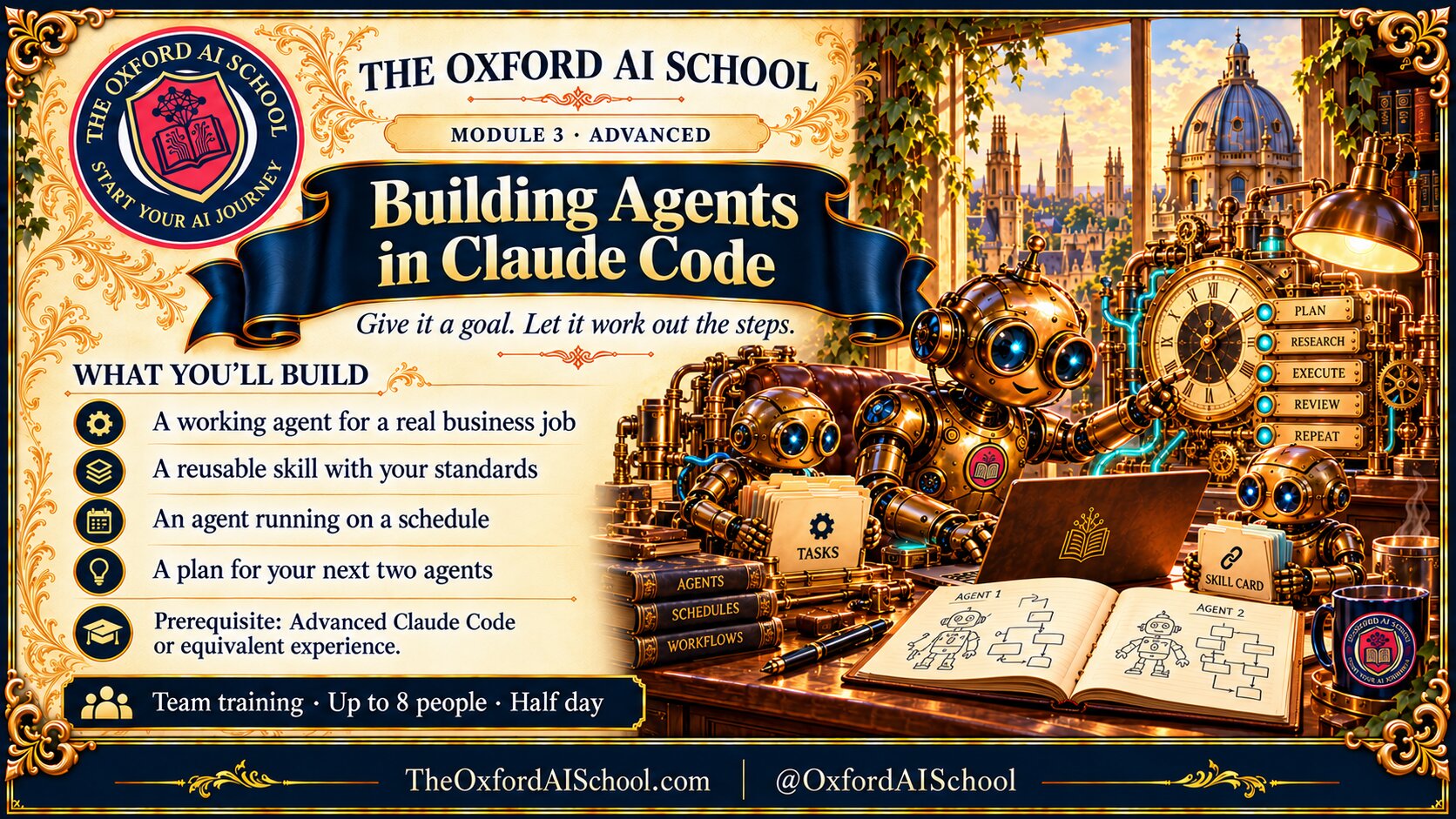
The difference between a tool you use and a colleague who gets on with it. This is the half day where you build an agent that does a real job for your business, and set it running while you get on with something else.
Up to now you have been giving Claude jobs one at a time. An agent is different. You hand it a goal, a few tools and the way you like things done, and it works out the steps itself. It does the research, writes the report, files the thing, checks its own work and comes back when it is finished. You are not typing instructions any more. You are running a small team. By the end of this half day you will have built one that does a genuine job you would rather not do yourself.
Built live, doing one real job from your business, whether that is research, a weekly report, sorting your inbox or drafting content. Not a demo. Yours.
What an agent is, when to let it hand parts of a job to helpers, and why that makes bigger jobs possible. The mental model, in plain terms.
A packaged piece of your own know-how the agent uses every time it runs. Your standards, baked in, so the output is yours and not generic.
Working while you sleep. A job that fires every morning, every Monday, or whenever you choose, and lands the result waiting for you.
Once you have built one, the others come quickly. You leave with the next two jobs mapped and ready to build.
Where to let an agent run free and where to keep a hand on it. Autonomy is powerful. Knowing its limits is what makes it usable.
Everything is built against a real job from your own business, so what you make is yours to keep and run from Monday.
The plain-English version, with the jargon stripped out. Goals, tools and judgement, and how they fit together.
We pick a real job from your week and build an agent for it together, start to finish.
When one agent should hand parts of a job to helpers, and how that lets you take on bigger work.
Package your own way of doing something so the agent applies it every single time it runs.
Point the agent at the real task and watch it plan, act and deliver without being walked through it.
Set it to run on its own, on a timetable, and land the result for you to review.
Map the next jobs, spot which ones suit an agent, and leave with a plan you can build against.
People who have Claude Code set up the way they like it and now want it working on its own. You are comfortable connecting tools and building shortcuts, and you have a job or three that runs like clockwork and eats your time. Business owners who want their evenings back, operators automating the weekly grind, and developers who want to ship agents without a research project first. If you have ever thought this should just run itself, this is where it starts to.
Advanced Claude Code, or the same ground covered. This module assumes you can teach Claude your context, build a shortcut and connect a tool. If you are already doing that comfortably, come and build your first agent.
Building Agents in Claude Code is the final module of three. Module 1 gets you running, Module 2 makes the tool yours, and this one hands the work over.
Get it installed and watch it do a real job on your own files.
Teach it your context, build your own shortcuts, automate a real job end to end.
Build an agent that does a real job and set it running on a schedule.
The things people ask before booking Module 3.
An agent is different from giving Claude one job at a time. You hand it a goal, a few tools and the way you like things done, and it works out the steps itself: it does the research, writes the report, files the thing, checks its own work and comes back when it is finished. You are not typing instructions any more, you are running a small team.
A working agent that does one real job from your business, built live: research, a weekly report, sorting your inbox or drafting content. You also build a skill the agent leans on, set it to run on a schedule, and leave with a plan for your next two agents.
Advanced Claude Code, or the same ground covered. The module assumes you can teach Claude your context, build a shortcut and connect a tool. If you are already doing that comfortably, you are ready to build your first agent.
A subagent is a helper an agent hands part of a job to. Delegating work this way keeps each piece focused and makes larger jobs possible. The session covers when delegating helps and when it is unnecessary complexity.
It is a half-day, hands-on session for teams of up to 8 people, priced at £2,299 excluding VAT and delivered virtually or in person. It is the final module in the Claude Code Pathway.
Half a day to build an agent that does a real job, then set it running.
Book your place