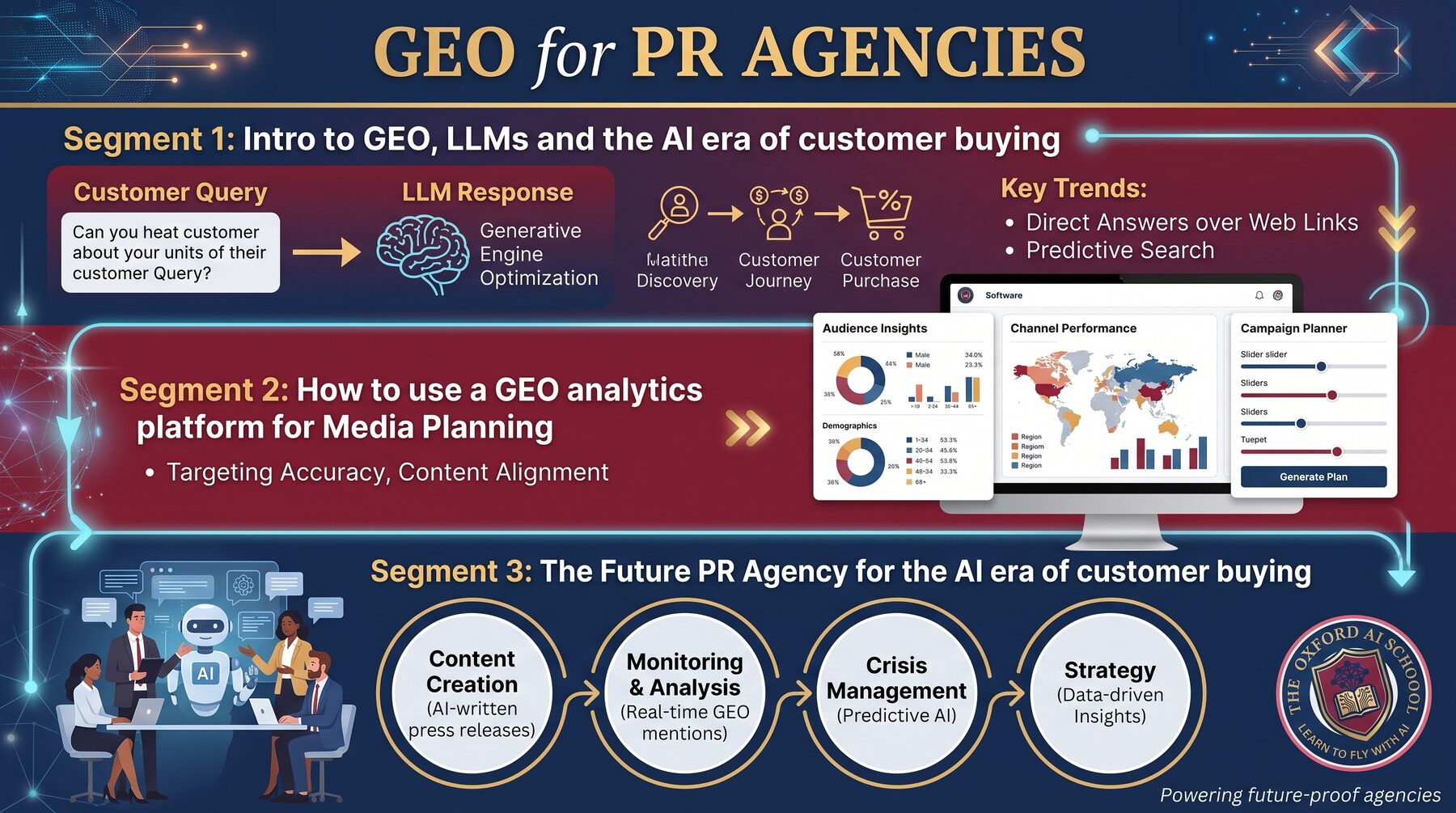
PR agencies should be leading the move from traditional search visibility to AI visibility. Not watching from the sidelines. Not waiting for SEO agencies to rename another dashboard. Leading it.
The reason is simple. When somebody asks ChatGPT, Claude, Gemini or Perplexity which company to trust, which product to shortlist or which expert knows their subject, the answer is influenced by what the wider information environment says. Websites matter. Structured content matters. Technical accessibility matters. But independent authority, consistent reputation and credible third-party coverage matter too.
That is PR territory.
Why should PR agencies lead GEO? Because agencies already know how to build the authority, expert evidence, earned media and coherent brand narratives that help a business become a credible source.
Why are so few leading it? Because GEO is being treated as a new service line before it is being treated as a new agency capability. The pitch deck is arriving before the training.
What GEO means for a PR agency
Generative engine optimisation, or GEO, is the practice of improving how accurately and prominently a brand appears in answers produced by AI systems. For a PR agency, that means helping clients become understood, trusted, mentioned and cited when buyers use conversational search.
It is not “doing PR for ChatGPT”. It is a broader discipline that connects:
- the questions audiences ask AI tools;
- the sources those tools use to form answers;
- the authority and evidence available around a client;
- the clarity of the client’s own website and expert content;
- the consistency of facts, entities and positioning across the web;
- and the measurement of whether AI answers improve over time.
Some of that belongs to SEO. Some belongs to content. Some belongs to digital product teams. But the authority layer – the part that cannot simply be published on command – is where PR has the strongest hand.
PR already owns the hardest part of GEO
A brand can publish a hundred pages saying it is brilliant. That does not make the claim independent. PR exists to create evidence beyond the company’s own domain: reporting, commentary, reviews, interviews, expert contributions, useful data and informed discussion.
Good PR teams also understand something that gets lost in technical conversations about AI search: reputation is not a keyword. It is a pattern. A company becomes believable when multiple credible sources describe it in a consistent, specific and relevant way.
SEO can help a source become discoverable. PR helps make the source worth discovering.
That is why the best GEO programmes need PR expertise. A technical audit can identify a visibility gap. It cannot manufacture genuine authority. A prompt-tracking platform can show that a competitor is being mentioned. It cannot earn the coverage that changes the picture.
So why aren’t PR agencies the GEO pathfinders?
1. GEO is being filed under SEO
The language of optimisation, rankings and visibility makes GEO sound like a branch of search marketing. That framing gives SEO agencies an early advantage, even though AI answers depend on a wider information ecosystem than a conventional results page.
PR leaders do not need to claim the entire discipline. They do need to recognise that a material part of it sits squarely inside their existing remit.
2. Agencies are productising before they are learning
There is commercial pressure to put GEO into credentials decks now. Fair enough. Clients are asking about it. New business teams need an answer. The danger is turning a live, changing discipline into three confident slides and a monthly report nobody in the account team can properly explain.
A credible GEO offer starts with shared understanding, not a new label on an old service.
3. The capability sits between departments
Media relations understands authority. Strategy understands audiences. Content understands language. Digital understands sites and data. Account teams understand the client. GEO needs all of them, which means it can easily belong to nobody.
The answer is not to create a lonely “Head of GEO” and hope for the best. It is to train a cross-functional group around one method.
4. Measurement is immature
AI answers vary by platform, prompt, user, location and time. That makes the neat certainty of a keyword ranking difficult to reproduce. Agencies need to be honest about what can be measured: visibility across a defined prompt set, the accuracy of brand descriptions, citation patterns, competitor presence and change over time.
GEO does not need fake precision. It needs a consistent baseline, transparent methodology and sensible interpretation.
5. Most teams have not been trained yet
This is the real blocker. PR people do not need to become machine-learning engineers. They do need to understand how generative AI retrieves information, where citations come from, why outputs differ, how to interrogate a GEO analytics platform and how those findings should change media planning.
Without that foundation, GEO remains a founder talking point rather than an agency competency.
The PR agency GEO operating model
A useful offer connects AI-search evidence to work the agency can actually deliver. The model below keeps responsibilities clear while showing where PR adds distinctive value.
| GEO task | Agency capability | Practical output |
|---|---|---|
| Map buyer questions | Audience strategy and research | A prioritised prompt and topic set linked to reputation and demand |
| Audit AI visibility | Insight and analytics | A baseline of mentions, descriptions, citations and competitor presence |
| Find authority gaps | Media planning | A source-led plan showing where credible third-party evidence is missing |
| Create expert evidence | Content, data and thought leadership | Original research, expert answers, useful resources and clear proof points |
| Earn trusted coverage | Media relations and digital PR | Relevant independent mentions that strengthen the client’s information footprint |
| Measure change | Reporting and counsel | Repeatable tracking with clear caveats, actions and client recommendations |
Train the team before selling the service
Founders and agency leaders do not need to wait for the market to settle. It will not. They do need to avoid promising an agency-wide competency that currently lives in one person’s browser history.
Start with the people who will have to explain, sell and deliver the work:
- leadership, so the proposition has a realistic scope and investment;
- new business, so GEO is sold clearly without inflated promises;
- strategists and planners, so AI visibility becomes an input to communications strategy;
- account teams, so clients receive confident, consistent counsel;
- media and content teams, so insights turn into work that can change the source environment;
- analytics teams, so measurement is repeatable and honest.
The goal is not for everybody to become a GEO specialist. The goal is for the whole delivery chain to understand what the agency is doing, why it matters and where its limits sit.
A 90-day pathfinder plan for agency leaders
Days 1–30: learn and baseline
Train a cross-functional working group. Define GEO, the agency’s role and the line between evidence and hype. Audit the agency’s own brand across a controlled set of relevant prompts. If the agency cannot diagnose its own AI visibility, it is not ready to sell the diagnosis to clients.
Days 31–60: build and pilot
Choose one client with a clear market category, accessible experts and a healthy relationship. Map buyer questions, review the answers and sources appearing now, then turn the gaps into a media, content and website collaboration plan. Record the baseline before activity starts.
Days 61–90: measure and productise
Repeat the audit using the same method. Document what moved, what did not and what cannot yet be attributed. Turn the learning into a defined offer with scope, roles, reporting language and exclusions. Train the wider agency using the pilot rather than a theoretical deck.
The greenfield opportunity is open now
PR agencies spent years watching search, social and performance disciplines occupy work that touched reputation but arrived with better data and clearer product packaging. GEO is a chance not to repeat that pattern.
The agencies that win will not be the ones that mention GEO most loudly. They will be the ones that connect AI-search evidence to excellent communications work, teach clients what the data can and cannot prove, and equip account teams to turn a changing technology into calm, useful counsel.
PR should be the pathfinder. But first, the pathfinder needs a map.
Frequently asked questions
Why should PR agencies lead GEO?
PR agencies already specialise in the hardest inputs to GEO: credible third-party coverage, expert commentary, reputation, authority and consistent brand narratives. GEO adds AI-search research, citation analysis, content structure and measurement to those existing strengths.
What is GEO for PR agencies?
GEO for PR agencies is the practice of helping client brands become understood, trusted, mentioned and cited in answers generated by tools such as Claude, ChatGPT, Gemini, Perplexity and Microsoft Copilot. It combines PR authority-building with AI-search research, content planning, technical collaboration and ongoing visibility measurement.
Can a PR agency sell GEO without training its team?
An agency can add GEO language to a proposal quickly, but delivering a credible service requires training. Account teams need to understand how AI answers are assembled, strategists need to interpret citation and visibility data, and media and content teams need a shared workflow for turning those insights into action.
Is GEO replacing SEO or PR?
No. GEO overlaps with both disciplines but does not replace either. SEO helps pages become discoverable in conventional search, while PR earns authority and third-party validation. GEO coordinates those signals around the questions people ask AI systems and measures whether the brand appears accurately in generated answers.
How should a PR agency start offering GEO?
Start by training a cross-functional team, auditing the agency’s own visibility in AI answers, defining a repeatable measurement method, piloting the workflow on one suitable client and documenting what changes. Productise the service only after the team can explain the method, evidence and limits clearly.

Harry Lang is the founder of The Oxford AI School and a former agency and client-side marketing leader. He trains PR agency teams to understand GEO, use AI-search evidence and turn it into practical client work.
Ready to build the capability before you sell it? Explore the GEO for PR Agencies training module, or book a free 10-minute intro call to discuss your team.