New module · Generative Engine Optimisation

Get your brand understood, trusted and cited by AI.

Your customers have started asking ChatGPT, Perplexity and Google Gemini before they ever reach Google. Intro to GEO is a half-day team session that shows your marketing, SEO, PR, content and dev people how to earn a place in the answers those models give.

CMOs Marketing teams SEO teams PR teams Content teams Dev teams
The module

Learn all about the intricacies of GEO.

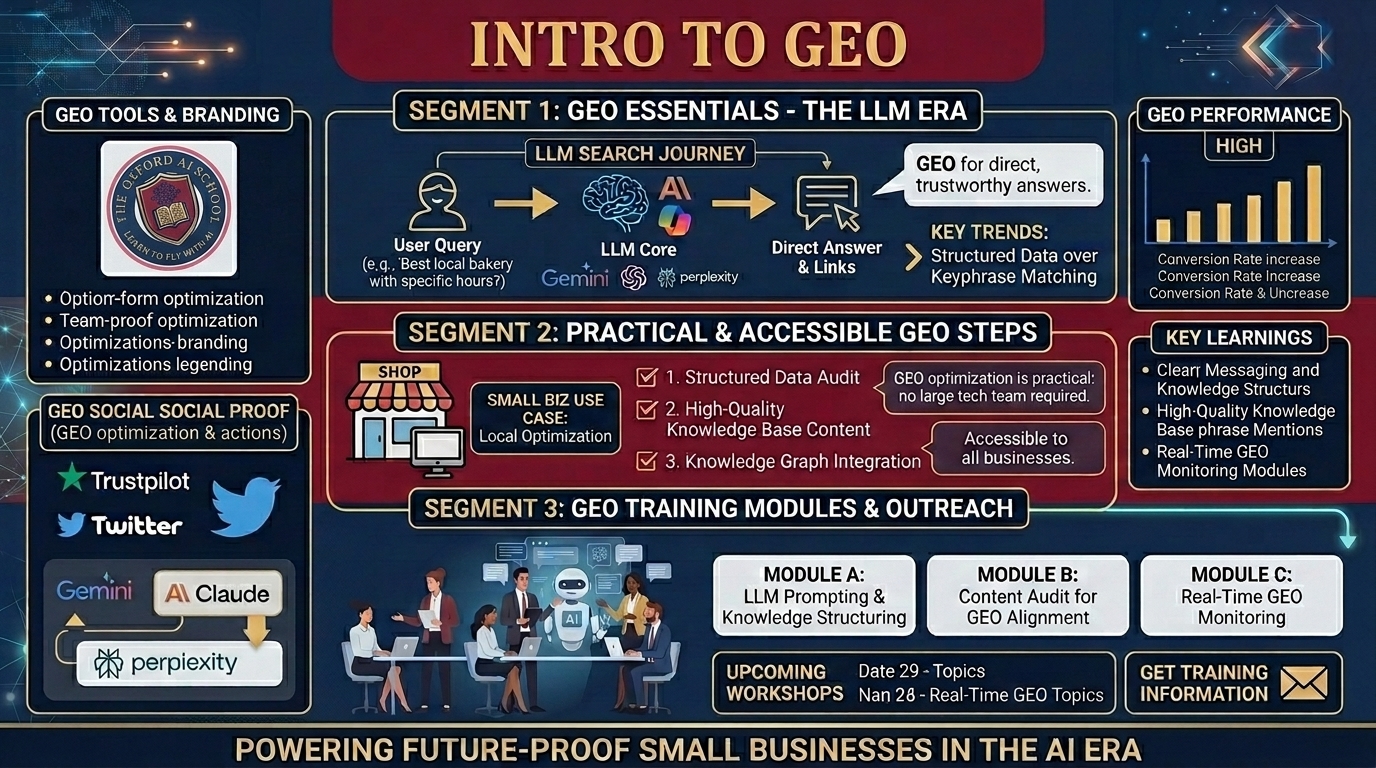
Generative Engine Optimisation (GEO) is the practice of creating content and content frameworks that appeal to AI models like ChatGPT, Perplexity and Google Gemini, so they understand, trust and cite your brand in the answers they give. It is the sister discipline to SEO for the age of AI search.

In this module, you and your team will learn how Generative Engine Optimisation actually works, and how to put it to work for your brand. Think of it as the sister discipline to SEO. Where SEO optimises pages to rank on Google, GEO focuses on creating content and content frameworks that appeal to AI models like ChatGPT, Perplexity and Google Gemini, and encourage them to understand, trust and cite your information in their synthesised answers.

The prize is the same as it has always been with SEO. Done well, good GEO strategy will help your brand win more traffic, this time from LLM searches rather than the traditional blue links.

It is built for CMOs, marketing teams, SEO teams, PR teams, content teams and dev teams. The session is accessible from the first minute, then goes further, handing you the more complex opportunities, strategies, methodologies, tools and tactics you can deploy for your brand straight away.

The GEO wave is coming. This module gives you a head start.

The short version

Like SEO, but for the machines doing the answering.

Same instinct, different battlefield. One optimises for a page of ranked links. The other optimises for a single synthesised answer, and for whether your brand is named inside it.

SEO

Optimising to rank on Google

You shape pages, links and technical signals so a search engine ranks you highly and a human clicks through. The click is the goal.

GEO

Optimising to be cited by AI

You shape content and content frameworks so a language model understands your information, trusts it, and cites you in the answer it writes for the user. The citation is the goal.

On the day

The module schedule.

Two hours and forty-five minutes of teaching, one proper break, and a clear line from theory to a platform you drive yourself.

01

Intro to GEO, LLMs and the AI era of customer buying

Theory 30 mins

Where this has come from, and why it matters to anyone with something to sell.

  • Acronym and jargon 101, so nobody is nodding along in the dark
  • Why LLMs have burst onto the scene
  • How buying journeys are changing
  • What that means for vendors
02

GEO vs SEO: the similarities and the differences

Theory 30 mins

What carries straight across from your SEO playbook, and what quietly does not.

  • Technical comparisons
  • Content and media comparisons
  • Operational comparisons
03

GEO metrics: what they mean and the traps to avoid

Theory 30 mins

The numbers that count, the numbers that flatter, and how to tell them apart.

  • All the GEO metrics, explained in plain terms
  • How to prioritise them
  • The KPI watchouts nobody warns you about
04

How to navigate a GEO data platform

Practical 45 mins

Hands on the wheel. We set up a real campaign and read what it tells us.

  • How to set up a campaign
  • How to navigate the platform
  • Reading GEO charts and data, and knowing what they are actually saying
15 minute break
05

Good GEO vs bad GEO

Theory 30 mins

What good looks like, and the shortcuts that get your brand quietly ignored.

  • What good GEO looks like in practice
  • How not to do GEO
Who it's for

Built for the whole team, not just the SEO desk.

GEO cuts across strategy, content, PR and the technical build. That is exactly who should be in the room. The session is accessible for everyone, then goes deep enough to give each function something to deploy on Monday.

CMOs Marketing teams SEO teams PR teams Content teams Dev teams
What you leave with

Three things you did not have this morning.

01

A shared language

Your whole team using the same terms for the same things, so GEO stops being a mystery and starts being a plan.

02

A working platform

Hands-on time inside a real GEO data platform, setting up a campaign and reading the charts that tell you if it is working.

03

A head start

The strategies, methodologies, tools and tactics to move first, while your competitors are still asking what GEO stands for.

Questions

GEO, answered.

The questions marketing, SEO and content teams ask us most about Generative Engine Optimisation.

What is Generative Engine Optimisation (GEO)?
Generative Engine Optimisation (GEO) is the practice of creating content and content frameworks that appeal to AI models such as ChatGPT, Perplexity and Google Gemini, encouraging them to understand, trust and cite your information in the synthesised answers they give users. Where SEO optimises pages to rank on Google, GEO optimises for being named and cited inside an AI answer.
What is the difference between GEO and SEO?
SEO optimises pages, links and technical signals so a search engine ranks you highly and a human clicks a blue link. GEO optimises content so a large language model understands your information, trusts it and cites you in the single answer it writes. With SEO the click is the goal. With GEO the citation is the goal. Both aim to win your brand more traffic.
Which AI models and search tools does GEO target?
GEO targets the generative AI and answer engines people increasingly reach for before Google, including ChatGPT, Perplexity and Google Gemini, along with AI Overviews and other LLM-powered search experiences.
Who should attend the Intro to GEO module?
It is designed for CMOs, marketing teams, SEO teams, PR teams, content teams and dev teams. The session is accessible for beginners and also delivers the more complex GEO strategies, methodologies, tools and tactics that experienced teams can deploy for their brand straight away.
How long is Intro to GEO and how much does it cost?
It is a half-day session for up to 8 people. It costs £1,499 +VAT delivered virtually, or £1,599 +VAT delivered in person across Oxfordshire and the UK. Takeaway materials and follow-up are included.
Do we need existing SEO or technical knowledge to take part?
No. The module starts with a plain-English jargon 101 and is accessible from the first minute, then goes deeper for SEO, content and dev teams who want the more advanced GEO methodologies and hands-on platform practice.
The cheat sheet

How to do GEO: our top 10.

A quick starter for Generative Engine Optimisation. Ten things that make AI models more likely to understand, trust and cite your brand. We go far deeper on the day.

  1. Answer the question firstLead each page with a clear, self-contained answer an AI model can lift and cite without hunting for it.
  2. Structure for machinesUse descriptive, question-led headings, short paragraphs, lists and tables that language models can parse cleanly.
  3. Add schema markupMark up pages with structured data (FAQ, Article, Organisation) so engines understand what your content actually is.
  4. Cite evidence and datesBack claims with sources, figures and clear dates. Models favour and reuse well-evidenced, current information.
  5. Build topical authorityCover your subject in depth across a cluster of related pages, not one thin post. Depth signals expertise.
  6. Earn mentions elsewhereGet referenced on sites and sources models already trust through digital PR, reviews and industry press.
  7. Keep your facts consistentSay the same thing about your brand everywhere, so models see one coherent, trustworthy entity.
  8. Write quotable linesCraft crisp, standalone sentences and definitions that are easy to extract and drop straight into an answer.
  9. Stay freshUpdate and re-date content regularly. Recency is a strong signal in synthesised AI answers.
  10. Let the AI bots inKeep your site fast, crawlable and technically clean, and make sure your robots rules allow the AI crawlers that matter.
Stay ahead of the wave

Book your team's half-day on GEO.

A 10-minute intro call first. Tell us what your brand needs to be found for, and we will tailor the session to your team, your tools and your goals.