Practical AI learning · A buyer’s guide
Best AI course in England: find the one you will actually use
A course chooser for people who want to learn something useful, rather than acquire another login they will forget by Thursday.
I have a weakness for an ambitious course description. Give me six modules, a handsome certificate and the words “unlock your potential”, and part of me is already buying a fresh notebook. The notebook, sadly, does not attend on my behalf.
When you search for the best AI course in England, you are offered everything from a first introduction to postgraduate study. That is rather like asking for the best pair of shoes and receiving both slippers and crampons.
I would begin with a much less glamorous question: what do you want to be able to do next week? I write for The Oxford AI School, so we have an obvious interest in your answer. Here is how I would choose even if our name were covered up.
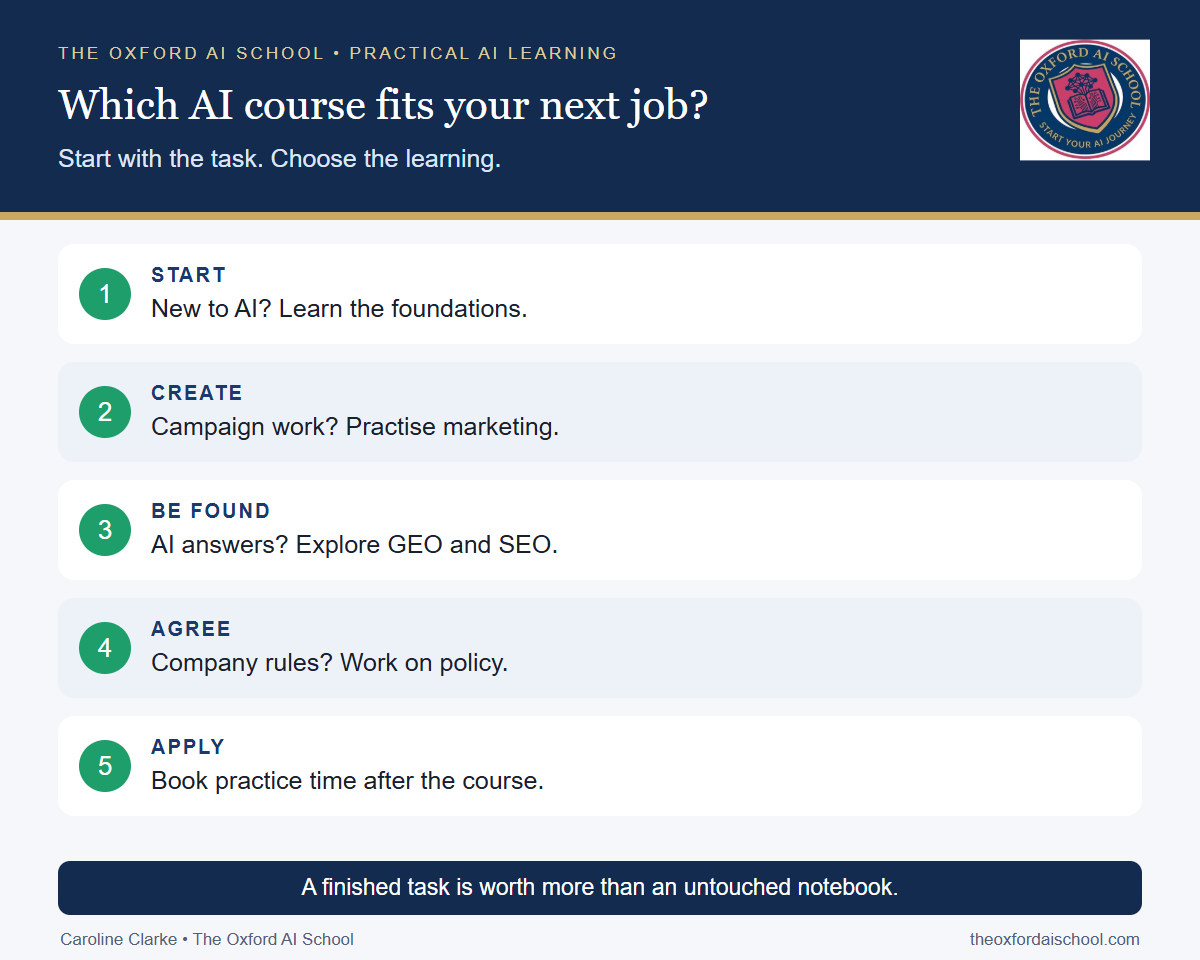
Choose your AI course by the job you need it to do
“I am new and would like the basics explained”
Look for a beginner course that lets you practise briefing, drafting, revising and checking. Setup and unfamiliar terminology should be part of the teaching. Start by exploring our basic AI training, then check whether the actual pace and format suit you.
Your useful finish line
You can take a short fictional note, turn it into a clear message and spot any facts the tool has added. Small? Yes. Useful? More than nodding through an explanation you cannot repeat.
“I work in marketing and need better output”
Choose applied learning built around a brief, audience, approved claims, brand voice and review. Our AI marketing workshops are worth considering if you want to discuss that kind of work. Ask for a task that fits your role rather than a tour of every tool on the internet.
“Our customers are asking AI where to buy”
Consider GEO training, alongside sound SEO practice. For an “AISEO training” brief, ask whether the course means using AI to assist SEO, improving visibility in AI answers, or both. Those are connected subjects, but they need different exercises.
“We need to agree how staff may use AI”
Discuss the AI Policy Workshop. Before booking, confirm the preparation, participants and intended outputs. Managers, operational colleagues and those responsible for information handling need a shared working discussion, rather than a policy nobody can interpret.
Compare three learning routes before you spend anything
| Route | Potential fit | Check first |
|---|---|---|
| Live practical workshop | You want feedback on familiar tasks. | Practice time, group size and tutor access. |
| Independent online learning | You prefer flexible study and can maintain your own routine. | Support, exercises and how learning is assessed. |
| University executive education | You want structured study with a management or strategic focus. | Prerequisites, workload and the specific syllabus. |
For alternatives, investigate AI for Non-Techies for non-technical learning and Saïd Business School’s AI programmes for an executive education route. These are different propositions, so compare the actual teaching with your goal. Our school is independent of the University of Oxford.
A course offered in England may be online, in person or blended. Do not assume the location in the search result tells you how you will attend. Check accessibility arrangements, dates, venue or time zone and the complete cost.
What should a basic AI course teach?
The foundations should travel with you when the fashionable tool changes. Learn to state the job, supply suitable context, specify a useful format and inspect the output. Then try again with a better brief.
A five-minute practice example
Use this fictional source: “The book club meets on Tuesday at 6 pm. Bring a book to recommend. The venue is still being arranged.” Ask for a 50-word invitation using only those facts.
Now check the day, time, request and unresolved venue. If the tool has booked a charming village hall on your behalf, you have discovered why review belongs in the syllabus.
The second attempt matters
Ask for a shorter invitation while preserving the uncertainty. Compare both versions. A useful tutor explains why a shorter response may still be worse if it quietly drops an important fact.
What should GEO and AISEO training cover?
GEO usually means generative engine optimisation: work intended to improve how a brand or source appears in generated answers. SEO addresses discoverability in search. AI SEO can refer to either AI-assisted SEO work or optimisation for AI search, depending on who is using the label.
Look for work you can inspect
Ask for exercises that involve answering customer questions clearly, verifying claims, improving page structure and recording what was tested. Do not mistake producing more pages for producing better information.
Ask how success will be measured
A sensible training brief separates visibility, visits, enquiries and sales. Being mentioned in an answer is one observation; earning a useful enquiry is another. Record the test question, tool and date so comparisons have some meaning.
Google’s guidance on AI features points website owners back to established SEO practices and says there are no additional technical requirements for these features. Treat special ranking guarantees with care.
A prompt to turn your goals into a course brief
Use the prompt below before comparing providers. It creates a learning brief from your needs. It does not browse, verify availability or decide which course is objectively best.
A prompt you can adapt
Help me write a course-selection brief.
My current AI experience: [details].
One task I want to improve: [task].
A good finished result looks like: [criteria].
Approved tools: [details].
Available learning and practice time: [details].
Budget, accessibility and delivery needs: [details].

Suggest the skills I need first, a sensible learning order and three observable outcomes. Separate essentials from optional topics. Write eight questions for a course provider. Do not recommend named courses, invent qualifications or estimate prices. Ask up to three questions if essential information is missing.
How I would choose the next course, rather than all the courses
Pick one outcome and one route. If you are new, a basic course is often a better start than a specialist session whose first slide already requires a translation. If you are comfortable with the tools, move towards your actual work: marketing, search visibility or company practice.
I would also book time to practise afterwards. Otherwise the course materials join that distinguished collection of documents called “Downloads”, where ambition goes to become a PDF.
See our current programmes, check the AI skills assessment if you would like a starting point, and ask which option fits your needs. We would like to be your best basic AI course. We should still be able to explain why we fit.
Keep choosing with confidence
Sources and further reading
Provider information checked on 21 October 2026. Confirm the current syllabus, tutor, format and full quote before booking.
Frequently asked questions
What is the best AI course in England?
The best choice depends on your goals, experience and preferred way of learning. Compare the actual syllabus, practical exercises, support and current delivery arrangements.
Which AI course is best for complete beginners?
Look for a course that explains setup and terminology, teaches clear prompting and includes guided practice and checking. Ask whether it assumes any prior experience.
Do I need coding for a basic AI course?
Basic use of conversational AI tools does not require coding. Courses on building AI systems may have technical prerequisites, so check the syllabus.
What is the difference between GEO and AISEO training?
GEO concerns visibility in generated answers. AISEO may mean AI-assisted SEO or optimisation for AI search. Ask providers to define their scope and show the exercises.
Which course should a marketing team choose?
Look for applied work on briefs, audiences, approved claims, content review and appropriate measurement. Ask how the workshop reflects your actual marketing tasks.
Will an AI course guarantee better Google rankings?
No. Training can improve your skills and working practices, but rankings, AI citations and business results depend on many factors and cannot be guaranteed.