Practical AI learning · A buyer’s guide
Best corporate AI training UK: buy a useful Monday
The workshop should leave your people able to do something. An enthusiastic group photograph is a lovely bonus, but a weak implementation plan.
The team training day has gone beautifully. The coffee was adequate, somebody made an impressive image, and the feedback form says “engaging”. On Monday, everyone returns to the same work in the same way.
As someone helping to promote an AI school, I would love to count the applause as an outcome. My spreadsheet would be much easier. Unfortunately, you are buying a change in what people can do.
This guide to the best corporate AI training in the UK starts with a purchasing brief and ends with a review of actual work. I have included a suggested plan, rather than pretending that every organisation needs the same workshop with its logo added to slide one.
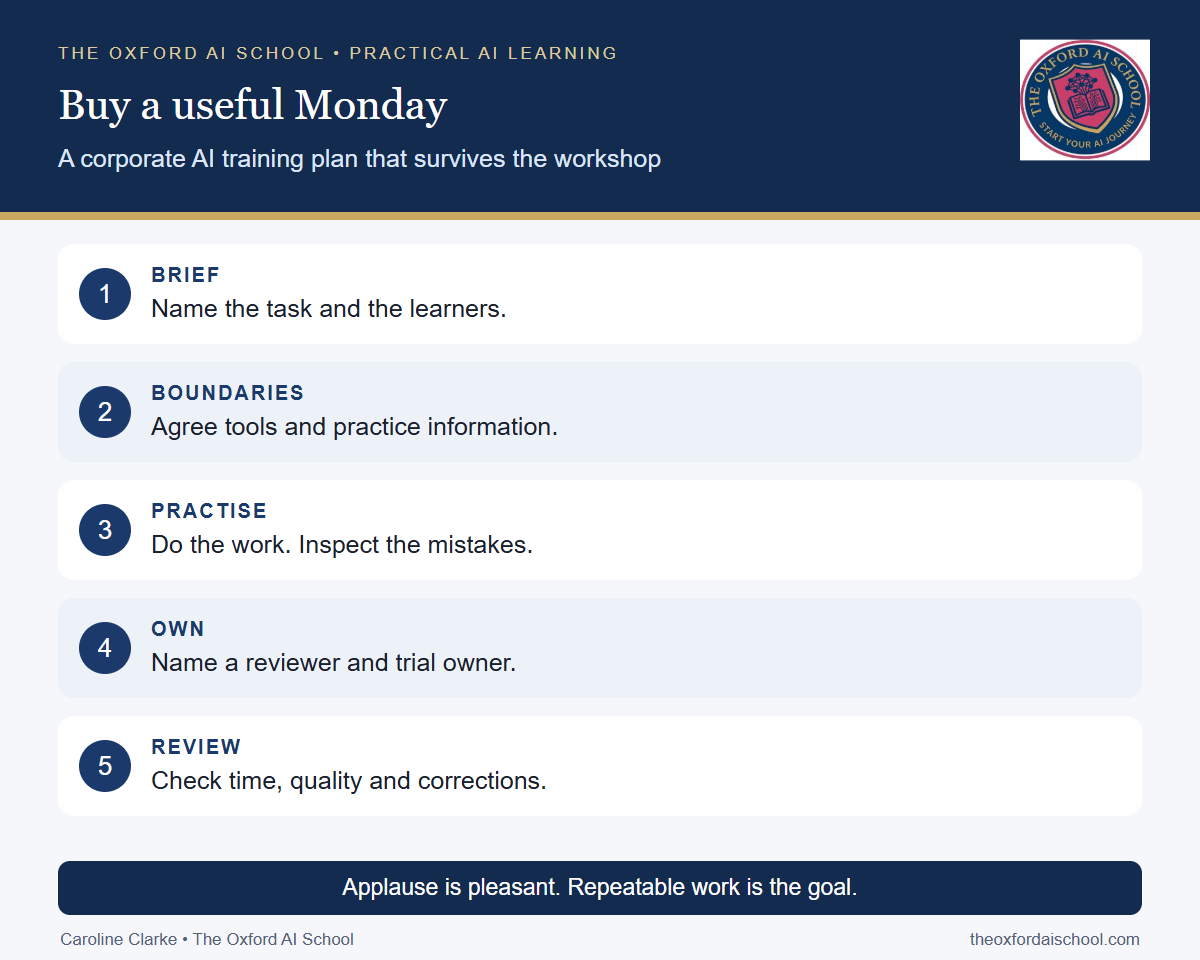
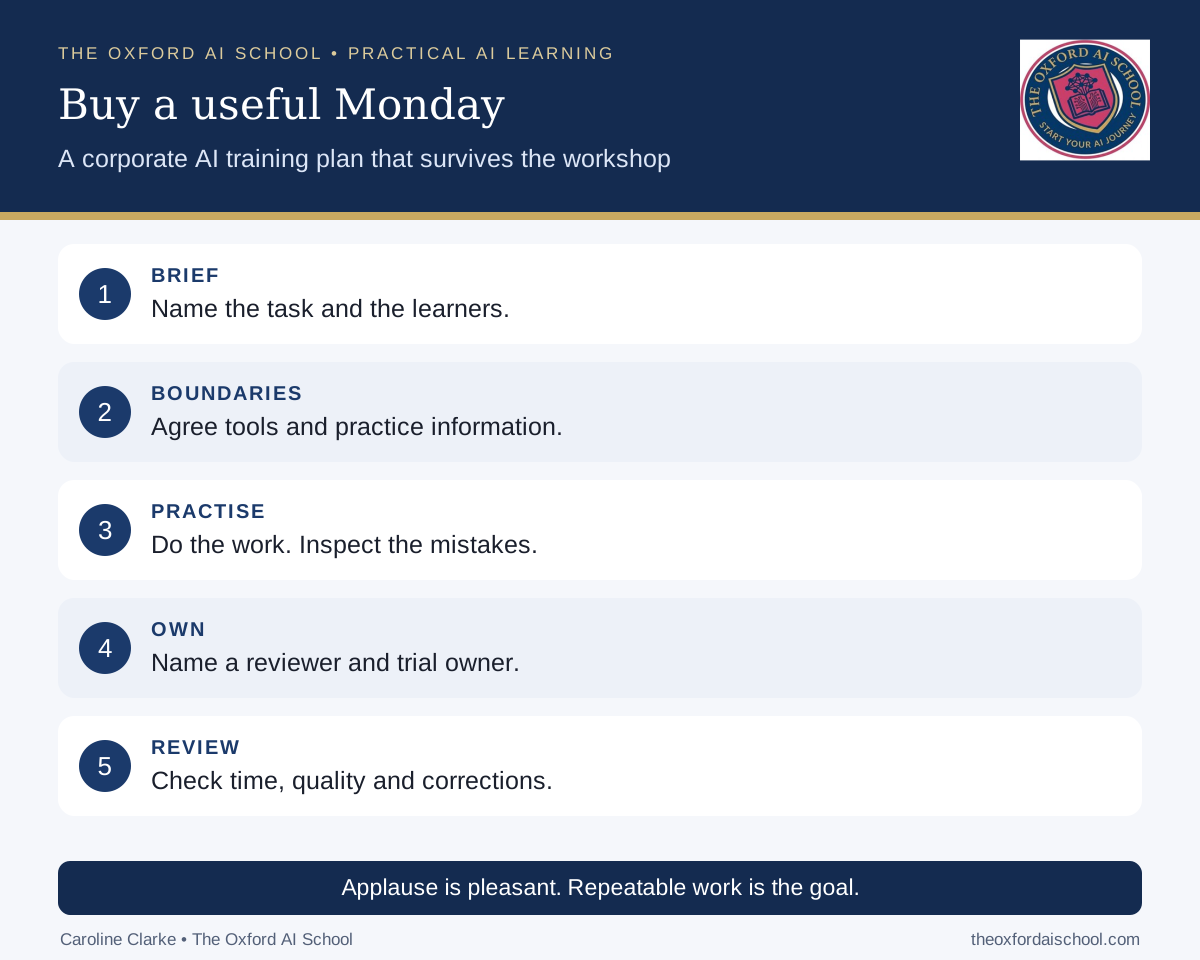
Write the corporate AI training brief before requesting quotes
A useful brief names the people, their tasks, their starting points and the boundaries they work within. “We need to get ahead on AI” is a perfectly understandable feeling. It is not yet something a trainer can design properly.
Use this fictional example
An account management team wants to turn approved meeting notes into accurate internal action lists. The group includes confident users and complete beginners. A manager checks the output before it becomes a working record. The training uses fictional notes until the appropriate information-sharing arrangements are confirmed.
Define the finished result
Every action must come from the source, names must be correct and uncertain dates must remain uncertain. The learner should be able to explain the checking process. That gives the trainer something concrete to teach and gives you something concrete to assess.
Ask for the complete commercial scope
Confirm preparation, delivery, participant numbers, travel, taxes, software requirements, materials and support. Ask what is excluded. “Tailored” deserves a sentence explaining what will actually change.
A suggested workshop plan for a mixed business team
This is an illustrative purchasing template, not a published Oxford AI School timetable. Adjust the sequence and time after assessing the group.
| Stage | What the team does | What you can inspect |
|---|---|---|
| Before the session | Choose one task per role and confirm permitted tools. | A short brief and fictional practice material. |
| Shared foundations | Practise a clear brief and examine a wrong answer. | Individual attempts and corrections. |
| Role practice | Repeat the method on a relevant job. | A draft, the source and a review checklist. |
| Close | Agree one small trial and who reviews it. | Named owners and a review date. |
| After the session | Repeat the task and record the complete effort. | Time, quality and the corrections needed. |
Do not hide a large skills gap by asking beginners to keep up quietly. Consider a foundation session first, followed by smaller role groups. Nobody learns faster because they are embarrassed to ask where the button is.
Which corporate AI workshops should you combine?
Foundations for shared working habits
Consider basic AI training when people need a common method for briefing and checking. Ask providers how they adapt for mixed experience and which practice tasks learners complete.
Marketing and search for specialist teams
Explore our AI marketing workshops when the brief is about campaign work. Add GEO training if the team needs to understand visibility in AI answers. If procurement calls it AISEO training, define that term in the brief so every supplier quotes for the same work.
Policy for decisions people need to follow
Our AI Policy Workshop is a separate route for working on organisational rules. Confirm the participants and intended outputs with us. A company also needs someone responsible for maintaining its decisions after the workshop; a folder called “Final_v7” is not an owner.
A useful sequence
Settle the boundaries needed for practice, build foundational skills, then deepen the role-specific work. Policy discussions may run alongside that learning. Choose the sequence around your current gaps.
Compare suppliers using the same evidence
Give every supplier the same brief. Ask each to explain the exercise, the feedback method, the tutor, the delivery format and the support. That makes the comparison more useful than counting topics on competing slide decks.
Providers worth investigating
The Oxford AI School belongs on your shortlist for a practical business brief that fits our programmes. Also investigate AI for Non-Techies for non-technical workforce learning and Katie King’s AI in Business training for business-focused workshops. These are options to investigate, not independently scored winners.
If the requirement is executive study rather than a team workshop, compare Saïd Business School’s AI programmes. The Oxford AI School is an independent provider, separate from the University of Oxford.
Ask the awkward delivery question
What happens if half the team cannot access the required tool on the day? I would like the provider to have an answer before your colleagues are all staring at a sign-in screen.
Use this prompt to draft your request for proposals
This prompt produces a draft brief and evidence checklist from your own requirements. Keep sensitive business details out of unapproved tools. Review the brief with the people who will attend before sending it to providers.
A prompt you can adapt
Draft a request for proposals for corporate AI training using only these requirements.
Organisation context: [non-sensitive description].
Participants and starting levels: [details].
Tasks to improve: [specific tasks].
Approved tools and information boundaries: [details].
Required delivery format and accessibility: [details].
Budget and timing: [details].

Include observable learning outcomes, preparation, guided role practice, feedback, output checking, required materials, named delivery tutors, full commercial scope and follow-up. Add questions about access problems and mixed experience levels. Propose a 30-day review covering total task time, quality and corrections, without inventing savings or targets. Mark unresolved decisions clearly. Do not invent supplier claims.
Review the training after 30 days
Thirty days is a suggested review point, not a promised time to value. Choose an interval that gives people enough opportunity to repeat the task.
Measure the complete job
Record briefing time, drafting time, checking time and corrections. Compare the finished result with the previous method. A faster first draft may be useful, but the customer receives the final version.
Keep an example that did not work
A failed attempt can reveal whether the task was unsuitable, the brief was unclear or the checking burden was too high. Keep that evidence in the discussion. Nobody becomes more capable because the awkward example was left out of the presentation.
Your three review questions
- Can people repeat the task without the trainer?
- Is the finished work at least as good by the criteria you agreed?
- Does the full effort justify continuing, adjusting or stopping?
Those questions may lead you to more learning. They may also tell you the proposed use was not worthwhile. Both are useful findings.
Tell us what a useful Monday would look like
We would like The Oxford AI School to be your first call for practical corporate learning. The way to earn that is to understand the work and propose a session you can assess.
Bring a short task description, the number of learners and an honest account of their starting points. Review our current programmes, then talk to The Oxford AI School. Ask which combination of basic AI, marketing, GEO or policy work we would recommend and why.
I cannot promise that every colleague will remember their password. I would much rather help you choose learning they have a reason to use.
Keep choosing with confidence
Sources and further reading
Provider information checked on 21 October 2026. Confirm the current syllabus, tutor, format and full quote before booking.
Frequently asked questions
What is the best corporate AI training in the UK?
The best fit is training matched to your team’s tasks, starting levels and operating rules. Compare practical exercises, tutor feedback, commercial scope and follow-up against one shared brief.
Should corporate AI training be tailored by role?
Often yes. Shared foundations can establish a common method, while role practice helps people apply it to relevant work. Ask which exercises will be adapted.
How do we measure the value of AI training?
Compare the complete task before and after learning, including briefing, checking and corrections. Assess quality and repeatability as well as time.
Do we need an AI policy before a workshop?
Agree the tools and information boundaries needed for the exercises first. Wider policy work can be planned alongside training, with clear ownership for unresolved decisions.
Can corporate training include marketing, GEO and AISEO?
Yes, if those subjects match your brief. Define whether AISEO means AI-assisted SEO, visibility in AI answers or both, then confirm the actual exercises and tutor expertise.
How much does corporate AI training cost?
Request a current written quote covering preparation, participants, delivery, VAT, travel, software and support. Prices and inclusions vary, so compare the complete scope.