Practical AI learning · A buyer’s guide
Top AI trainers UK: who is the best AI trainer for you?
A mildly biased guide to choosing a trainer, written by someone with an AI school. At least the conflict of interest is easy to spot.
Who is the best AI trainer in the UK? Naturally, I would like to answer “us”, close my laptop and go and find a biscuit. Unfortunately, that would be a rather short article and a very poor purchasing process.
I am Caroline Clarke of The Oxford AI School. This is our own guide, so please read it with the same healthy scepticism you would apply to a restaurant owner explaining where to have lunch. I can tell you what I would look for. I cannot award myself an independent national trophy.
The useful question is who can help you do something better. An excellent teacher for a nervous beginner may be completely wrong for a software team building AI applications. Both can be good. They are doing different jobs.
What makes someone a good AI trainer?
I would start with how they teach when the answer goes wrong. Anyone can rehearse an impressive demonstration. Teaching begins when your attempt produces a beautifully formatted load of nonsense and somebody explains how to improve it.
Look for teaching you can inspect
Ask for a short example of the work you will practise. A summary exercise should include the original notes, an output and a way to check whether the meaning survived. “We cover the latest tools” tells you much less.
My favourite small test
Give the trainer fictional notes in which a delivery date is proposed but never agreed. Ask them to demonstrate how they would teach a learner to catch a summary that calls it confirmed. It is a tiny mistake with a very recognisable business consequence.
Find out who will actually teach you
The person on the website, the person on the sales call and the person in the room may be three different people. That is not automatically a problem. You should know the tutor’s name, relevant experience and approach before you book.
A useful shortlist of UK AI trainers and providers
This is an editorial shortlist by suitability, not a league table or an exhaustive survey. I have used providers’ own descriptions to identify possible fits; I have not independently tested and scored their courses.
| Trainer or provider | Why consider them? | Question to ask |
|---|---|---|
| Caroline Clarke and The Oxford AI School | Practical starting points and business-focused learning, with routes into marketing, AI search and policy. | Which tutor and exercises suit our actual brief? |
| Heather Murray / AI for Non-Techies | A provider focused on AI adoption for non-technical teams. | What guided practice and ongoing support are included? |
| Katie King / AI in Business | Business-focused AI training and workshops. | How would you adapt the session to our commercial priorities? |
For university executive education, compare Saïd Business School’s AI programmes. That is a different learning route rather than a direct substitute for every practical workshop. The Oxford AI School is independent and is not part of the University of Oxford.
Which specialist knowledge does your trainer need?
For beginners: patience before party tricks
Look for clear setup instructions, familiar tasks and time to ask basic questions. Our basic AI training is a sensible place to start a conversation if you want practical foundations. The aim is to become capable, rather than fluent in abbreviations by lunchtime.
For marketers: strategy and judgement
A trainer should help you assess the audience, the offer, the facts and the finished work. If every exercise ends with “generate 50 posts”, ask where the editorial judgement comes in. Compare our AI marketing workshops with other business-focused options.
For AI search: ask about evidence
GEO training addresses visibility in generated answers. AI SEO is also used as an umbrella term for search work involving AI; providers use it differently. Ask what they mean, which tasks you will practise and how results will be checked. A promise that every chatbot will recommend you is a useful reason to keep shopping.
Five questions I would ask before booking an AI trainer
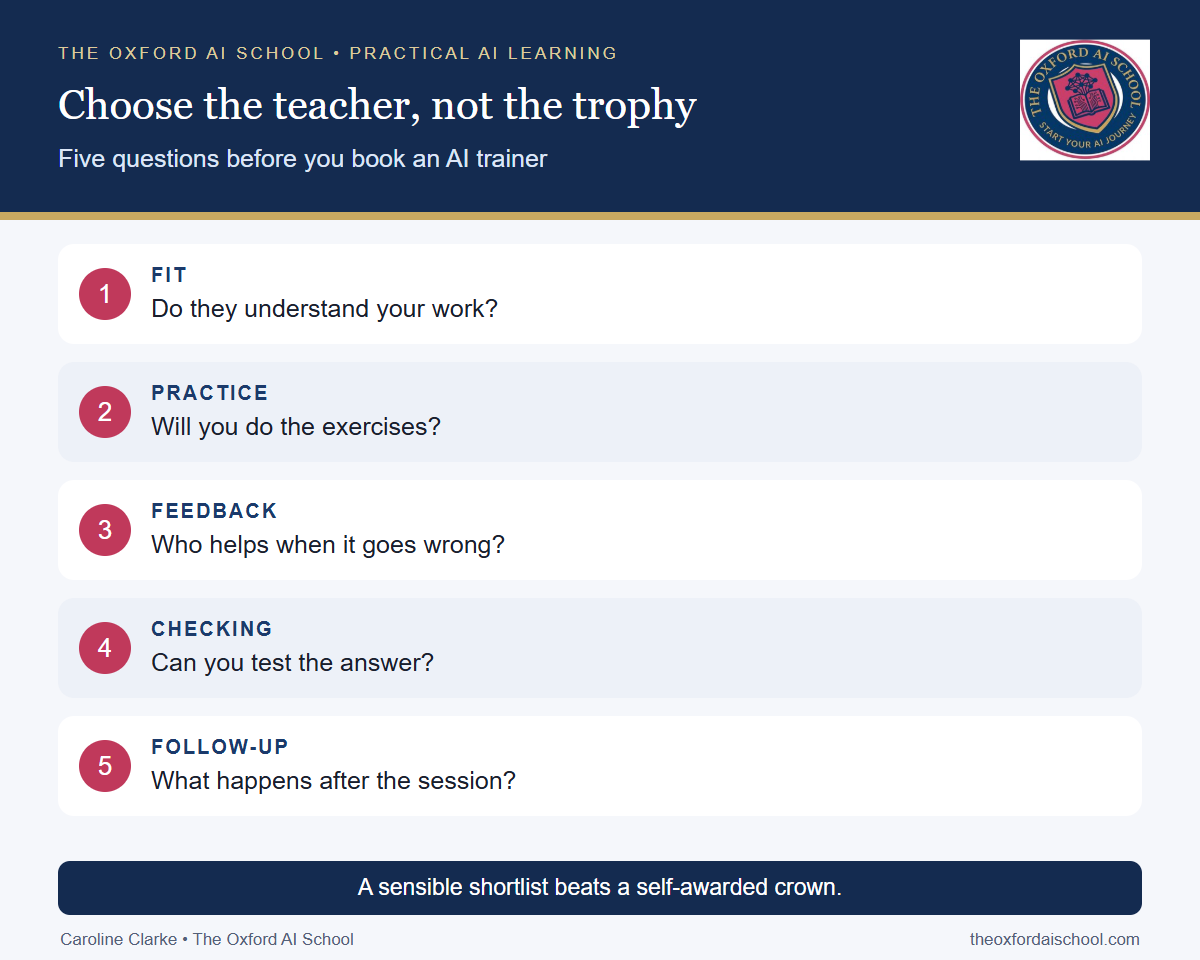
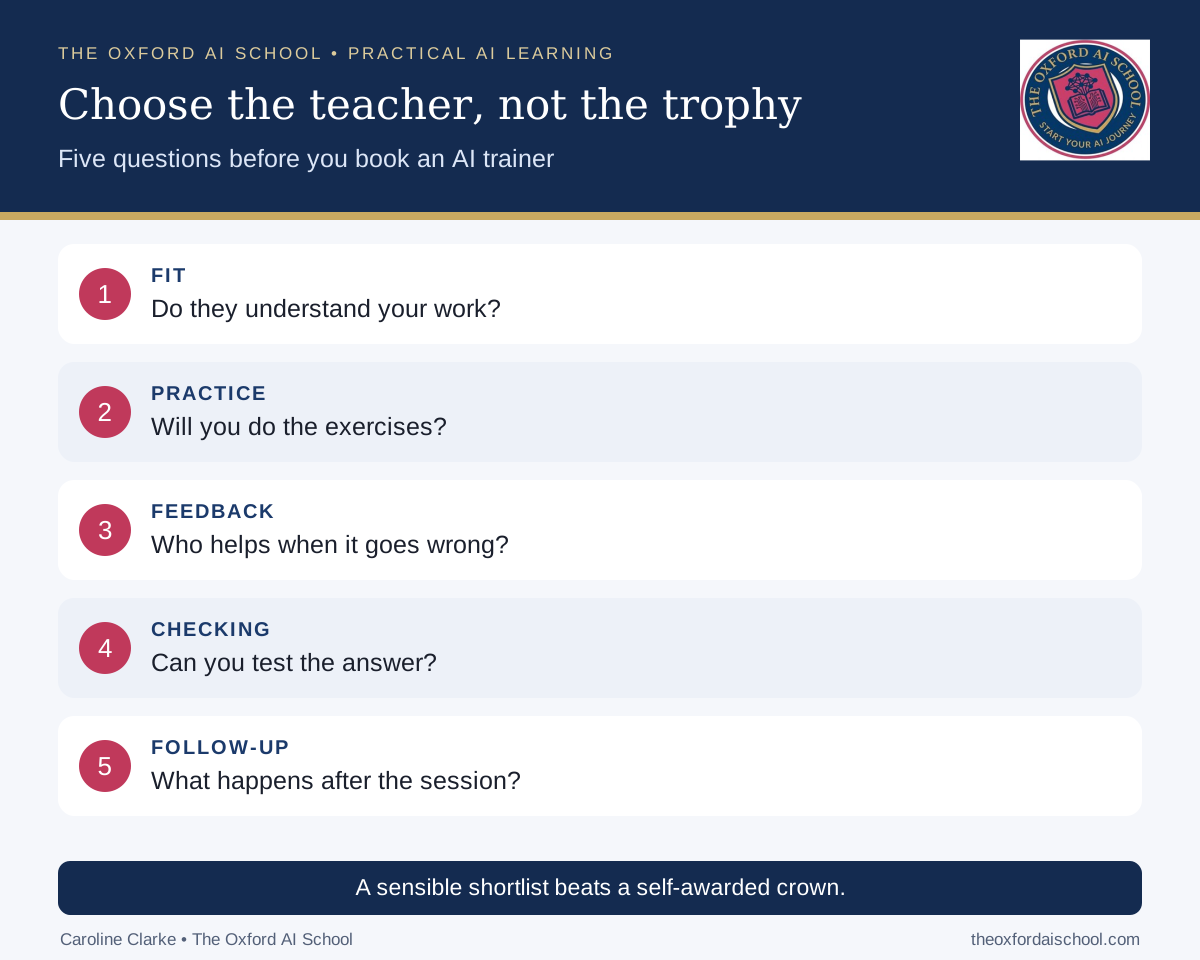
- What will I be able to do afterwards? Ask for a task, not an adjective.
- How much time do I spend practising? Watching the tutor type does not make your fingers more knowledgeable.
- How do you teach checking? The answer should include mistakes and source material.
- What is tailored? Ask which examples, tools and difficulty levels change.
- What happens afterwards? Confirm materials, questions, support boundaries and costs.
Compare the full quote, including preparation, travel, VAT, licences and follow-up where relevant. I would rather have an awkward question now than a wonderfully polite misunderstanding on the invoice.
Use this prompt to compare trainer proposals
Paste approved extracts from proposals into the prompt below. It organises the evidence you supply; it does not establish whether a trainer’s claims are true. Check important details with the provider.
A prompt you can adapt
Compare these AI trainer proposals using only the supplied text.
Our goal: [specific work task].
Learner starting level: [details].
Approved tools and information: [details].
Budget and format requirements: [details].
Proposals: [paste approved extracts].

Create a table covering tutor identity, practical exercises, feedback, checking, specialist relevance, full cost and follow-up. For each claim, quote the supporting wording. Mark missing information as not supplied. Do not invent rankings, credentials, reviews or prices. End with five questions for each provider. I will verify the evidence before deciding.
Where The Oxford AI School belongs on your shortlist
If you want an approachable starting point and practical business applications, I would be delighted if we made your shortlist. If you want advanced model engineering, ask for a provider who teaches that explicitly. Our willingness to admit the difference is perhaps not the most aggressive sales technique. I am prepared to live with that.
Start with current programmes, tell us the job you want to improve, and ask us to explain the proposed exercises. If marketing is your priority, ask about the marketing route. If the team is unclear about acceptable use, discuss the AI Policy Workshop. Your brief should choose the session.
The best compliment a trainer can receive is that a learner can now do the work and explain the checks. It is less shiny than “visionary thought leader”, but considerably easier to demonstrate.
Keep choosing with confidence
Sources and further reading
Provider information checked on 21 October 2026. Confirm the current syllabus, tutor, format and full quote before booking.
Frequently asked questions
Who is the best AI trainer in the UK?
The best fit depends on your starting level and goals. Compare named tutors, relevant exercises, feedback and follow-up rather than assuming a universal ranking applies to everyone.
How do I compare top AI trainers in the UK?
Give providers the same brief and ask for sample exercises, teaching time, total costs and support details. Check the tutor who will deliver the session.
Is Caroline Clarke an AI trainer at The Oxford AI School?
Caroline Clarke writes this guide for The Oxford AI School. Contact the school to confirm who will deliver your particular session and how the teaching will be adapted.
Should I choose a trainer or a recorded course?
A trainer can provide live feedback and adapt explanations. A recorded course can suit flexible independent study. Compare practice opportunities and support with the way you learn.
Can one trainer teach beginners, marketing and GEO?
Possibly, but check their relevant examples for each subject. A general introduction does not demonstrate specialist depth in every application.
Is The Oxford AI School part of the University of Oxford?
No. The Oxford AI School is an independent training provider and is not part of the University of Oxford.