How To Use Claude Like A Pro · Part 2 of 6
How to Write the Best Claude Prompt
Tell Claude what the job is, give it the facts and show it what a useful answer looks like.
“Write me something about our business” is a perfectly serviceable way to receive something about a business. Whether it is your business is where the adventure begins.
When I write a Claude prompt, I try to make the job easy to understand and the answer easy to check. Start with what you need someone to do, the facts they need and what a finished result should contain. You can usually leave the elaborate job title out.
Where do you write a Claude prompt?
Open a new Claude chat and type into the message box. If the task belongs to an existing Project, open that Project first. Attach or paste the relevant source before asking Claude to use it. Merely mentioning a document’s name does not establish that Claude can read it.
For the first exercise, use fictional information and keep the task small. It is easier to spot a changed meeting time in an 80-word email than in a 30-page “strategic communications ecosystem”.
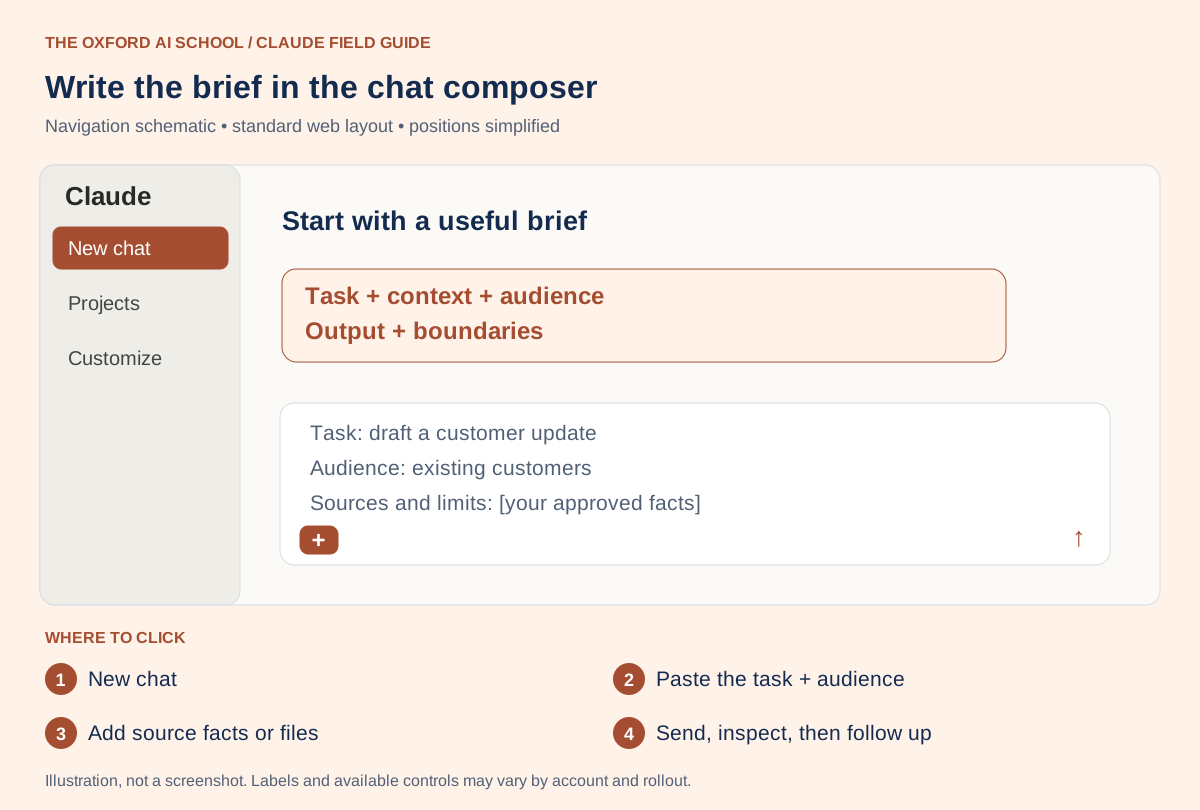
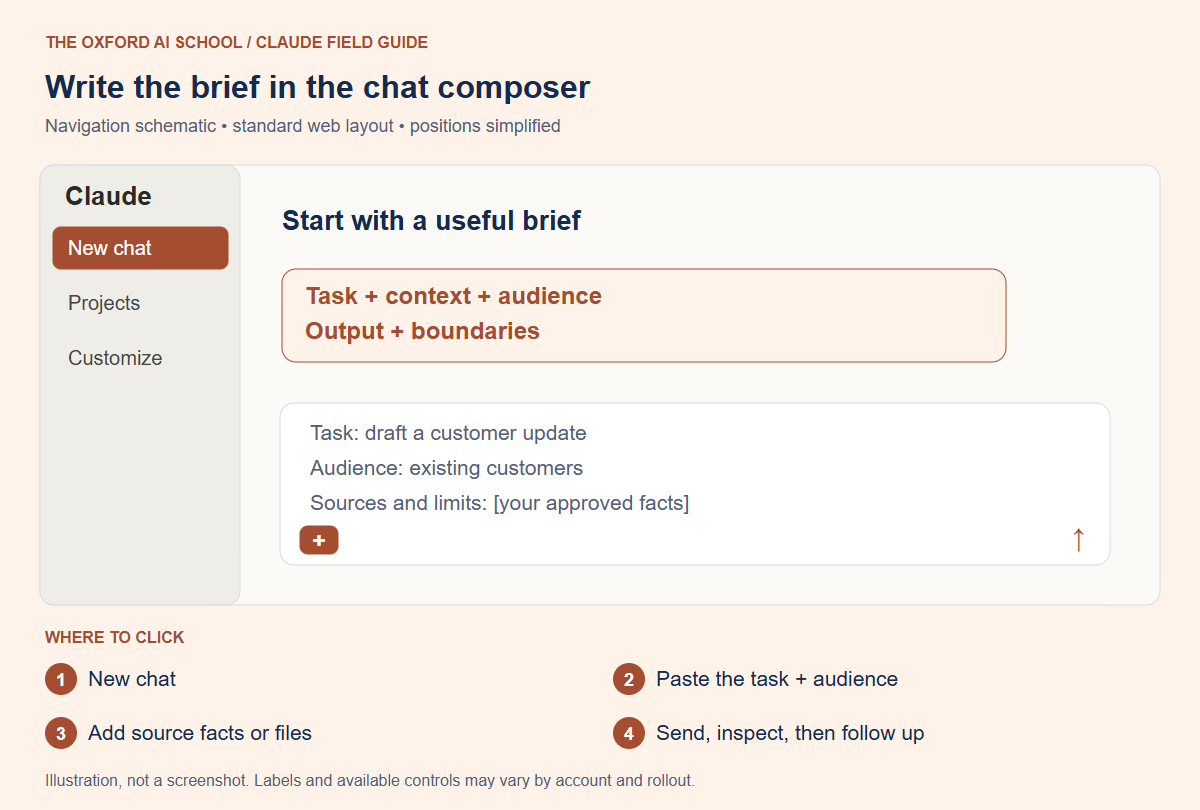
New chat → Paste the task + audience → Add source facts or files → Send, inspect, then follow up
The five things I would put in a Claude prompt
Anthropic’s prompting guidance emphasises clear instructions, examples and structure. Here is my practical way to apply that advice.
- Task: what should Claude produce or decide?
- Context: which facts and sources should it use?
- Audience: who will read or use the result?
- Output: what shape, length and level of detail are useful?
- Boundaries: what must stay unchanged, be excluded or be flagged?
Include the reason behind an unusual constraint. “Keep the uncertainty about the venue because it has not been booked” is more useful than hoping Claude understands why you put a question mark in your notes.
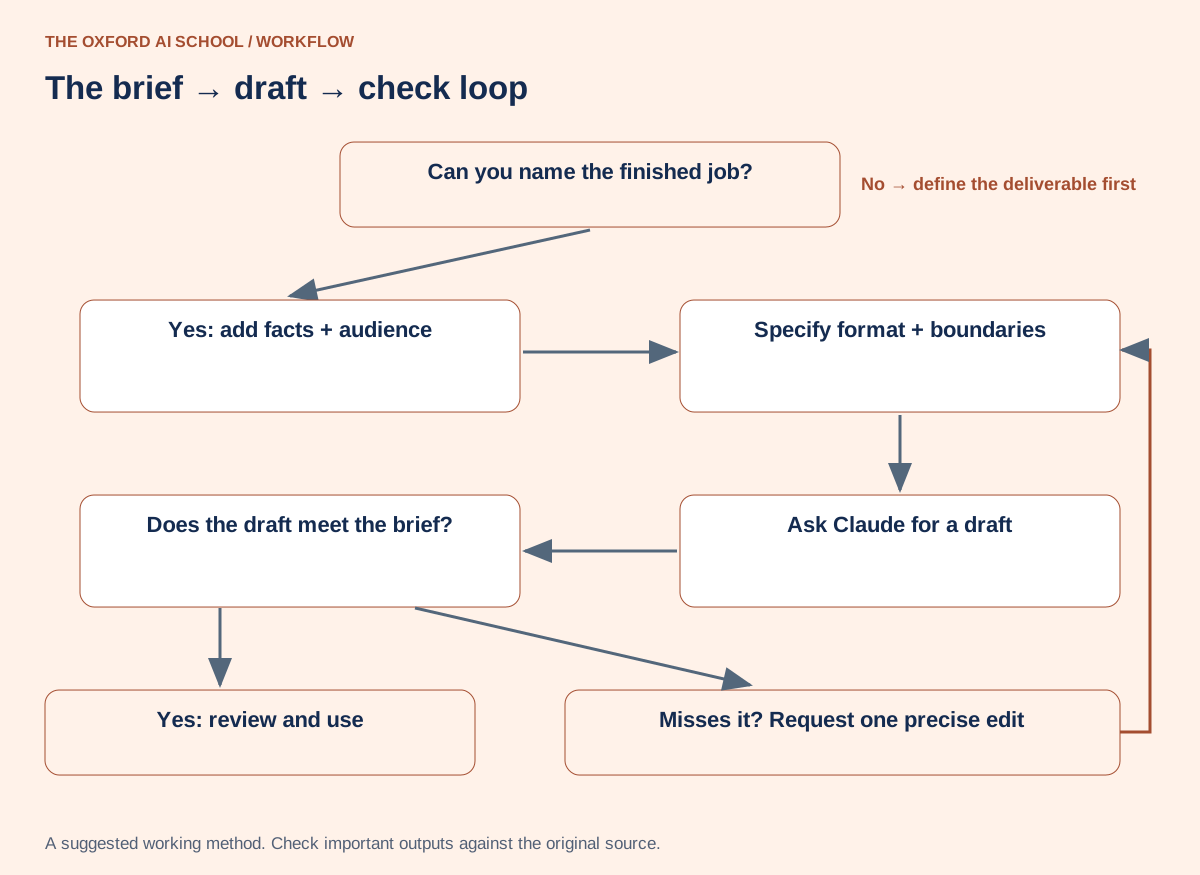
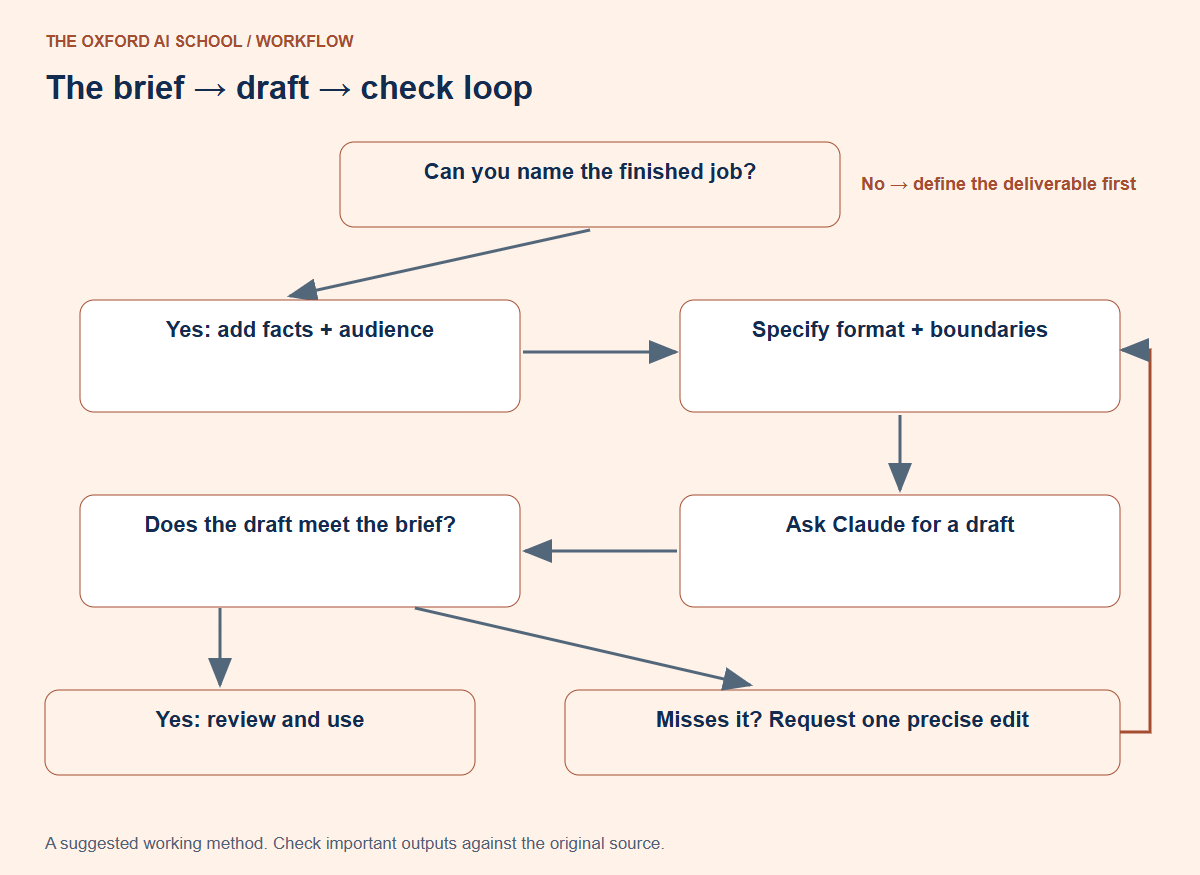
Read the flowchart as text
- Can you name the finished job?
- No: define the deliverable first
- Yes: add facts + audience
- Specify format + boundaries
- Ask Claude for a draft
- Meets the brief? Review and use
- Misses it? Request one precise edit
A vague prompt and a better one
Vague: “Write an email about the workshop.” There is no audience, factual brief or instruction about missing details.
Fictional source: a workshop is on 12 November, from 10 am to noon. Participants should bring a laptop. The venue is unconfirmed. No price has been supplied.
A better prompt keeps those unknowns visible. Polished writing should not turn an unbooked room into a confirmed conference centre.
Draft a factual workshop email
Write an email inviting our existing customers to a practical workshop.
Use only these fictional facts: 12 November; 10 am to noon; bring a laptop; venue unconfirmed. No price has been supplied.
Use friendly British English and no more than 100 words.
Include a subject line. Keep the venue unconfirmed and do not invent a price, booking link or speaker.
After the draft, list missing details we need before sending.
Check it: Draft a factual workshop email
Check date, time, laptop instruction and unknown venue. Remove any fact absent from the brief.
How do you make Claude sound like you?
Give it a short sample you wrote and explain what you like about it: direct opening, short paragraphs, ordinary vocabulary and a dry aside where it helps. “Sound human” leaves quite a lot open to interpretation. Humans also write parking notices.
Tell it which parts of the example are style only. Otherwise yesterday’s topic, customer name or sales claim can slip into today’s draft. Ask for two opening options if you are deciding the angle, then choose one before drafting the whole piece.
Use a writing sample without copying its facts
Rewrite the draft below for [audience].
Match these features of my sample: [three specific features].
Use the sample for style only. Do not copy its names, figures, topic or claims.
Keep every factual statement in the draft unchanged. Flag unclear statements instead of improving them by guessing.
SAMPLE: [paste your approved writing]
DRAFT: [paste the draft]
Check it: Use a writing sample without copying its facts
Compare factual claims before and after. A nicer sentence is not an improvement if its meaning changed.
Use structure when the prompt gets complicated
For a longer brief, use labels such as Task, Sources, Requirements and Output. XML-style tags can also separate a document from the instructions about it. They are useful signposts, not a requirement for every chat.
Ask for the questions or outline first when a wrong assumption would waste a lot of work. For a simple task, answer the obvious questions in the brief and let Claude draft. A three-stage approval process for a two-line reminder is a rather expensive hobby.
Ask for evidence you can inspect
Request source passages, calculations or a concise explanation of a recommendation. Do not mistake a long explanation for correctness. You need enough evidence to verify the answer, not a performance of deep thought.
Improve the next prompt using the actual mistake
“Make it better” is less useful than “remove the unsupported claim in paragraph two, retain the date and cut the opening to one sentence”. Identify what failed: missing facts, wrong audience, bad structure or invented detail.
Save a prompt after it works on several realistic examples. Include a note about the required inputs and checking steps. A prompt without its source requirements is like a recipe that begins “obtain ingredients somehow”.
Try one change at a time. Compare the finished work, including your editing time. The winning prompt is the one that helps you produce a reliable result, rather than the one that looks most impressive in a screenshot.
Sources and product notes
Official documentation checked on 25 October 2026. This guide focuses on the Claude web app; availability, wording and organisation controls can differ. Examples and working methods are original teaching suggestions, with fictional practice material.
How to Write the Best Claude Prompt: frequently asked questions
What is the best prompt for Claude?
There is no single best prompt. A useful prompt defines the task, facts, audience, output and limits for the specific job.
How long should a Claude prompt be?
Long enough to remove important ambiguity. A short email brief may need only a few lines; a complex analysis needs clear sources, criteria and structure.
Should I tell Claude to act as an expert?
A role can clarify perspective, but it does not establish expertise or accuracy. State the actual task, evidence and checking requirements as well.
Do I need XML tags in Claude prompts?
No. Clear headings are often enough. Tags can help distinguish instructions, source material and examples in a complicated prompt.
How do I stop Claude inventing facts?
Supply the relevant source, ask it to flag missing information and check its claims yourself. A prompt can reduce errors but cannot guarantee accuracy.
Can I reuse the same prompt?
Yes. Save the required inputs and review steps alongside it, and test it when the task or source changes.
Why does Claude sound generic?
The audience, purpose or voice may be vague. Supply a short approved writing sample and identify the specific features to follow.
Should I ask Claude to explain its answer?
Ask for source references, calculations and a concise rationale you can verify. Length and confidence are not evidence.