Somebody on LinkedIn has just posted a nine-letter acronym that will 'change your prompting forever'. Underneath it, 400 people have commented 'Saved!' and will never open it again.
An AI prompt framework is a checklist of what to include in a prompt, such as role, context, task and format. Popular ones include RTF, CO-STAR and RISEN. Our Five-Part Brief uses role, context, task, format and check. They all do the same job: stop you leaving out what the AI cannot guess.
Prompt frameworks are not magic. They are checklists, the same way pilots use a checklist: not because they are stupid, but because they are busy. The best framework is the one you remember at 4.40pm on a Thursday.
What is an AI prompt framework?
A framework is a short list of things to include in a prompt. Role. Context. Task. Format. That is basically all of them, with different letters on top. They exist to stop you doing the one thing that ruins most AI answers: leaving out what the model cannot guess.
The Five-Part Brief
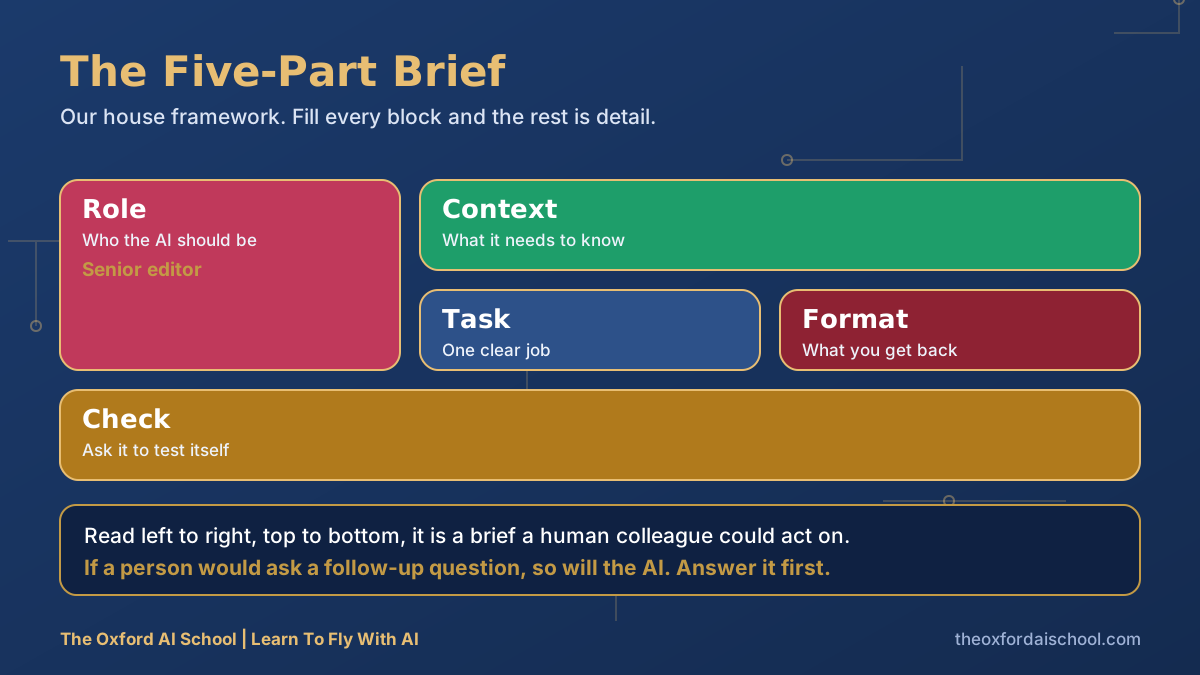
This is the house framework at The Oxford AI School. It is the four parts from our ChatGPT prompts guide plus one that changes everything.
1. Role
Who should the AI be? A sceptical finance director gives different advice from an enthusiastic intern. One line is plenty.
2. Context
The facts it cannot guess. Audience, constraints, what you have tried, what good looks like. This is the part people skip, and it is the part that matters most.
3. Task
One job. 'Summarise and then critique and then rewrite' is three prompts wearing a trench coat.
4. Format
How long? What shape? Table, bullets, email, script? Tell it, or it will pick, and it picks long.
5. Check
Ask it to test itself: list assumptions, flag low confidence, or tell you what it needs to know. This is the part nearly every other framework leaves out, and the one that cuts invented answers the most.
A worked example
The Five-Part Brief in action
ROLE: You are a sceptical sub-editor at a trade magazine.
CONTEXT: This is a 600-word column for UK accountants. Tone: dry and direct. The readers are busy and allergic to jargon. My weakness is long openings.
TASK: Tighten the draft below without changing my meaning.
FORMAT: Give me the clean copy first, then a list of what you cut and why.
CHECK: Before you finish, flag anything you were unsure about.

[paste draft]
Why it works: nothing here is clever. It simply answers every question a human sub-editor would have asked.
How do the famous frameworks compare?
| Framework | Stands for | Best for | Weakness |
|---|---|---|---|
| Five-Part Brief | Role, Context, Task, Format, Check | Everyday work prompts | Needs you to write the context |
| RTF | Role, Task, Format | Quick, simple requests | No room for context |
| CO-STAR | Context, Objective, Style, Tone, Audience, Response | Writing and communications | Six parts is a lot to remember |
| RISEN | Role, Instructions, Steps, End goal, Narrowing | Multi-step processes | Can be heavy for simple jobs |
| No framework | Just ask, then refine | Casual questions | Hit and miss on important work |
Treat the spelling of these acronyms as a rule of thumb: different sources stretch the letters slightly differently. The point is the same.
When should you ignore every framework?
Often. If the task is small, just ask. 'Give me five names for a dog' needs no role, context or check. The test I use is the Tuesday Test:
- Would getting this wrong cost me more than ten minutes? Use a framework.
- Will someone else read or rely on the output? Use a framework.
- Is it a one-off curiosity? Just ask, then refine.
From framework to habit
- Write the Five-Part Brief on a sticky note and put it on your screen.
- For one week, use it on anything that matters. Skip it for anything that does not.
- Save the three briefs that worked in a document.
- Turn the best one into a Custom GPT or a Claude Skill, so you never retype it.
Stuck on the wording? A prompt generator can draft it for you, and our beginner's four-week plan shows the order to learn it in.
The Five-Part Brief is the quick version. For the longer method we teach in training, read how to write prompts for AI with the Five Rivets, and for the bigger picture, what prompt engineering is and why it matters for business.
AI prompt frameworks: frequently asked questions
What is an AI prompt framework?
An AI prompt framework is a checklist of what to include in a prompt, such as role, context, task and format. It reminds you to give the AI the information it cannot guess.
What is the best AI prompt framework?
The best framework is the one you will actually remember. Our Five-Part Brief (role, context, task, format, check) covers everyday work. RTF is quicker, and CO-STAR suits writing.
What does CO-STAR stand for in prompting?
CO-STAR is commonly given as Context, Objective, Style, Tone, Audience and Response. It is popular for writing and communication prompts.
Do prompt frameworks really improve results?
They help most when you tend to leave out context or format. Used on tasks that matter, they usually cut the number of rounds needed. For trivial tasks they are overkill.
How long should a prompt using a framework be?
Usually four to eight lines. Each part can be a sentence. If it grows beyond a page, split it into separate tasks.
Can I teach my team a prompt framework?
Yes, and it is one of the fastest wins. Our Basic AI Training teaches a simple framework and practises it on your team's real work.

Harry Lang runs The Oxford AI School in Witney, Oxfordshire. A former CMO, he now teaches teams and individuals across the UK to use AI in plain English, on their own real work. Email Learn@TheOxfordAISchool.com.