I use ChatGPT, Gemini, Copilot and Perplexity most weeks. When I have a forty-page report to read, a draft that needs a careful edit, or a tone of voice to match, I open Claude. That is not tribal loyalty. It is what its habits suit.
The best Claude prompts use clearly labelled sections, often XML-style tags, put long documents first, ask for a specific format, and give Claude permission to say it is unsure. Claude is particularly strong on long documents and careful writing, so give it real material and a precise job.
This guide gives you ten Claude prompts and the four habits that make them work. The habits are more useful than the prompts, so read those first. If you are choosing between tools, our Claude AI training guide covers the practical differences, and our Claude training in London page covers how we teach it.
The four habits of a good Claude prompt
1. Label the parts
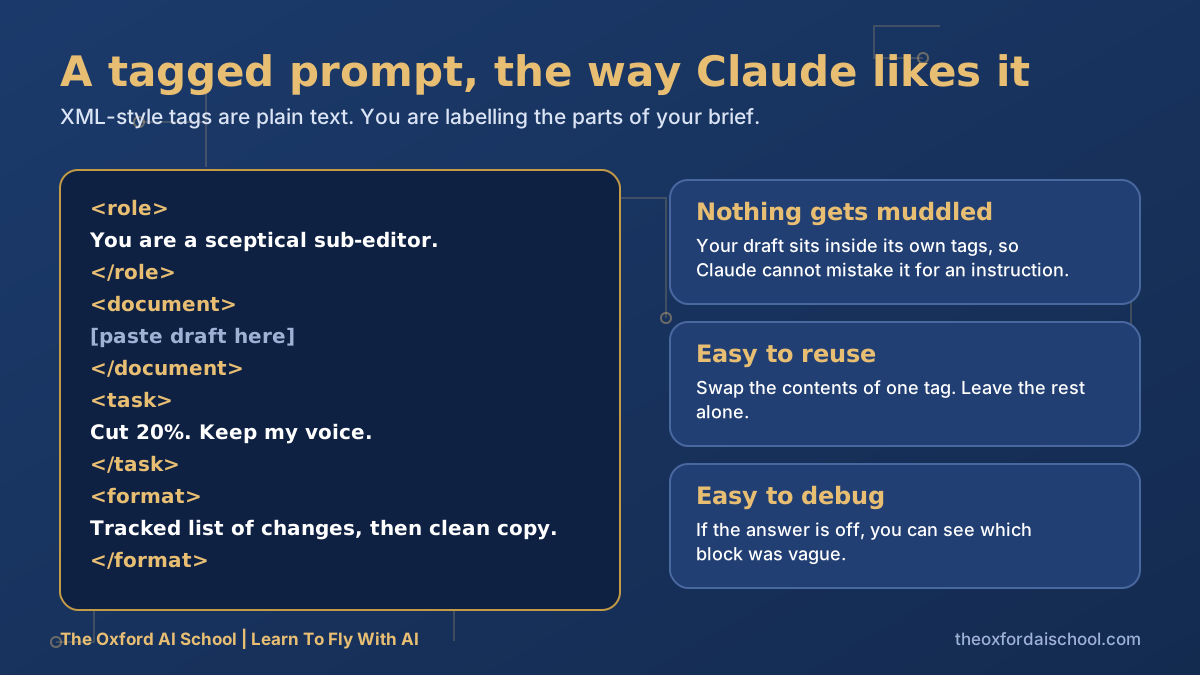
Claude responds well to clearly separated sections. Anthropic's own guidance recommends XML-style tags, such as <document> and <task>. They are plain text, not code. You are simply labelling the parts of your brief so nothing gets mistaken for an instruction.
2. Put long material first
When you paste a long document, put it at the top and your question underneath. It reads more naturally and tends to give better answers on long inputs.
3. Give it permission to be unsure
A model that thinks it must always answer will sometimes invent. Say outright that 'I do not know' is acceptable.
4. Say what a good answer looks like
Length, structure, reader, tone. Claude follows detailed style instructions well, so use that.
Ten Claude prompts to copy
1. The tagged edit
<role>You are a sceptical sub-editor.</role>
<document>
[paste draft]
</document>
<task>Cut 20%. Keep my voice. Do not add anything.</task>
<format>A list of what you cut and why, then the clean copy.</format>
Why it works: each part has a label. Change the contents of one tag and reuse the rest.
2. Quote first, then answer
<document>
[paste long document]
</document>
First, pull out the exact quotes most relevant to this question: [question]. Then answer using only those quotes. If the document does not contain the answer, say so.
Why it works: forcing it to quote first keeps it anchored to the text on long inputs.
3. Tone of voice analyser
Here are three pieces I wrote: [paste]. Describe my voice in under 150 words: sentence rhythm, vocabulary I favour, what I never do. Then list ten phrases I should ban from anything written as me.
Why it works: it extracts a style guide from your real writing. Save the result and reuse it.
4. The red team
<plan>[paste]</plan>
You are the smartest person who wants this plan to fail. Write the three most damaging criticisms, ranked. For each, say what evidence would change your mind.
5. The Socratic tutor
Teach me [topic] by asking questions. One at a time. If I answer wrongly, do not correct me straight away: ask a follow-up that exposes the gap. Summarise what I now understand after eight questions.
6. Give me your uncertainty
Answer the question below. Then add a section called 'How sure am I': for each claim, mark high, medium or low confidence, and say what I should verify independently. 'I do not know' is a perfectly good answer.
7. Strip the AI tells
Edit the text below so it reads like a human wrote it. Remove: em dashes, 'it's not just X, it's Y' constructions, lists of three adjectives, and any sentence that could appear in any company's blog. Vary the sentence length. [paste]
Why it works: naming the tells is more effective than asking for 'natural' writing.
8. Interview me for a brief
I need a brief for [project]. Interview me, one question at a time, until you have enough. Then write the brief on one page and list anything you had to assume.
9. Meeting to actions
<transcript>[paste]</transcript>
List decisions, then actions with owner and date. If an owner or date was not stated, write 'unassigned'. Do not invent. Finish with one sentence on any unresolved disagreement.
10. The second opinion
Here is advice another AI gave me: [paste]. Where is it wrong, incomplete or overconfident? Be specific, and say what you would add.
How do Claude prompts differ from ChatGPT prompts?
| Claude tends to... | ChatGPT tends to... | |
|---|---|---|
| Structure | Respond well to tagged sections | Cope well with plain headed text |
| Long documents | Handle long pasted material carefully | Handle it too; quoting-first helps either |
| Writing | Hold a tone of voice with a good sample | Hold it too; needs firmer banned-phrase lists |
| Uncertainty | Reliably honest if you invite it | Needs the invitation spelled out |
Take that table as a rule of thumb, not a law. Models change every few months, so test on your own work. And if you want to stop retyping your standing instructions, Claude Skills are the next step.
Claude can still get things wrong, including with confident wording. Check anything that matters, and read our guide on keeping information safe with AI tools before pasting client data anywhere.
For a step-by-step walkthrough of a single prompt, read how to write the best Claude prompt, then how to add context to Claude.
Best Claude prompts: frequently asked questions
What are the best Claude prompts?
The best Claude prompts label their parts, usually with XML-style tags, put long documents first, say what a good answer looks like and give Claude permission to say it is unsure. Prompts that ask for quotes before answers work especially well on long documents.
Do I need XML tags to prompt Claude?
No. Plain, clearly separated sections work fine. Tags just make the boundaries obvious, which helps on longer or more complex prompts.
How do I make Claude sound like me?
Paste three examples of your own writing, ask Claude to describe your voice and list phrases to avoid, then save that description and include it in future prompts.
Is Claude better than ChatGPT?
It depends on the task. Many people prefer Claude for long documents and careful writing, and ChatGPT or others for different jobs. The sensible approach is to test both on your own work.
What is the best Claude prompt for long documents?
Paste the document first, then ask Claude to extract the relevant quotes before answering, and to say so if the answer is not in the text.
Where can I get Claude training in the UK?
The Oxford AI School runs Claude training in person and online. See Claude AI training UK and Claude training in London.

Harry Lang runs The Oxford AI School in Witney, Oxfordshire. A former CMO, he now teaches teams and individuals across the UK to use AI in plain English, on their own real work. Email Learn@TheOxfordAISchool.com.