Ask ten people at a networking event what a GPT is and you will get ten answers, two of them confident. So, plainly: GPT stands for Generative Pre-trained Transformer, the family of models behind ChatGPT. ChatGPT is the product. A Custom GPT is a version of it you have set up with standing instructions, so it behaves the same way every time.
'GPT prompts' usually means one of two things: the instructions that set up a Custom GPT, or prompts written for GPT models in general. The best ones state the role, the rules, what to do when unsure, and the exact output format. Write them once, test them with awkward questions, and reuse them every day.
Which means 'GPT prompts' is really two topics. Prompts you type into a GPT model, which are covered in our best ChatGPT prompts guide. And the instructions that build a Custom GPT, which is what this page is about, because that is where the time saving is.
What is the difference between a GPT prompt and a ChatGPT prompt?
| ChatGPT prompt | Custom GPT instructions | |
|---|---|---|
| Used | Once, in the moment | Every time, automatically |
| Written for | Yourself | Yourself and colleagues |
| Must cover | This task | Every task in its remit, including awkward ones |
| Fails when | It is vague | It meets a case you did not think of |
| Tested by | Reading the answer | Trying to break it |
That last row is the whole craft. A prompt only has to work once. Instructions have to survive Dave from accounts asking something odd at 4.50 on a Friday.
The four parts of a Custom GPT
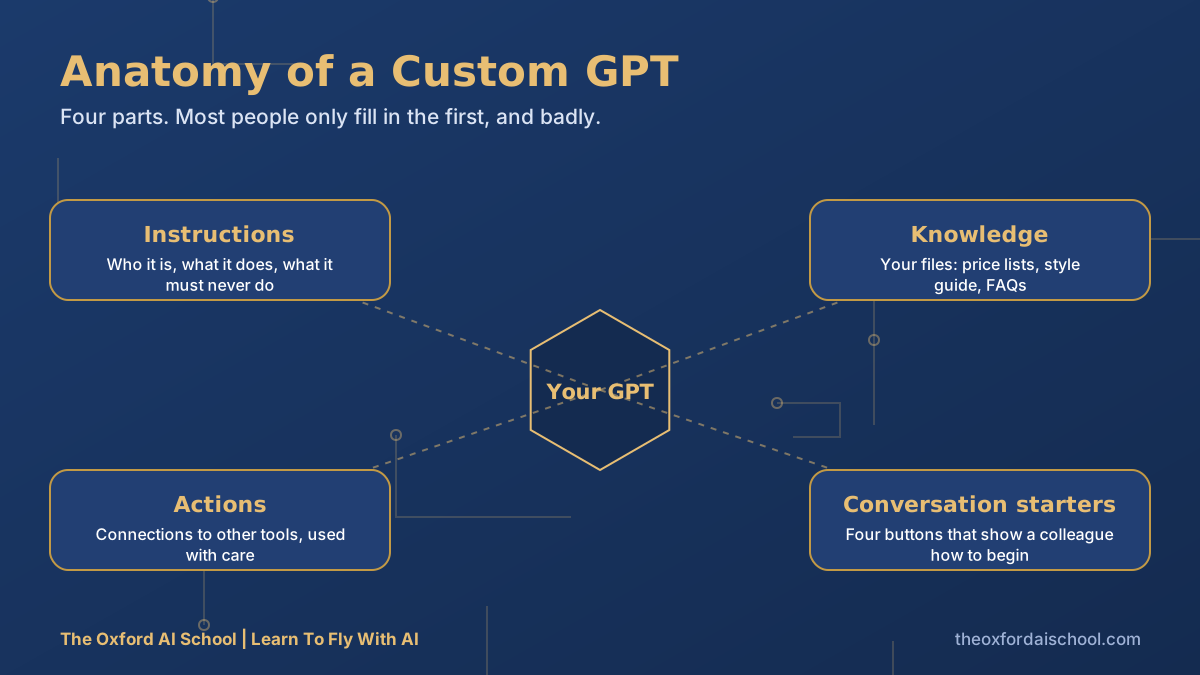
Instructions
The job description. Who it is, what it does, what it never does, how it sounds, and what it does when it is unsure.
Knowledge
Files you upload for it to draw on: a price list, a style guide, your FAQs. Keep them short, current and free of anything confidential, especially if you plan to share the GPT.
Actions
Connections to outside tools. Powerful and easy to get wrong. Start without them.
Conversation starters
Four buttons that show a colleague how to begin. Underrated. Nobody reads the manual, but everybody clicks a button.
Six GPT prompts to copy
1. The instruction skeleton
ROLE: You are [role] for [organisation].
AUDIENCE: You are helping [who], who are [level of knowledge].
JOB: Your job is to [one clear job]. You do not [out-of-scope things].
STYLE: [tone, length, British English, banned phrases].
WHEN UNSURE: Ask one clarifying question. If you still do not know, say so. Never invent facts, prices or policies.
FORMAT: [exact output structure].
Why it works: 'when unsure' is the line most people forget, and the reason most GPTs bluff.
2. The interview GPT
You build briefs by interviewing me. Ask one question at a time about [topic]. After six questions, write the finished brief in this format: [format]. Do not write anything until the interview is done.
3. The reply drafter
You draft replies to customer emails for [company]. Use the tone guide in the knowledge file. Always: greet by name, answer the question in the first line, keep to 120 words. If the email contains a complaint, refund or legal threat, do not draft. Instead write: 'ESCALATE: [one-line reason]'.
Why it works: it defines the cases it should refuse. Good instructions are as much about what not to do.
4. The meeting minutes GPT
I will paste a meeting transcript. Produce: decisions made, actions with owner and date, open questions, and one line on anything that sounded like disagreement. If an owner or date was not stated, write 'unassigned' rather than guessing.
5. The proposal checker
You review proposals before they go to clients. Check against the checklist in the knowledge file. Return a table: item, pass or fail, one-line fix. Finish with the single change that would most improve the proposal.
6. The knowledge-file rule
Answer only from the uploaded files. If the answer is not in them, say 'Not in my files' and suggest who to ask. Quote the file name for each answer.
Why it works: it stops the GPT blending your price list with whatever it half-remembers from the internet.
How to test a Custom GPT before anyone else uses it
- Ask it something simple. It should be good.
- Ask it something slightly outside its remit. It should decline politely.
- Ask it something it has no file for. It should say so.
- Try to make it break a rule. Be a bit rude. Someone will be.
- Give it to one colleague, watch them use it, and fix the first confusion you see.
Tips for GPT prompts in newer models
- Be explicit. Do not rely on it inferring what you meant.
- Use clear separators, such as headed sections, for your instructions and for pasted material.
- Reasoning models often plan their own steps, so 'think step by step' adds less than it used to. Check the current guidance for the model you are using.
- Keep instructions tidy. A GPT told fourteen things equally loudly obeys none of them.
A Custom GPT you share can reveal what is in its knowledge files. Never upload anything you would not put on a shared drive. For more on keeping data safe, read our guide on how to keep information safe using AI tools.
Prefer Claude? The same idea is called a Project or a Skill. See the best Claude Skills for how that works.
Building assistants rather than one-off chats? How to prompt ChatGPT covers custom instructions, memory and Projects, and how to prompt an AI agent covers the next step up.
Best GPT prompts: frequently asked questions
What does GPT stand for?
GPT stands for Generative Pre-trained Transformer. It is the type of model behind ChatGPT. A Custom GPT is a ChatGPT assistant set up with its own standing instructions and files.
What are the best GPT prompts?
The best GPT prompts, meaning Custom GPT instructions, state the role, audience, job, style, what to do when unsure, and the exact output format. Testing them with awkward questions matters as much as writing them.
How do I write instructions for a Custom GPT?
Start with a short skeleton: role, audience, job, style, when unsure, format. Add examples of good output, then test with simple, off-topic and rule-breaking questions and fix what fails.
Is a Custom GPT the same as a prompt?
Not quite. A prompt is a single request. A Custom GPT packages standing instructions, optional files and optional actions, so you do not have to repeat yourself.
Can a Custom GPT leak my files?
It can. Treat uploaded knowledge as potentially visible to anyone who can use the GPT, and never upload confidential or personal data to a GPT you plan to share.
Should my business build Custom GPTs?
Yes, for repeated tasks with a clear format, such as reply drafting, minutes and checklists. Start with one, test it hard, and expand only when people actually use it.

Harry Lang runs The Oxford AI School in Witney, Oxfordshire. A former CMO, he now teaches teams and individuals across the UK to use AI in plain English, on their own real work. Email Learn@TheOxfordAISchool.com.