It is ten past nine on a Sunday evening. You have typed write me a marketing plan into ChatGPT and received nine hundred words that could belong to any company on earth. Beige. Confident. Useless.
The best ChatGPT prompts give the model a role, the real context, one clear task and the format you want back. Weak prompts ask a question. Strong prompts brief a colleague. Copy the twenty below, swap the square brackets for your own details, and expect usable first drafts instead of beige waffle.
The model is not the problem. The brief is. ChatGPT is the most patient new starter you will ever manage, and like every new starter it does its best work when somebody tells it who it is, what the situation is and what a good answer looks like.
Below are twenty prompts I use or teach every week at The Oxford AI School. Copy them, change the bits in square brackets, and use the same bones for your own. New to all of this? Start with how to get started with prompting AI first, then come back.
What makes a ChatGPT prompt good?
A good prompt does four jobs, and you can see them side by side in the picture below. You do not need all four every time, but if an answer disappoints you, one of them was missing.
- Role. Who should ChatGPT be? A sceptical finance director gives different advice from a cheerful intern.
- Context. The facts it cannot guess: your audience, your budget, your tone, what you have already tried.
- Task. One clear job. Two jobs in one prompt is how you get two half-jobs back.
- Format. A table, five bullets, 120 words, a script. If you do not say, it picks, and it picks long.
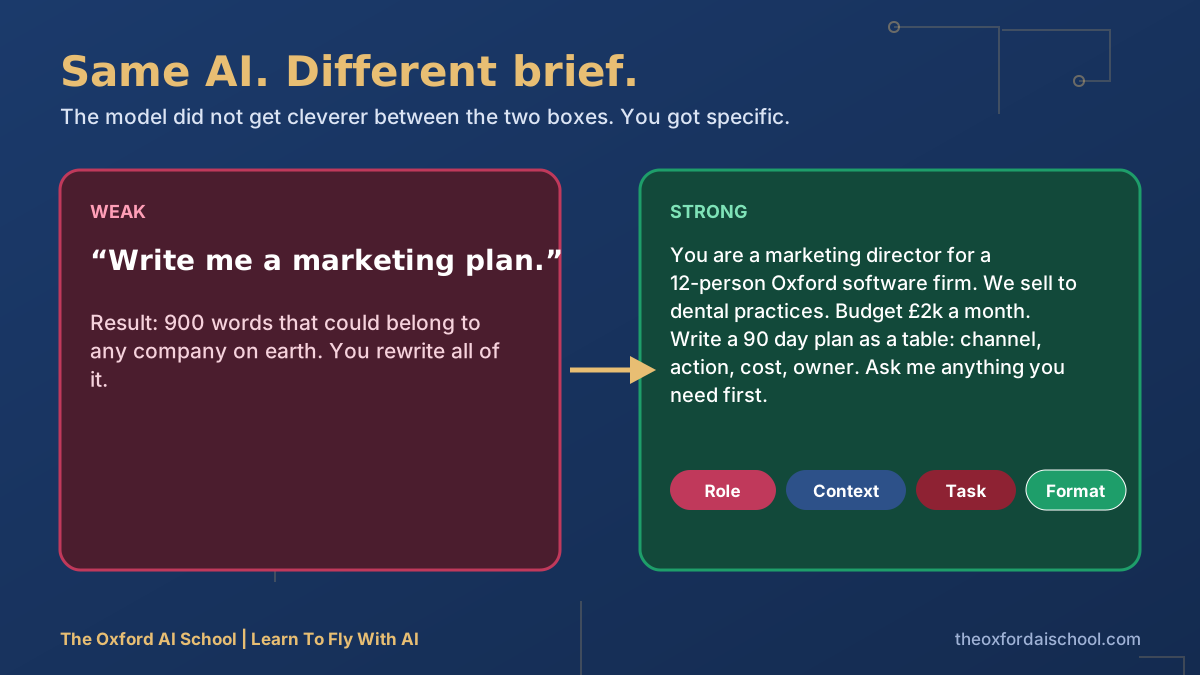
If you want the full method, our guide to AI prompt frameworks gives you a five-block brief you can keep on a sticky note.
The best ChatGPT prompts for writing
Writing is where most people start, and where most people get the flattest results. These five fix that.
1. Rewrite it in my voice
Rewrite the text below in my voice.
My voice: [three adjectives, e.g. warm, dry, direct].
Here is a paragraph I wrote that sounds like me: [paste].
Keep my meaning. Cut anything that sounds like a press release.
Text: [paste]
Why it works: a sample of your real writing beats any adjective. Give it one, and it copies rhythm, not just vocabulary.
2. Cut it by a third
Cut this by 30% without losing a single fact. Then list everything you removed, so I can overrule you.
[paste]
Why it works: the list of cuts keeps you in charge. You will put one or two things back, which is the point.
3. The difficult email
I need to write to [person and role] about [problem]. They are [mood]. I want [outcome].
Write three versions: firm, friendly and brief. Under 120 words each. Do not apologise more than once.
Why it works: three versions let you hear the tone before you commit. The apology limit stops the grovelling.
4. Twelve headlines
Give me 12 headlines for [piece]. Four plain, four curious, four funny. Then pick the two you would actually use and say why in one line each.
Why it works: forcing a spread stops it giving you the same headline twelve ways.
5. Summarise for a busy reader
Summarise the document below for a busy [role]. Give me: the point in one sentence, the three decisions it requires, and anything that looks wrong or missing.
[paste]
Why it works: asking what looks wrong turns a summary into a review.
The best ChatGPT prompts for thinking and deciding
This is the underrated use. ChatGPT is a mediocre oracle and an excellent sparring partner.
6. Devil's advocate
Here is my plan: [plan]. Argue against it as hard as you can. Assume I am about to make an expensive mistake. Give me the three strongest objections and what evidence would settle each one.
7. The pre-mortem
Imagine it is twelve months from now and [project] has failed. Write the post-mortem. What went wrong, in order of likelihood, and what could I do this week to prevent each one?
Why it works: people are better at explaining a failure than predicting one.
8. Explain it properly
Explain [topic] to me as if I am a smart 14-year-old who is allergic to jargon. Then give me the one thing most people get wrong about it.
9. Decision matrix
I am choosing between [A], [B] and [C]. My priorities, in order: [list]. Build a table scoring each option out of 10 against each priority, explain each score in one line, and tell me which one wins and by how much.
10. What am I not asking?
I am trying to [goal]. Here is my current thinking: [paste]. What question should I be asking that I am not? What am I assuming without evidence?
Why it works: it goes after your blind spots, which no amount of rewording your own question can do.
The best ChatGPT prompts for learning
11. Teach me by asking
Teach me [topic]. Do not lecture. Ask me one question at a time, find out what I already know, and adjust. Stop every five questions and tell me what I am getting right.
12. Seven day plan
I have 20 minutes a day for seven days. Build me a plan to get from [starting point] to [goal]. Each day: one task, one thing to read or watch, and one way to check I learned it.
13. Quiz me
Quiz me on [topic] with ten questions, easiest first. Wait for my answer before revealing the correct one. Keep a score.
14. Plain English clause
Explain this clause in plain English and tell me what questions I should ask a solicitor about it. This is for understanding only, not legal advice.
[paste clause]
Why it works: it gives you better questions, which is what an expensive hour with a solicitor needs.
15. The best counter-argument
What is the single strongest argument against [belief I hold]? Write it the way its smartest supporter would, not as a straw man.
Five prompts that improve every other prompt
These are the cheap tricks that add the most. Bolt them on to almost anything.
16. Ask me questions first
Before you answer, ask me up to five questions you need to do this well. Wait for my replies.
Why it works: you stop guessing what the model needs, because it tells you.
17. What is missing?
Read my prompt again. What information would make your answer significantly better? List it, then answer as best you can without it.
18. Critique, then rewrite
Critique your own answer as a harsh editor would, in three bullets. Then rewrite it fixing those problems.
19. Three versions
Give me three versions: safe, bold, and strange. Label them. Do not explain them.
20. Check your own answer
List every factual claim in your answer. For each, say how confident you are, and flag anything I should verify from a primary source before I rely on it.
Why it works: it will not catch everything, but it separates what it knows from what it is guessing.
ChatGPT can state invented facts with a straight face. Anything with a date, a number, a legal point or a quote in it needs checking before it leaves the building. Our guide to keeping information safe with AI tools covers what you should never paste in the first place.
Which prompt for which problem?
| You need to... | Start with prompt | What you get |
|---|---|---|
| Stop a draft sounding like a robot | 1, 2 | Your voice, shorter |
| Say something awkward kindly | 3 | Three tones to choose from |
| Pressure-test a plan | 6, 7, 10 | The holes, listed |
| Learn something fast | 11, 12, 13 | A plan and a quiz |
| Get a better answer to anything | 16, 17, 18 | A sharper second pass |
Five mistakes that ruin good prompts
- Asking one vague question and judging the whole tool on the reply.
- Pasting a wall of text with no instruction about what to do with it.
- Never saying who the answer is for.
- Accepting the first version. The second is nearly always better.
- Treating confident wording as accuracy.
More depth? Our ChatGPT training guide for UK teams shows how we teach this in a day, and ChatGPT prompts for work has eighteen more by job function.
Want the settings behind the prompts? Read how to use ChatGPT effectively and how to prompt ChatGPT so your instructions stick.
Best ChatGPT prompts: frequently asked questions
What is the best ChatGPT prompt?
There is no single best prompt, but the most reliable pattern is: a role, the real context, one task and a format. 'Ask me questions first' is the best add-on, because it makes ChatGPT tell you what it is missing.
How do I write a good ChatGPT prompt?
State who ChatGPT should be, give the facts it cannot guess, ask for one job, and say what format you want. Then ask it to critique and improve its own first answer.
Are ChatGPT prompts the same as Claude prompts?
The principles are identical. Claude tends to respond particularly well to clearly labelled sections, which our Claude prompts guide covers.
Can I copy and paste these prompts?
Yes. Replace everything in square brackets with your own details. Do not paste confidential client or personal data into any AI tool unless your organisation's policy allows it.
Do ChatGPT prompts still matter with newer models?
Yes. Newer models cope better with vague requests, but a clear brief still gets a more useful, more specific answer in fewer rounds.
How long should a ChatGPT prompt be?
As long as the job needs. Two sentences is fine for a simple task. For anything you will use professionally, four to eight lines of context pays for itself.

Harry Lang runs The Oxford AI School in Witney, Oxfordshire. A former CMO, he now teaches teams and individuals across the UK to use AI in plain English, on their own real work. Email Learn@TheOxfordAISchool.com.