Tuesday, 8.40am. The coffee is still hot, the inbox is not, and somebody wants a summary of something by ten. This is where ChatGPT either earns its keep or becomes another tab you feel guilty about.
The best ChatGPT prompts for work name the job, the audience and the output you need, and include the real constraints: deadline, budget, tone. Below are eighteen prompts for six teams, ready to paste. Swap the square brackets for your own details and never paste confidential client or personal data without checking your AI policy.
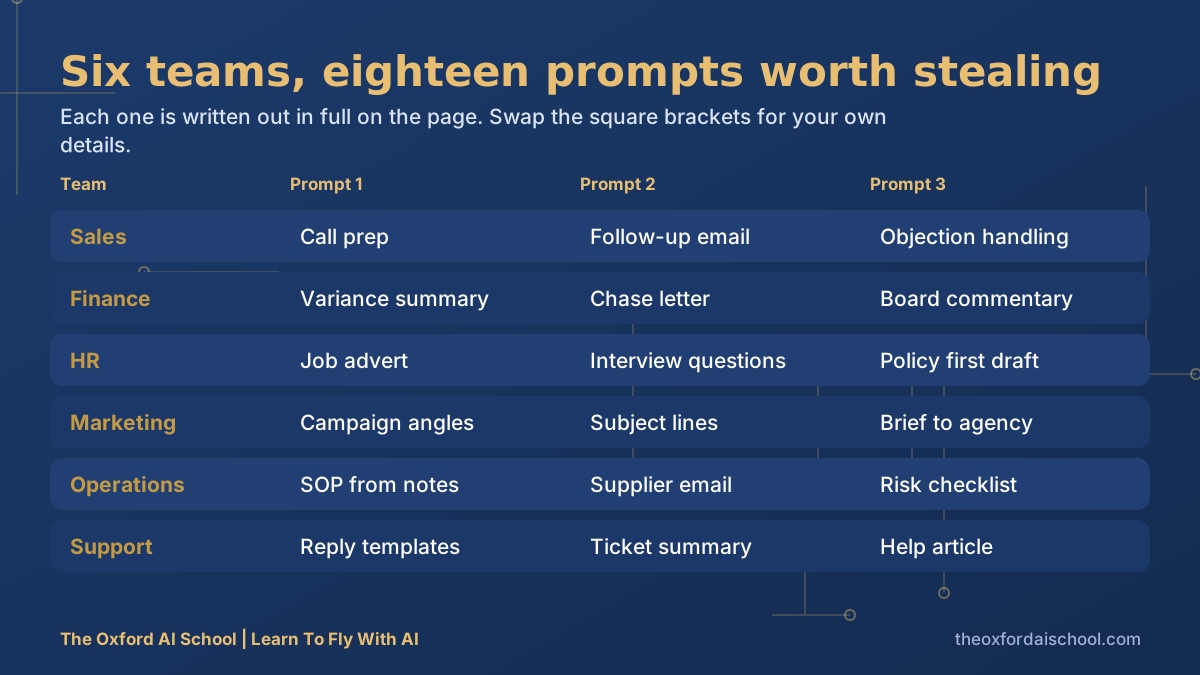
General prompts are fine. Prompts written for your job are better. Below are eighteen, three for each of six teams, each built around a task that eats time every single week. If you want the general toolkit first, start with the twenty best ChatGPT prompts.
Before you paste anything: the five-second check
Work prompts often involve real names, real prices and real customers. Settle this once and you can stop worrying about it.
| Fine to paste | Check first | Never paste |
|---|---|---|
| Your own draft text | Customer names and emails | Passwords and API keys |
| Public information | Unreleased financials | Special category personal data |
| Anonymised examples | Contracts with NDAs | Anything your policy forbids |
No policy yet? Our guide on how to write an AI policy takes an afternoon, and the AI Policy Workshop does it with you.
ChatGPT prompts for sales
Call prep
I have a call at [time] with [name, role] at [company, one line on what they do]. They last [did / said]. Give me: three questions that show I have done my homework, one likely objection with a reply, and a one-sentence reason they might care about [our offer].
Follow-up email
Write a follow-up to [name] after our call. We agreed: [points]. Next step is [step] by [date]. Under 100 words, warm but not gushing, no 'just checking in'.
Why it works: banning the cliché phrase removes the cliché.
Objection handling
A prospect said: '[objection]'. List the five most likely things behind that sentence, then give me one honest response for each. No pressure tactics.
ChatGPT prompts for finance
Variance summary
Here are this month's actuals against budget: [paste anonymised table]. Summarise the three biggest variances in plain English for a non-finance director, suggest one likely cause for each, and list what I should check before I present this.
The chase letter
Draft a payment reminder for an invoice of £[amount], [number] days overdue, to a customer we want to keep. Firm, polite, with a clear date and a way to pay. Three escalating versions: first, second, final.
Board commentary
Turn these figures into six bullets of board commentary: what happened, why, and what we will do about it. No adjectives I cannot back with a number. [paste]
Why it works: 'no adjectives without a number' is the best editing rule in business writing.
ChatGPT prompts for HR
Job advert
Write a job advert for [role] at a [size] [sector] company in [place]. Salary [range]. Be honest about the hard parts of the job. Plain English, no 'rockstar', no 'fast-paced'. Under 300 words.
Interview questions
Give me eight interview questions for [role], each testing a specific skill. For each, tell me what a strong answer sounds like and what a worrying one sounds like.
Policy first draft
Draft a one-page [policy name] policy for a [size] UK business. Include purpose, scope, rules, who is responsible, and review date. Flag any points that need checking against current UK employment law by a professional.
Why it works: the last sentence makes it show its gaps. It is a draft, never the final word.
ChatGPT prompts for marketing
Campaign angles
We sell [product] to [audience]. Give me ten campaign angles, each in one line. Five should be sensible. Five should be the ones my competitors would be too nervous to run.
Subject lines
Write 15 email subject lines for [email topic]. Under 45 characters, no emojis, no exclamation marks. Group them by tactic: curiosity, benefit, urgency, plain.
Brief to an agency
Turn these rough notes into a one-page agency brief: background, objective, audience, budget, timing, what good looks like, what we have already tried. Notes: [paste]
ChatGPT prompts for operations
SOP from notes
Turn my rough notes about [process] into a step-by-step standard operating procedure. Number the steps, name who does each one, and add a 'what can go wrong' line to every step. Notes: [paste]
Supplier email
Write to [supplier] about [issue]. Facts: [facts]. I want [outcome] by [date]. Civil but unmistakably serious. Keep my goodwill, lose the passive voice.
Risk checklist
I am about to [change / launch / move]. List the ten things most likely to go wrong, how I would spot each early, and who needs to know. Put it in a table.
ChatGPT prompts for customer support
Reply templates
Here are five common customer questions and my current answers: [paste]. Rewrite each as a reply template that is shorter, kinder and clearer, with space for the customer's name and one personal line.
Ticket summary
Summarise this customer thread in three lines: what they want, what we have tried, what happens next. Then suggest the single best next message. [paste, anonymised]
Help article
Turn these resolved tickets into a help article titled '[question]'. Use the customer's own wording for the headings, numbered steps, and one 'still stuck?' line at the end. [paste]
How to make these prompts better for your team
Save them where people will find them
A prompt that lives in one person's head helps one person. Put the good ones in a shared document, named by task, and review them monthly. Ten battle-tested prompts beat a hundred nobody uses.
Add your own context once, reuse it forever
Write a short paragraph about your company, tone and customers, and paste it at the top of anything you send. Better still, turn it into a reusable assistant, which our guides on Custom GPTs and Claude Skills explain.
A quick test
Show the output to a colleague without saying where it came from. If they spot it in under ten seconds, your prompt still needs more of you in it.
For the everyday tasks around these prompts, see how to use AI for work tasks, and if your company runs on Microsoft 365, how to prompt Microsoft Copilot.
ChatGPT prompts for work: frequently asked questions
What are the best ChatGPT prompts for work?
The best work prompts name the task, the audience and the format, and state real constraints such as budget, deadline and tone. Prompts for follow-up emails, meeting summaries, job adverts and board commentary save the most time.
Can I use ChatGPT for work safely?
Yes, with rules. Do not paste passwords, special category personal data or anything your policy forbids, and check customer information first. Having a short written AI policy removes most of the guesswork.
Which team gets the most from ChatGPT?
Teams with lots of writing and summarising, such as sales, marketing, HR and support, see fast gains. Finance and operations benefit most from structured summaries and checklists, with a human checking the numbers.
How do I stop ChatGPT sounding generic at work?
Give it a sample of your real writing, ban the phrases you hate, and tell it who the reader is. Then edit the output, because it is a first draft.
Do I need ChatGPT Plus for work prompts?
Not to start. The free tier handles most of these. Paid plans mainly add higher usage limits and extra features, which change often, so check the current plans before deciding.
Where can my team learn this properly?
Our Basic AI Training teaches your team to apply these prompts to their own work in a single day, in person or online.

Harry Lang runs The Oxford AI School in Witney, Oxfordshire. A former CMO, he now teaches teams and individuals across the UK to use AI in plain English, on their own real work. Email Learn@TheOxfordAISchool.com.