Healthcare teams and practice managers
AI for Healthcare
Give the practice a quieter inbox. Keep clinical judgement with the people qualified to exercise it.
Discuss training for your healthcare team
A practice manager already has more ways to receive a task than a human should have. AI can help with some of that work. I would begin with a job the team can check against an approved source, such as explaining how to prepare for an appointment. That is a much better first exercise than asking the chatbot what to do about a symptom.
Choose a first job by role
| Who | A useful first exercise | What to check |
|---|---|---|
| Reception | Draft opening-hours and access information from approved copy | Phone number, hours, accessibility and escalation |
| Practice manager | Turn a fictional rota handover into a checklist | Owner, time and unresolved actions |
| Training lead | Create a quiz from public induction material | Every answer traces to the source |
| Communications | Rewrite an approved leaflet for a wider reading audience | Preserve meaning and ask the service owner to review |
Try a patient information exercise
Take a public page that explains how to reach a clinic. Give the assistant the approved wording. Ask it to make the instructions easier to scan. Read the result as a person arriving for the first time, possibly in the rain and already ten minutes late.
Try this prompt
Use only this approved public service information [paste text]. Draft a short arrival guide for first-time visitors. Preserve the contact details and accessibility wording. Flag anything missing. Leave out medical advice and do not infer an appointment or access policy.
Compare the draft with the original, line by line. Check the directions, telephone number and opening hours. Ask a colleague unfamiliar with the building to follow it. Record any edits before the information is shared.
Draw the line before anybody uploads a file
Health information is special category data under UK GDPR. For training, use fictional records and public material. A note with the name removed can still identify someone through its details. Ask the relevant information governance lead about any proposed use of real data and follow local rules for approval.
Ambient scribing deserves its own assessment. It can involve recording a consultation and creating a draft clinical note. NHS England provides dedicated guidance on selecting and deploying these tools. Discuss the intended use with the organisation’s governance and clinical leads, including consent or transparency processes, assurance and clinician review as applicable.
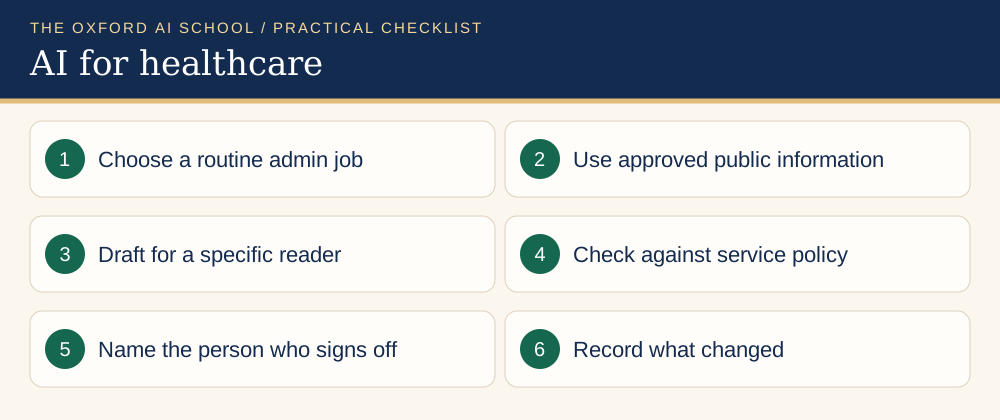
Read the checklist as text
- Choose a routine admin job
- Use approved public information
- Draft for a specific reader
- Check against service policy
- Name the person who signs off
- Record what changed
Give the pilot a finish line
Try five examples of the same administrative task. Count time spent correcting details and getting approval. Keep the result if a colleague can repeat the exercise and the checks hold up. Move a new task involving clinical information through the appropriate approval route before it enters the pilot.
Training to try next
AI Basics Deep Dive
Practise briefing tools and checking results with public or fictional examples.
AI Policy Workshop
Agree approved tools, data boundaries and who reviews the work.
AI for Dentists
Explore the dedicated route for dental practice teams.
Official guidance
Keep learning
More AI training by industry
Related guides and courses
Frequently asked questions
What is a good first AI use in healthcare?
Start with a repeatable admin task using public or fictional information, such as drafting a visitor guide from approved service details.
Can staff paste patient notes into a public AI tool?
Use fictional or approved public information for training. Ask your information governance team about any proposed use of patient data and use only an approved workflow.
Do you teach diagnosis with AI on this route?
The training routes on this page focus on workplace skills, administrative exercises and governance. Clinical tools require their own assessment and approval.