
The short answer
- Learn To Fly With AI is a plain-English book about using AI at work and at home, written for total beginners who feel behind. It is out now on Amazon in Kindle and print.
- No code and no maths. It covers what AI is and is not, an honest roundup of ChatGPT, Claude, Gemini, Copilot and Perplexity, how to prompt them properly, how to spot when they are making things up, and how to use them safely under GDPR.
- It is the honest version. The data and privacy risks, the power and water that AI data centres drink, and the handful of very large companies sitting at the top of all of it are in there too.
- I created and edited it, and used Claude, Perplexity and ChatGPT heavily to research and frame it. Claude has a co-author credit and Google Gemini illustrated it, which felt like the only honest way to write a book about using AI well.
- The book and our training programmes teach the same ideas. The book is for learning on your own; the training is for changing how a team works.
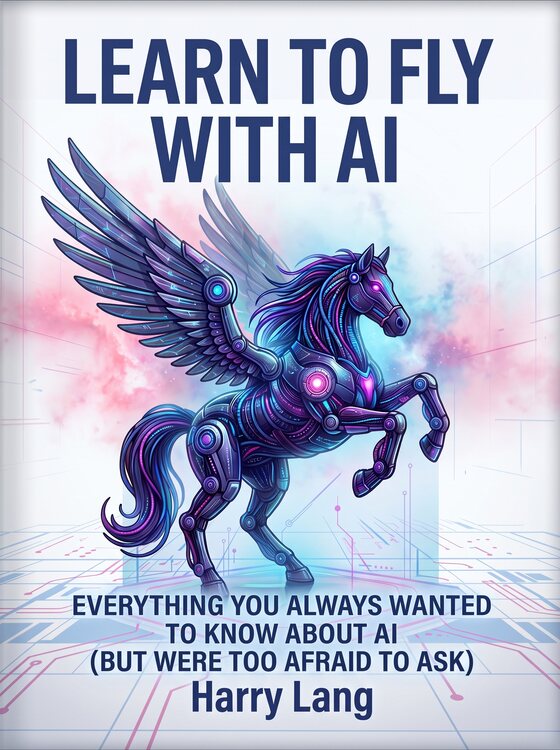
This book was, perhaps unsurprisingly, written in collaboration with Claude, ChatGPT and Perplexity with cover art done by Google Gemini’s Nano Banana 2. I usually write everything I put my name to (outside of SEO and GEO inducing blog posts) but for this book, I experimented with a full AI collaboration. The result is, objectively, credible, useful and relevant, but as I really didn’t commit a huge amount of time to crafting every word, I’ll be giving all proceeds from the book sales to local children’s charities here in Oxfordshire. So if you’re cross that I used AI to write a book about learning basic AI, just don’t buy it.
Thank you,
Harry
Why I wrote an AI book
I spend most of my week in rooms with clever, busy people who are secretly worried they have missed something. Business owners. Marketing teams. Accountants. Farmers, genuinely. They have watched the headlines pile up for two years, thought "right, I really must sort this out", and then gone back to the actual job of running a life and a business.
Then at some point in every session, someone asks the same question in a slightly embarrassed voice: is there a book I could just read? Something they can take home, go through at their own speed, without a colleague watching them type. For a long time my answer was a shrug and two or three recommendations that were either written for engineers or written to sell you the miracle.
So I wrote the one I kept wishing I could hand them. If you have been hunting for the best basic AI book, or a straight guide to using AI at work that does not assume you are a coder, this is that book. You have not missed anything. You are just about to start.
This note is the honest write-up: what is in it, who it is for, what it cost to make, and the mistakes I made along the way. It is the second in the Notes From Harry series, after the one about building our merch shop with AI in a weekend.
Is this the right AI book for you?
It is written for people, not programmers. The test I applied to every page was whether I could say it out loud in a room full of non-technical business owners without anyone's eyes glazing over.
Who Learn To Fly With AI is for
- A total beginner who wants a basic AI book to start from scratch, with no maths and no code.
- A business owner or manager who wants a practical book about using AI at work.
- Someone at home who wants AI to help with meal plans, holidays, admin, homework and money.
- A sceptic who wants the honest version, downsides and all, rather than a sales pitch for the robots.
- A team lead who wants everyone at the same starting point before a training session.
Who it is not for
- Engineers who want to build models. There is no Python in here and no linear algebra.
- Anyone after a prediction piece about where AI goes in 2035. This is about Tuesday morning.
- People who already run reliable AI workflows daily. Go straight to the advanced material instead.
- Anyone who wants to be told AI is either a miracle or a con. It is neither, and the book says so.
What kind of AI book it is
An honest one. AI is a genuine contradiction: a brilliant technology that can change how you work and live, and one that still makes things up, flatters you to death, and will happily disappear down a pointless rabbit hole if you do not know how to drive it. Plenty of books sell you the miracle. This one hands you the keys and also tells you where the potholes are.
The honest version, not the sales pitch
You get the what, where, when, why and how. What AI can do, what it cannot, and how to use the main tools safely, effectively and practically. There is even a bit on why these large language models are so weirdly obsessed with a certain kind of long dash. If you know, you know.
No code, no maths, no acronyms left unexplained
Every term gets defined the first time it appears, in the sort of language you would use to explain it to a friend in a pub. "Large language model" gets explained. So does "context window", "hallucination", "token" and "agent", because those four words cause more confusion in my sessions than everything else combined. If you want the short version of that last one before you buy, here is what AI agents can actually do for a small business.
Who wrote it, and why the credits matter
I created and edited the book. I also used Claude, Perplexity and ChatGPT heavily to research, source and frame it. So Claude gets a co-author credit and Google Gemini gets the illustrator credit, which feels like the only defensible way to publish a book about using AI well.
It practises what it preaches: a human doing the thinking, the judgement and the editing, with AI doing a lot of the legwork, and the join shown honestly rather than hidden. If you are going to teach people that AI is a collaborator rather than a vending machine, you cannot then pretend you wrote 60,000 words unaided at 6am.
Worth saying plainly: AI did not write this book and then get a credit as a courtesy. It did research, challenged my framing, found sources I would not have found, and produced drafts I then rewrote. Every judgement call, every opinion and every joke that survived is mine. That division of labour is exactly what the book teaches you to set up for your own work.
What is inside the book
It is built in three parts, so you can start wherever you are and keep going as your confidence grows. Most people start at Part One and are surprised how quickly they are ready for Part Two.
The Age of AI, and why you are not too late
Where we actually are, the growing skills gap and what it means for your job, and why the bus has not left. Plus that long-dash obsession.
Getting your head around AI
- What AI actually is, and what it is not
- How it works, with no maths
- Meet the Big Five: an honest roundup of Claude, ChatGPT, Gemini, Copilot and Perplexity, and which to start with
- Your first proper conversation: getting past using it like Google
- Will it take my job? The honest, evidence-based answer
Getting good at AI
- How to write a good prompt: the 10 rules
- Getting it to question you back: 5 ways to interrogate better
- Context is everything: 10 suggestions for managing it
- How to tell when it is lying: spotting hallucinations and checking accuracy
- AI at work: emails, proposals, research, data and meetings
- AI at home: meal plans, holidays, household admin, homework, letters and money
Getting ahead with AI
- Building systems, not one-off queries: custom instructions, projects and reusable workflows
- What is an agent, anyway? Automation explained in plain terms
- Doing it safely: data, privacy, GDPR and what you never paste in
- Doing it well: ethics, a simple AI policy, and how not to drown everyone in AI slop
Ten lessons for your wall
The things worth remembering long after you have put the book down. If you only photograph one page, it is this one.
The honest bit most AI books skip
AI is not free, and I do not mean the subscription. The book looks squarely at the downsides: the data and privacy risks, the huge and growing amounts of power and water that AI data centres drink, the ecological bill, and the fact that a small handful of very large companies sit at the top of all of it.
None of that is a reason to avoid AI. It is a reason to use it with your eyes open, and to make the choices every one of us now has to make. I would rather you had the full picture than a shiny half of one. It is also the part of my job I find most interesting, and the part most training quietly skips because it is awkward to sell.
What you will walk away with
By the end, you will be able to
- Understand what AI is, and is not, without a computer science degree.
- Pick the right tool to start with, from an honest look at the big five rather than a feature grid.
- Write prompts that get useful work back, and get the AI to question you when it should.
- Spot when it is making things up, and check before you trust it.
- Use it for real tasks at work and at home, safely and within the rules.
- Do it ethically and sustainably, with your eyes open to the trade-offs.
Get Learn To Fly With AI
Everything you always wanted to know about AI, but were too afraid to ask. Out now on Amazon UK in Kindle and print.
Get the book on AmazonBy Harry Lang · with Claude (co-author) · illustrated by Google Gemini · opens Amazon.co.uk in a new tab
How I actually worked with AI on the book
This is a Notes From Harry post, so here is the working out. The useful thing about writing a book on using AI well is that you cannot fake the method. If the process had been "ask ChatGPT for 60,000 words and tidy it", the book would have been unreadable and I would have known it.
The division of labour, honestly
What I settled on, roughly in the order the work happened:
| The job | What AI did | What stayed human |
|---|---|---|
| Deciding what the book is for | Interrogated me on it and refused to accept vague answers | The answer. Every time. |
| Research and sourcing | Found material, papers and examples I would not have found | Checking every claim and source before it went in |
| Structuring the three parts | Proposed several structures and argued for each | Choosing one and living with the consequences |
| Drafting explanations | First passes at explaining hard ideas simply | Rewriting almost all of them in my own voice |
| Challenging the framing | Pushed back where I was being lazy or one-sided | Deciding which pushback was right |
| Illustration | Generated the artwork throughout | Art direction, selection and the bin |
| Judgement, opinions and jokes | Nothing usable | All of it |
What I would tell you if you are writing something long with AI
Decide the point of it before you generate a word
Exactly the same lesson as the merch shop. I had drafts of chapters before I had properly answered who the book was for, and the ones written before that decision were the ones I threw away. Ask an AI assistant to interrogate you on the purpose and to refuse to let you off with a vague answer. It is uncomfortable and it saves weeks.
Check every fact, especially the ones that sound right
The dangerous output is never the obviously wrong one. It is the plausible statistic with a confident tone and no source. A book about spotting hallucinations that contained hallucinations would have been quite the own goal, so every number and every citation got checked by hand. If you take one habit from the book, take that one.
Keep your own voice, ruthlessly
AI gets you to a competent 80% fast, and competent is not the same as worth reading. The last 20% is you: the opinion, the aside, the bit where you admit something did not work. That is the part people actually remember, and no model will produce it for you because it does not have your week.
Show the join
Crediting Claude and Gemini was not a marketing decision, it was the thing that made the rest of the book defensible. If you use AI on client work, decide now how you will disclose it, and put that in your AI policy before someone asks you the awkward version of the question.
The book, or the training?
People ask me this and expect me to say training, because that is what we sell. The honest answer depends on what you are trying to change.
| If you want to… | Start with | Why |
|---|---|---|
| Understand AI at your own pace, on your own | The book | Cheap, complete, and nobody is watching you type |
| Change how a team actually works | Training | Adoption is a habit problem, not a knowledge problem |
| Get everyone to the same starting point first | Both, in that order | A session where nobody is lost is a much better session |
| Solve one specific job this week | A single module | Targeted, hands-on, done with your own work in front of you |
| Write the rules before you roll anything out | The AI policy workshop | Policy first avoids unpicking bad habits later |
The book and the school teach the same ideas, because they came from the same place: two years of explaining this to people who did not want a lecture. If you would like your people trained hands-on, the full programme list and pricing is here.
Ready to stop feeling behind on AI?
Read the book, or bring the school to your team. Either way you will be flying sooner than you think. Ten minutes on a call and we will tell you honestly which one you need.
Book a callPractical AI training for your team
The Oxford AI School delivers plain-English AI training in Oxfordshire and London, across the UK, and live online for international teams. Sessions cover basic and advanced AI skills, policy, marketing, websites and GEO, and they are built on the same material as the book.
Programmes that cover the ground in this book
Basic AI Training
Parts One and Two of the book, hands-on, in a single practical session.
Explore this trainingAll Programmes & Pricing
Every module, format and price in one place, for individuals and teams.
See all programmesAI Policy Workshop
Write the usage policy the book's Part Three tells you that you need.
Explore this trainingBuild Your Best AI Stack
Pick the right tools for your work, beyond the honest roundup of the big five.
Explore this trainingLearn To Fly With AI: frequently asked questions
What is the best book about AI for beginners?
If you want plain English and no jargon, Learn To Fly With AI is written exactly for you. It assumes you know nothing, starts from what AI actually is, and builds you up to using it confidently at work and at home. There is no code and no maths in it. It is aimed at total beginners rather than techies, which is what makes it a sensible first AI book. If you would rather learn with other people in the room, The Oxford AI School teaches the same material as hands-on training.
Is there a book about using AI at work?
Yes. Learn To Fly With AI has a whole section on AI at work: emails, proposals, research, data and meetings, which are the real Tuesday-morning tasks rather than the demo ones. It also covers doing it safely, what you should never paste into a chatbot, GDPR, and how to write a simple AI policy, so it is a practical book about using AI at work rather than a theory book about where AI is heading.
What is a good basic AI book to start with?
A good basic AI book does three things: it explains the tools in plain terms, it shows you how to actually use them, and it is honest about the limits. Learn To Fly With AI does all three, including an honest roundup of ChatGPT, Claude, Gemini, Copilot and Perplexity and a clear recommendation on which one to start with depending on what you do all day.
How can I learn AI from a book if I am not technical?
You do not need to be technical. There is no code and no maths in Learn To Fly With AI. It explains how AI works in plain language, teaches you how to write a good prompt using ten rules, and walks you through real tasks step by step. If you can send an email, you can follow it. The tools themselves are just conversations, which is the part most people are surprised by.
Who wrote Learn To Fly With AI?
It was created and edited by Harry Lang, founder of The Oxford AI School, who used Claude, Perplexity and ChatGPT extensively to research, source and frame the content. Claude is credited as co-author and Google Gemini as illustrator, which is rather fitting for a book about using AI well. The thinking, judgement and editing are human; a good deal of the legwork was not, and the book says so rather than hiding it.
Does the book cover the downsides of AI?
Yes, honestly. It covers hallucinations and how to check accuracy, data and privacy risks, GDPR, the large amounts of power and water that AI data centres consume, the environmental bill, and the concentration of power among a small number of very large companies. None of that is a reason to avoid AI. It is a reason to use it with your eyes open.
Where can I buy Learn To Fly With AI?
It is on Amazon UK, in Kindle and print. If you would rather learn with your team in person or live online, The Oxford AI School runs practical, jargon-free workshops built on the same material, available in Oxfordshire and London, across the UK and internationally.
Should I read the book or book AI training for my team?
Read the book if you are learning on your own, want to go at your own pace, and want the whole picture cheaply. Book training if you need a team to change how they work, because the hard part of AI adoption is rarely knowledge and almost always habit. Most people do both: the book gets everyone to the same starting point before a session, which makes the session far more useful.

Harry Lang runs The Oxford AI School, teaching teams and businesses the basics of AI in a fun, easy and practical way. A marketing leader turned AI trainer, he is the author of Learn To Fly With AI and can be reached at Learn@TheOxfordAISchool.com.
Notes From Harry
First-person notes on things built with AI at The Oxford AI School: what worked, what cost what, and what I would do differently.