

Start with the short answer
What are the top 3 AI books to read in 2026?
Our top three are Co-Intelligence for working with AI, The Coming Wave for understanding its wider impact, and Learn To Fly With AI for beginners who want to start using it. Each answers a different question, so the right first book depends on what you want to do next.
A note on this list: this is The Oxford AI School’s editorial selection, not a sales chart or an independent awards ranking. Our founder, Harry Lang, created and edited Learn To Fly With AI, and the school has a commercial interest in promoting it.
For working with AI
Co-Intelligence
Start here if you want to understand how AI can become part of your working life. Mollick explores collaboration, learning and human judgement: useful foundations before you decide which tasks to hand over.
Publisher’s overview ↗For the bigger picture
The Coming Wave
Read this to step back from the latest product launch and consider the larger questions. Who holds power as technology spreads, what could go wrong, and how much control can societies retain?
Publisher’s overview ↗For getting started
Learn To Fly With AI
Our choice for people who feel behind and want a practical starting point. It introduces everyday AI tools and prompting in plain English, alongside the checks and limitations that matter when you actually use them.
See what’s inside the book →The top 10 books about AI at a glance
- Co-Intelligence by Ethan Mollick – working with AI
- The Coming Wave by Mustafa Suleyman & Michael Bhaskar – technology and power
- Learn To Fly With AI by Harry Lang – beginners using AI at work and home
- Artificial Intelligence: A Guide for Thinking Humans by Melanie Mitchell – how AI works
- Human Compatible by Stuart Russell – AI safety
- Prediction Machines by Ajay Agrawal, Joshua Gans & Avi Goldfarb – business decisions
- Nexus by Yuval Noah Harari – information, society and power
- You Look Like a Thing and I Love You by Janelle Shane – AI mistakes, explained with humour
- HBR’s 10 Must Reads on Artificial Intelligence by Harvard Business Review – leading AI adoption
- AI 2041 by Kai-Fu Lee & Chen Qiufan – imagining AI’s future
The full reading list
The top 10 books about artificial intelligence, compared
Some books help you do a job. Others help you understand the technology, question its claims or think about its consequences. This list covers those different needs. “2026” means books worth considering this year; it does not mean every title was first published in 2026.
On a small screen, swipe the table sideways to read the summaries →
| No. | Book & author | Best fit | Short summary |
|---|---|---|---|
| 01 | Co-Intelligence | Working with generative AIGeneral reader | Explores AI as a collaborator in work and learning, with examples of how people can use it while keeping their own judgement. A useful starting point for professionals who want to think more clearly about working alongside AI. Before you choose: A guide to the human–AI relationship rather than a current menu-by-menu software manual. |
| 02 | The Coming Wave | Understanding technology and powerGeneral reader | Examines the opportunities and dangers of powerful technologies, including AI, and the difficulty of keeping their effects under control. Choose it for a wider view of the choices facing governments, companies and society. Before you choose: Best for the bigger picture; less useful if your immediate goal is writing better prompts. |
| 03 | Learn To Fly With AIOur founder’s book | Beginners using AI at work and homeBeginner · no code or maths | A plain-English introduction to AI tools, prompting and everyday tasks, with an honest look at mistakes, privacy and wider trade-offs. Created and edited by Harry Lang, founder of The Oxford AI School, for people who want to start using AI with more confidence. Before you choose: A practical starting point for everyday users; not a machine-learning engineering textbook. Explore Learn To Fly With AI → |
| 04 | Artificial Intelligence: A Guide for Thinking Humans | Understanding how AI worksCurious general reader | Explains the ideas, history and limitations behind artificial intelligence. Mitchell asks what machines actually understand and why apparently impressive systems can still struggle with tasks people find straightforward. Before you choose: Choose it for concepts and perspective rather than instructions for a particular chatbot. |
| 05 | Human Compatible | AI safety and human objectivesGeneral reader · conceptual | Asks how increasingly capable AI systems can remain aligned with what humans want. Russell explains the problem of control and argues for a different approach to designing systems around human preferences. Before you choose: A conceptual discussion of AI safety, rather than a practical workplace policy template. |
| 06 | Prediction Machines | Business decisions and economicsManagers and business owners | Uses a simple economic idea: AI makes prediction cheaper. The authors explore how that changes decisions, the value of data and the organisation of work. A useful lens for leaders assessing where AI might create value. Before you choose: An economic framework, not a catalogue of the latest generative AI tools. |
| 07 | Nexus | Information, society and powerGeneral reader · substantial read | Traces the role of information networks through human history and asks what changes when AI becomes part of those networks. It connects questions about truth, institutions and power to the choices surrounding AI. Before you choose: Much broader than AI alone; choose it for historical context rather than hands-on training. |
| 08 | You Look Like a Thing and I Love You | An entertaining introduction to AI mistakesBeginner-friendly | Uses funny and revealing experiments to show how machine learning behaves, fails and surprises us. Shane makes the gap between a human intention and a machine’s output easy to recognise. Before you choose: Its examples predate today’s chatbots, so read it for enduring lessons about AI behaviour. |
| 09 | HBR’s 10 Must Reads on Artificial Intelligence, Updated and Expanded | Leading AI adoption in a businessManagers and team leaders | This May 2026 collection brings together articles on organisational adoption, changing workflows, human values, decision-making and generative AI. A useful choice for leaders who prefer a range of perspectives in shorter chapters. Before you choose: A collection of management articles, rather than one continuous beginner course. |
| 10 | AI 2041 | Imagining AI’s possible futureGeneral reader · fiction and analysis | Pairs fictional scenarios with explanations of the technologies behind them. The combination offers a different way to consider how AI could affect everyday life, work and society. Before you choose: These are imagined futures, not a timetable or a set of guaranteed predictions. |
Book titles link to publisher or author information; our book links to its Oxford AI School page. The reader-fit recommendations are our editorial judgement. Prices and availability vary by edition and retailer.
Find the right reading list
The best AI books by category: advanced, business, beginner and creative
Use these four supporting charts to choose by your experience and interests. Each has its own ranking, so a book can sit at a different position from the overall top ten. The lists also introduce specialist titles beyond the ten covers in the header.
These are The Oxford AI School’s editorial picks. Learn To Fly With AI is our founder’s book; it is ranked first for basic AI and second for business in these lists.
For builders and technical readers
Top 5 Advanced AI Books
For readers ready to build AI applications, train models or study the technical foundations. These choices assume some programming or mathematical confidence; the reader-fit column helps you choose a starting point.
Swipe the table sideways to read every column →
| Rank | Book & author | Best for | Short summary |
|---|---|---|---|
| 1 | AI Engineering | Developers building with foundation models | A practical framework for building applications around existing foundation models. Covers the engineering decisions behind useful AI products, including evaluation and improving the quality of outputs. |
| 2 | Build a Large Language Model (From Scratch) | Python users who want to understand LLM internals | Builds up a GPT-style language model through code, from attention mechanisms to training and fine-tuning. Choose it to understand what happens inside a model, rather than simply calling one through an API. |
| 3 | Designing Machine Learning Systems | Engineers taking machine learning into production | Looks beyond an isolated model to the surrounding system: data, objectives, deployment, monitoring and changing conditions. Useful for readers responsible for making machine learning work reliably in a real organisation. |
| 4 | Deep Learning with Python, Third Edition | Python programmers learning deep learning | Connects deep-learning concepts with practical Python examples, including generative AI. A structured route into implementing models for readers who want to work through a substantial technical book. |
| 5 | Artificial Intelligence: A Modern Approach, Fourth Edition | Students seeking broad technical foundations | A wide-ranging textbook covering search, reasoning, uncertainty, learning and other foundations of AI. Best treated as a course or reference, with time for exercises, rather than a quick guide to today’s tools. |
Titles link to publisher or author information. Rankings reflect the reader needs in this category.
Choose another category ↑For owners, managers and teams
Top 5 AI Books For Business
Our business list starts with human–AI collaboration, then practical confidence, commercial decisions and organisational change. Learn To Fly With AI is our number 2 pick for owners and teams who need an accessible route into everyday use.
Swipe the table sideways to read every column →
| Rank | Book & author | Best for | Short summary |
|---|---|---|---|
| 1 | Co-Intelligence | Rethinking how people work with AI | Explores how professionals can collaborate with generative AI while retaining human judgement. Our first business pick for thinking through what AI changes about the work people already do. |
| 2 | Learn To Fly With AI#2 business pick | Getting business owners and teams started | Plain-English guidance on AI tools, prompts and familiar work such as emails, proposals and research. Our number 2 business pick for building everyday confidence, with attention to unreliable answers and information privacy. See what’s inside the book → |
| 3 | Prediction Machines | Understanding commercial value | Explains AI through the economics of cheaper prediction. Helps leaders examine which decisions might improve, what data matters and where human judgement remains valuable. |
| 4 | Human + Machine, Updated and Expanded | Redesigning work and business processes | Examines how people and AI can work together across an organisation. The expanded edition includes generative AI and is useful for leaders considering changes to roles, workflows and operating models. |
| 5 | HBR’s 10 Must Reads on Artificial Intelligence, Updated and Expanded | Comparing management approaches | A 2026 selection of HBR articles on adoption, workflows and the management questions surrounding AI. Suits busy leaders who want shorter chapters and several perspectives rather than one continuous argument. |
Titles link to publisher or author information. Rankings reflect the reader needs in this category.
Choose another category ↑For beginners and the AI-curious
Top 5 Basic AI Books
Our number 1 basic AI book is Learn To Fly With AI: a practical, no-code introduction for people who want to use AI at work or at home. The other picks offer different routes into collaboration, limitations and the ideas behind the technology.
Swipe the table sideways to read every column →
| Rank | Book & author | Best for | Short summary |
|---|---|---|---|
| 1 | Learn To Fly With AI#1 basic AI pick | A practical first step · no code or maths | Introduces everyday AI tools and prompting in plain English, with guidance on spotting mistakes and using information carefully. Our first choice here for beginners who want to move from curiosity to trying useful tasks. See what’s inside the book → |
| 2 | Co-Intelligence | Understanding AI as a collaborator | A general-reader introduction to working and learning alongside AI. A useful next step once you want to think beyond individual prompts and consider how AI fits into your habits. |
| 3 | You Look Like a Thing and I Love You | Learning through funny examples | Uses playful experiments to make machine-learning failures easier to understand. Good for readers who prefer humour and concrete examples; its enduring lessons matter more than the age of individual tools. |
| 4 | Artificial Intelligence: A Guide for Thinking Humans | Understanding capabilities and limits | Explains AI’s ideas and history while questioning what machines really understand. Choose it when you want conceptual clarity rather than a step-by-step chatbot tutorial. |
| 5 | Artificial Intelligence: A Very Short Introduction | A concise overview of the field | A compact introduction to AI’s history, achievements and limitations, including questions about intelligence and creativity. A useful orientation to the field, rather than a guide to current AI apps. |
Titles link to publisher or author information. Rankings reflect the reader needs in this category.
Choose another category ↑For writers, designers, artists and makers
Top 5 AI Books For Creatives
Creative readers need different things: a way to collaborate, a view of machine-made art, fresh ideas or the skills to build their own tools. These picks span those needs; the final choice is specifically for creatives who code.
Swipe the table sideways to read every column →
| Rank | Book & author | Best for | Short summary |
|---|---|---|---|
| 1 | Co-Intelligence | Collaborating without losing your judgement | A useful framework for bringing AI into thinking and creative work while keeping the person responsible for the result. Our practical starting point for creatives exploring collaboration with AI. |
| 2 | The Artist in the Machine | Exploring AI in art, music and literature | Visits the people and ideas behind computer-generated art, writing and music. Suits creatives interested in what machine creativity could mean, rather than instructions for the latest image generator. |
| 3 | You Look Like a Thing and I Love You | Creative experimentation and useful scepticism | Shows how strange outputs can expose the gap between a human brief and a machine’s interpretation. A playful choice for creatives interested in experimentation and the limits of automated originality. |
| 4 | AI 2041 | Storytelling and future scenarios | Combines fictional stories with technological analysis. Useful inspiration for writers and designers exploring possible futures, while keeping the distinction between an imagined scenario and a prediction clear. |
| 5 | Generative Deep Learning, Second Edition | Creative technologists · coding required | Explains generative models through practical implementation, including approaches to producing images and text. Choose it if you want to build with the underlying technology; it is a technical choice rather than a no-code creative handbook. |
Titles link to publisher or author information. Rankings reflect the reader needs in this category.
Choose another category ↑Choose by the job you need it to do
Which AI book should you read first?
Start with the question you want answered. Buying the most technical book on the shelf is unlikely to help if your immediate aim is writing a better email.
- “I’m new to AI. Where do I start?” Choose Learn To Fly With AI for a practical introduction. Try one small task as you read, using information you are comfortable sharing.
- “How can I use AI more thoughtfully at work?” Start with Co-Intelligence. Look for tasks where you can evaluate the output yourself.
- “Where could AI create value in my business?” Read Prediction Machines, then the HBR collection for management perspectives.
- “What does AI actually understand?” Choose Melanie Mitchell for concepts or Janelle Shane for a lighter route into the limitations.
- “What might AI change about society?” Start with The Coming Wave. Follow with Human Compatible for control, Nexus for information networks or AI 2041 for imagined scenarios.
A useful reading habit: write down one idea, try one suitable task and note what needed correcting. A book can give you the framework; practice tells you whether you can use it.
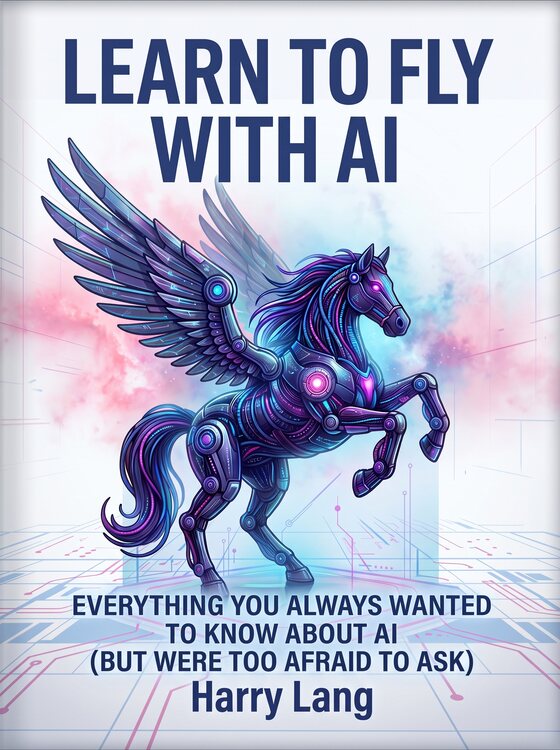
Number 3 on our list · First steps for you
Learn To Fly With AI: our number 3 pick for beginners
Ready to stop feeling behind?
Learn To Fly With AI is for people who want to understand what AI can do and start using it. It covers familiar tools including ChatGPT, Claude, Gemini, Copilot and Perplexity, with prompting, everyday uses and the limitations worth understanding.
There is no coding or maths requirement. Harry Lang created and edited the book with extensive AI assistance; the book page explains the co-author and illustration credits.
Read the overview to decide whether it fits what you need, or head straight to Amazon for the current buying options.
How we chose these AI books
Our selection criteria
We selected titles across practical use, business decision-making, underlying concepts, safety and social impact. The order puts accessible routes into AI first, with specialist perspectives further down. It is a reading guide, not a claim that unlike books can be given an objective quality score.
Where the summaries come from
Summaries are based on the linked publisher and author descriptions, checked on 7 October 2026. These are editorial recommendations, not first-hand reviews of every book. Where a title discusses possible futures, we treat those as arguments or scenarios rather than settled forecasts.
Books, documentation and training
For current tools, use books alongside up-to-date documentation. If you learn better by trying things with someone in the room, explore our practical AI training programmes. For more reading, visit the AI Learning Hub.
Questions before you choose
AI books: frequently asked questions
Choosing your first AI book
What are the top 3 AI books to read in 2026?
Our top three are Co-Intelligence by Ethan Mollick for working with AI, The Coming Wave by Mustafa Suleyman and Michael Bhaskar for the wider implications, and Learn To Fly With AI by Harry Lang for beginners. This is The Oxford AI School’s editorial selection, and Lang is the school’s founder.
What is the best AI book for a complete beginner?
Learn To Fly With AI is number 1 in our basic AI books chart for people who want to use AI at work or at home without coding or maths. Our other beginner picks are Co-Intelligence, You Look Like a Thing and I Love You, Melanie Mitchell’s Artificial Intelligence and Margaret A. Boden’s Artificial Intelligence: A Very Short Introduction.
Can I learn to use AI from a book without coding?
Yes. Learning to use an AI assistant for drafting, research support or planning does not require programming. Choose a book aimed at everyday users, practise on non-confidential examples and check the results. Building machine-learning systems is a different learning path.
How does Learn To Fly With AI compare with Co-Intelligence?
Co-Intelligence explores what it means to work and learn alongside AI. Learn To Fly With AI is aimed at beginners looking for a plain-English route into using AI tools, writing prompts and recognising common pitfalls. Choose according to your starting point and the kind of help you want.
AI books for work, business, technical and creative readers
Which AI book should I read for work or business?
Our business chart ranks Co-Intelligence first for thinking about working alongside AI, and Learn To Fly With AI second for practical beginner confidence. Prediction Machines, Human + Machine and HBR’s updated collection complete the five, covering commercial decisions, work processes and management.
Which advanced AI book should I read first?
For building applications with existing foundation models, start with Chip Huyen’s AI Engineering. For understanding a language model through code, choose Sebastian Raschka’s Build a Large Language Model (From Scratch). Pick according to your programming experience and whether you want to use models or build them.
Which AI books are useful for creatives?
Co-Intelligence is our first pick for working alongside AI. The Artist in the Machine explores creativity in art, music and literature; AI 2041 offers fictional future scenarios. Creative technologists who want to code can explore Generative Deep Learning, while Janelle Shane provides a playful look at AI’s limitations.
Risks, publication dates and where to buy
Which books explain the risks and limitations of AI?
Human Compatible focuses on the problem of control and human objectives. The Coming Wave explores wider technological risks and power. Melanie Mitchell’s Artificial Intelligence explains capabilities and limitations, while Learn To Fly With AI introduces practical concerns such as unreliable answers and privacy.
Are these all new AI books published in 2026?
No. This is a selection to read in 2026, combining established books with newer material, including the HBR collection published in May 2026. Earlier books can still explain useful ideas, but tool names, interfaces and features should be checked against current documentation.
Where can I buy Learn To Fly With AI?
You can buy Learn To Fly With AI on Amazon UK. Visit the Oxford AI School book page for an overview of its contents and how it was created, then check Amazon for current editions, prices and availability. Read the book overview or buy on Amazon UK.
Keep learning: related AI guides and training
Books give you the framework. These guides from the AI Learning Hub help you put it to work.
More from the AI Learning Hub
Practical AI training from The Oxford AI School
Basic AI Training
The hands-on half of any beginner AI book, in a single practical session.
Explore Basic AI TrainingAI Basics Deep Dive
Go further with prompting, everyday workflows and checking AI output.
Explore the deep diveAI Policy Workshop
Turn the risks these books describe into clear rules for your team.
Explore the workshop