
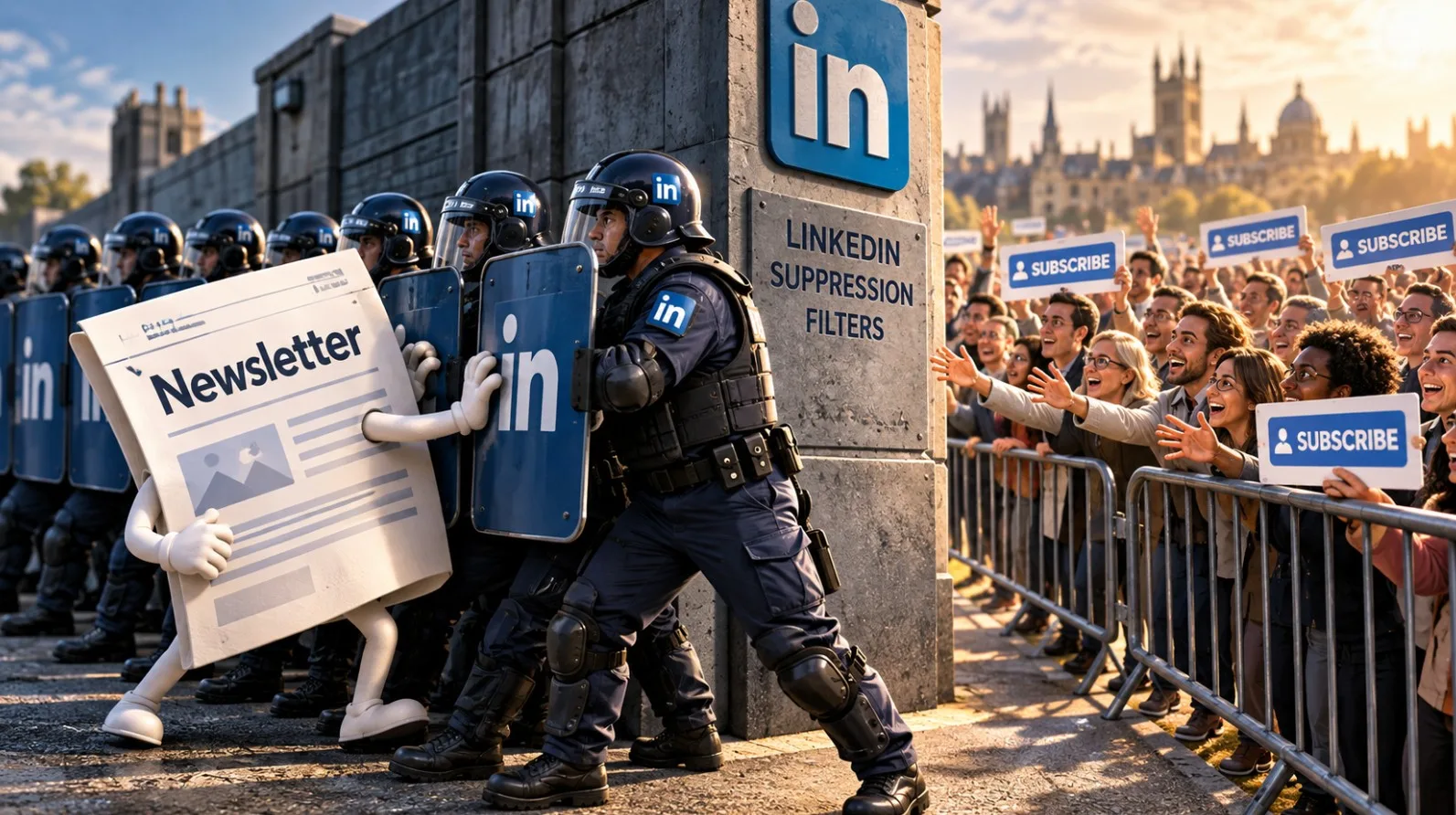
LinkedIn newsletter views have collapsed because the platform now decides which subscribers get the email, based on how "relevant" its algorithm thinks you are to them. Some big accounts report only around 35% of subscribers being sent each edition, while feed reach is down somewhere between 47% and 65%. You earned the list. LinkedIn holds the keys.
If there's one screen likely to turn a newsletter writer the colour of a week-old avocado, it's the LinkedIn analytics page at lunchtime on publication day.
You know the drill. Three evenings of writing, a couple of rewrites, a headline you're quietly proud of, and at eight on Friday morning you hit publish to the hundreds (or thousands) of people who put their hand up and asked for it. Then you check the numbers and find fewer views than a parish council livestream.
I write Marketing Unfiltered and I've been at it for about a hundred editions, so I've had a front-row seat for this particular pile-up. Good news, your writing probably isn't to blame. Bad news, the culprit is a multibillion-dollar platform with a ranking model and no sense of shame.
1/ The Postman Who Reads Your Post
When somebody subscribes to a newsletter, they're about as clear as humans ever get. They've raised a hand, signed on the dotted line and asked for it to land in their inbox every single time.
LinkedIn has decided they can't possibly have meant it.
Newsletter emails are now filtered for "relevance." If a subscriber hasn't liked, commented on or lingered over your recent posts, the algorithm can decide your edition isn't for them and simply never send the email. Independent creator data suggests some big accounts are seeing as few as 35% of their subscribers actually receive it.
So roughly two in every three people who asked for your newsletter never find out it exists. That's Royal Mail steaming open your copy of Private Eye, deciding you've not been reading it closely enough lately, and popping it in the recycling. You'd be livid. You'd write a stiff letter. They'd judge that irrelevant too.
2/ Sixty Minutes To Live
Cross-post to the feed and the indignities pile up. LinkedIn's ranking engine (the infrastructure people are calling 360Brew) shows your post to a small test sample of your network first, then watches them like a nervous parent at a school disco. If they don't stop scrolling and click within the first hour, your reach gets throttled and stays throttled.
Your carefully crafted 1,500 words now have the shelf life of a Pret egg sandwich left on a radiator.
Clicks alone won't save you either. The algorithm rewards depth over applause: fifteen-plus seconds of dwell time, saves and reposts. Somebody who opens your edition on a packed Central line, gets elbowed by a bloke eating a Ginsters and closes it to read later has just told LinkedIn your work is rubbish. Nuance doesn't get a vote.
3/ The Slop Police
Feed reach has fallen off a cliff, with creator analyses putting the drop in visibility somewhere between 47% and 65%. On top of that comes the crackdown on "AI slop," complete with buttons for users to report anything that reads as generic, salesy or machine-made.
I teach AI for a living, so I'm broadly in favour. Most AI-written LinkedIn content reads like a fortune cookie that's been on a leadership retreat. But there's something gloriously daft about a platform that offers to write your posts with its own AI tools and then punishes posts that sound like AI wrote them. It's Greggs fining you for eating a sausage roll on the premises.
Worse, long, text-heavy newsletters are exactly the shape the slop filters are trained to sniff at. Genuine, hand-crafted human writing now has to prove its innocence before anyone's allowed to read it.
Why LinkedIn newsletters don't work: the symptoms and the causes
If you've landed here searching "why is my LinkedIn newsletter not working," this is the quick diagnosis. Each symptom maps to a different part of the new AI algorithm.
| What you're seeing | What's actually causing it |
|---|---|
| Subscriber count keeps growing, views don't | The relevance filter on email sends. Subscribers who haven't engaged with you lately aren't sent the edition |
| Email Sends far lower than total subscribers | The same filter, measured. Some big accounts report only around 35% of subscribers being sent each edition |
| A strong first hour, then nothing | The golden-hour test. Miss it and the post is throttled for life |
| Lots of opens, little reach | Low dwell time. Quick opens and closes read as "not worth it" to the algorithm |
| Long, thoughtful editions doing worst of all | AI slop filters, which look hardest at long, text-heavy posts |
| Everything down, across the board | Wider feed reach losses, estimated at 47% to 65% by creator analyses |
4/ So What's The Point?
A newsletter has one job. Someone subscribes, you write, they receive it. That's the deal, and it's the only thing that makes a newsletter worth the sweat compared with firing posts into the scroll and praying.
LinkedIn has quietly torn up that deal. What's left is a feed post in a slightly nicer jacket, handed out at the whim of a landlord who rewrites the tenancy agreement every quarter and never lets you read it.
If you can't reach the people who asked to hear from you, a LinkedIn newsletter is about as useful as a chocolate teapot in a heatwave.
5/ If You're Staying, Play The Game
First, find out how bad it is. Open your analytics and compare total subscribers against Email Sends and Article Views. The gap between those numbers is the relevance filter's handiwork.
Then change a few habits:
| Stop | Start |
|---|---|
| Broad, catch-all business advice with no real hook | Owning a narrow topic. Your newsletter keywords should match your profile headline closely, so the algorithm knows exactly who you're for |
| Chasing likes through pods and "Great post!" comment loops | Writing things people want to keep. Frameworks, playbooks and checklists get saved, and a save now counts for far more than a like |
| Stuffing in external links or pulling the tired "link in comments" trick | Keeping the good stuff native, and asking questions that earn proper comments of ten words or more |
All sensible, and frankly what a decent newsletter should be doing anyway. None of it changes who owns the relationship.
6/ Own The List
Which is why so many B2B writers are packing up their long-form work and moving it somewhere they actually hold the email addresses. Substack, Beehiiv, Kit, their own website, anywhere a subscriber stays a subscriber. LinkedIn becomes the shop window, the place for short, sharp opinions and getting found. The relationship lives somewhere no algorithm can mark it irrelevant.
That's where I've landed with Marketing Unfiltered. I'll keep turning up on LinkedIn, because plenty of you found me there. But when you subscribe, you'll get the thing you subscribed to. Every time, no audition, no sixty-minute trial by scroll.
Build your house on rented land and sooner or later the landlord changes the locks. LinkedIn just did, and it didn't think the email was relevant enough to send you.
Get Marketing Unfiltered in your actual inbox
Weekly, free, and delivered to every single subscriber. No relevance filter required.
Subscribe FreeLinkedIn newsletters and the AI algorithm: questions people ask
Why don't LinkedIn newsletters work anymore?
Because LinkedIn's AI algorithm now sits between you and your subscribers. Newsletter emails are filtered for relevance, so subscribers who have not recently liked, commented on or lingered over your posts may never be sent the edition. Feed reach has also fallen sharply, with creator analyses putting the drop between 47% and 65%, and long text-heavy posts are now judged against AI slop filters. The newsletter still publishes; far fewer of the people who subscribed ever see it.
Is LinkedIn's newsletter feature broken, or is it just me?
It is not just you. The feature works as LinkedIn now designs it to, which is the problem: delivery to subscribers is decided by algorithmic relevance rather than by the subscription itself. Independent creator data suggests some large accounts see only around 35% of subscribers sent each edition. Compare total subscribers with Email Sends in your newsletter analytics to see your own gap.
Why have my LinkedIn newsletter views dropped so much in 2026?
LinkedIn now filters newsletter emails by algorithmic relevance, so subscribers who have not engaged with your recent posts may never be sent the edition. Feed reach has fallen hard too, with creator analyses putting the drop somewhere between 47% and 65%.
Does LinkedIn email every newsletter subscriber?
No. Independent creator data suggests some large accounts see only around 35% of subscribers sent each edition by email. Compare total subscribers with Email Sends in your newsletter analytics to see your own gap.
How does the LinkedIn AI algorithm decide who sees my newsletter?
LinkedIn's ranking engine, the large AI model infrastructure widely referred to as 360Brew, scores how relevant you are to each subscriber based on their recent engagement with you. It shows new posts to a small test sample first, then rewards depth signals such as dwell time of fifteen seconds or more, saves and reposts over likes. Content that reads as generic or machine-made can be reported and down-ranked as AI slop.
What is the LinkedIn golden hour?
LinkedIn shows a new post to a small test sample of your network first. If that sample does not stop and click within roughly the first 60 minutes, reach is throttled for the life of the post.
Does LinkedIn penalise AI-written content?
LinkedIn has cracked down on what it calls AI slop, including buttons that let users report posts as generic, salesy or machine-made. Long, text-heavy newsletters are exactly the shape those filters look at, so writing that sounds like you, with specific detail and opinion, matters more than ever, whether or not AI helped draft it.
Is a LinkedIn newsletter still worth it?
As a discovery tool, yes. As the only home for your newsletter, it is risky, because LinkedIn decides which subscribers receive each edition. Many B2B writers now keep the long-form newsletter on a platform where they own the subscriber list and use LinkedIn for short posts and getting found.
Should I move my newsletter off LinkedIn?
If the newsletter matters to your business, keep the subscriber list somewhere you own it, such as Substack, Beehiiv, Kit or your own website, and use LinkedIn for discovery and short posts that point people there.
More from Notes From Harry
First-person notes from Harry Lang on things built and tested with AI at The Oxford AI School.

Harry Lang
Harry is a former CMO and the founder of The Oxford AI School, teaching teams the basics of AI in a fun, easy and practical way. He writes the Marketing Unfiltered newsletter and is the author of Learn To Fly With AI. Get in touch at Learn@TheOxfordAISchool.com.