Notes from Harry · AI for business leaders
What's the best Executive AI Coaching in the UK?
Better decisions. Fewer impressive slides.
You probably do not need another introduction to the future
If you run a business, you have probably sat through a presentation explaining that AI will change everything. Excellent. So will the renewal quote on your office lease. Neither observation tells you what to do on Tuesday.
Executive AI coaching should close that gap. You bring a decision, a recurring task or a business problem. The coach helps you use AI to work through it, check the result and decide what belongs in your working week. If the session ends with twelve new acronyms and no new habit, I would ask for the afternoon back.
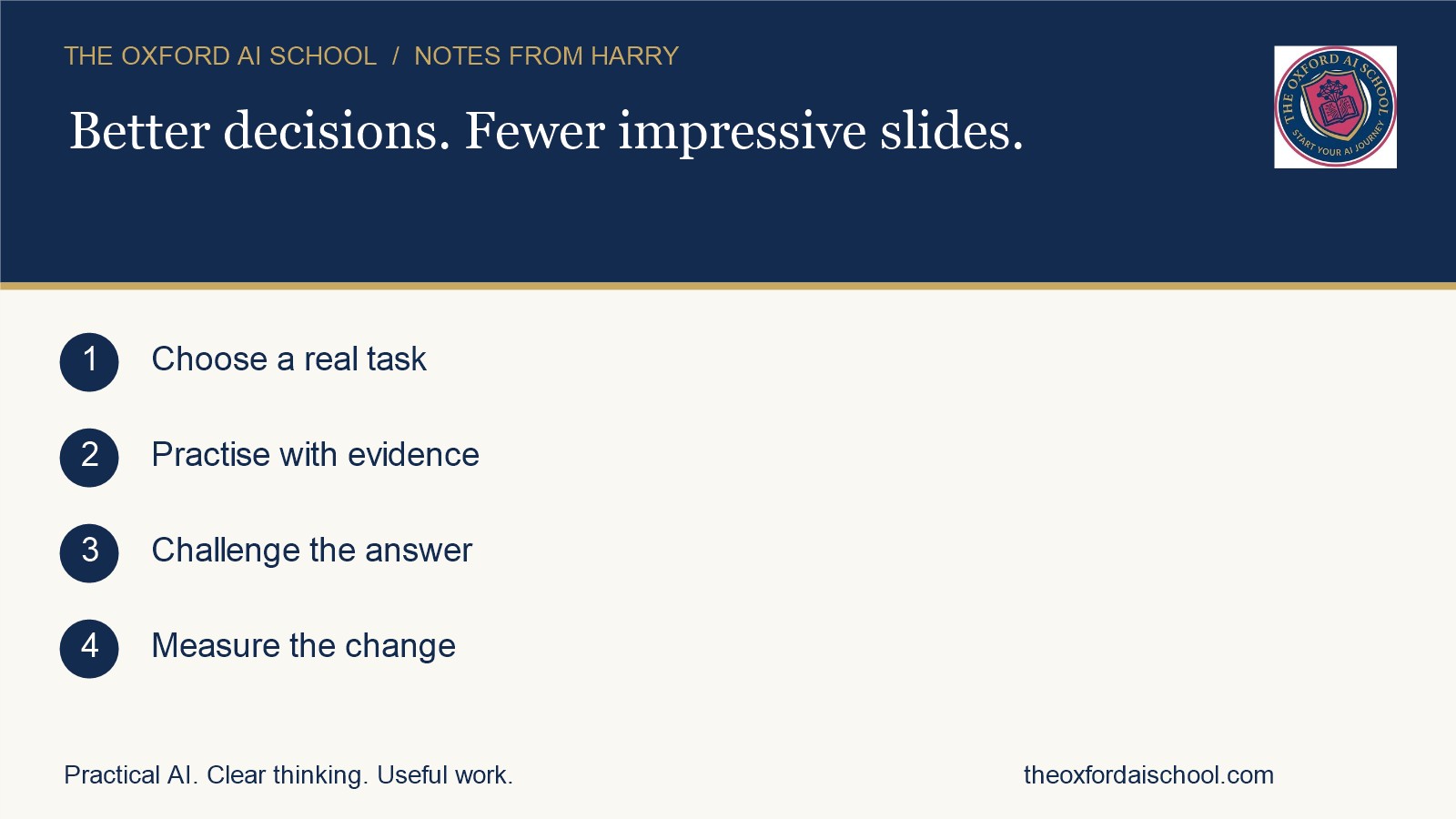
The four-step executive coaching checklist
The diagram above summarises the method in four steps.
1. Choose a real task
Bring a live decision, report or recurring job, not a generic demonstration.
2. Practise with evidence
Work through approved, anonymised material so every claim can be traced to a source.
3. Challenge the answer
Separate evidence from assumption and ask what would change the recommendation.
4. Measure the change
Compare time, quality and your ability to explain the checks after a month.
What should an executive actually learn?
Start with briefing: giving an assistant the task, audience, evidence, constraints and required output. Then practise judgement. Which claims came from your documents? Which are assumptions? What would change the recommendation?
A useful exercise is to take an approved, anonymised management report and ask for three options, the evidence supporting each and the missing information. Compare that with your own reading. You are learning to interrogate the work rather than admire the formatting.
Other useful jobs include preparing for a board discussion, reviewing a proposal, identifying operational bottlenecks and challenging a strategy. AI can help organise and question information. Responsibility for the decision still sits in your chair. It has not acquired directors’ duties because it used a confident font.
How I would choose an executive AI coach
Ask who will coach you, what relevant business experience they bring and how they adapt the work to your starting point. Ask for an example exercise and how they teach verification. Confirm confidentiality arrangements, approved tools, preparation and follow-up.
Then ask the slightly awkward question: “What should I be able to do without you afterwards?” A good answer describes a repeatable task. “Feel empowered” is pleasant, but difficult to put in a management report.
Coaching suits someone who wants individual feedback on live work. A team workshop suits shared foundations. A longer academic programme may suit broader leadership study. Choose the format for the learning you need.
What a useful first month might look like
Agree one task and record how long it currently takes, including checking and revisions. Practise it with approved material. Save the briefing method, note the failure points and repeat it the following week. At the end of the month, compare time, quality and your ability to explain the checks.
This is a suggested way to evaluate coaching, rather than a promised package. Discuss your priorities through our Executive & C-Suite AI Coaching and current programmes. Where the issue is company-wide adoption, ask about AI Advisory. Where the team lacks shared boundaries, the AI Policy Workshop may be the more useful next step.
Start with one real job
Before enquiring, read how to use AI effectively at work and bring one task you would like to improve. Tell us what currently happens, where it gets stuck and what a good result looks like.
I would love us to be your best executive AI coaching option. I would rather establish that through useful work than announce it with a trophy we bought ourselves. Book a conversation and we can work out the fit.
Keep reading
Sources and further reading
Checked on 3 November 2026.
Frequently asked questions
What's the best Executive AI Coaching in the UK?
The best executive AI coaching is the coaching that changes how you make decisions and run your business. Look for personal practice, commercially relevant tasks, clear boundaries and measurable follow-through. The Oxford AI School offers Executive & C-Suite AI Coaching; whether we are your best fit depends on what you need to achieve.
What should an executive learn in AI coaching?
Start with briefing an AI assistant on the task, audience, evidence, constraints and output, then practise judgement: which claims came from your documents, which are assumptions and what would change the recommendation. Useful jobs include board preparation, proposal reviews and challenging a strategy.
Is executive AI coaching better than a team workshop?
They suit different needs. Coaching suits a leader who wants individual feedback on live work. A team workshop suits shared foundations, and a longer academic programme may suit broader leadership study. Choose the format for the learning you need.
How do I measure whether executive AI coaching worked?
Agree one task and record how long it takes today, including checking and revisions. Practise it with approved material for a month, then compare time, quality and your ability to explain the checks.
What questions should I ask an executive AI coach?
Ask who will coach you, what relevant business experience they bring, how they teach verification, what confidentiality arrangements apply and what you should be able to do without them afterwards.
How do I choose the right next step?
Bring one real business task, your starting level and the tools you can use. Compare these with the current programme outlines on The Oxford AI School programmes page, then confirm scope and arrangements before booking.