Notes from Harry · AEO, GEO and AI search
How do I optimise my business website for AEO, GEO and AI Search?
Make the expertise obvious. Retire the magic beans.
Three abbreviations have entered the meeting
SEO is search engine optimisation. AEO usually means answer engine optimisation. GEO means generative engine optimisation. People use the labels differently, which has not prevented anyone putting them on an invoice.
The shared business problem is straightforward: when a potential customer asks a relevant question, can a search service find your expertise, understand it and usefully point someone towards you? Our AEO, GEO and SEO comparison explains the terminology. Your customer still wants an answer.
The four-step AI search checklist
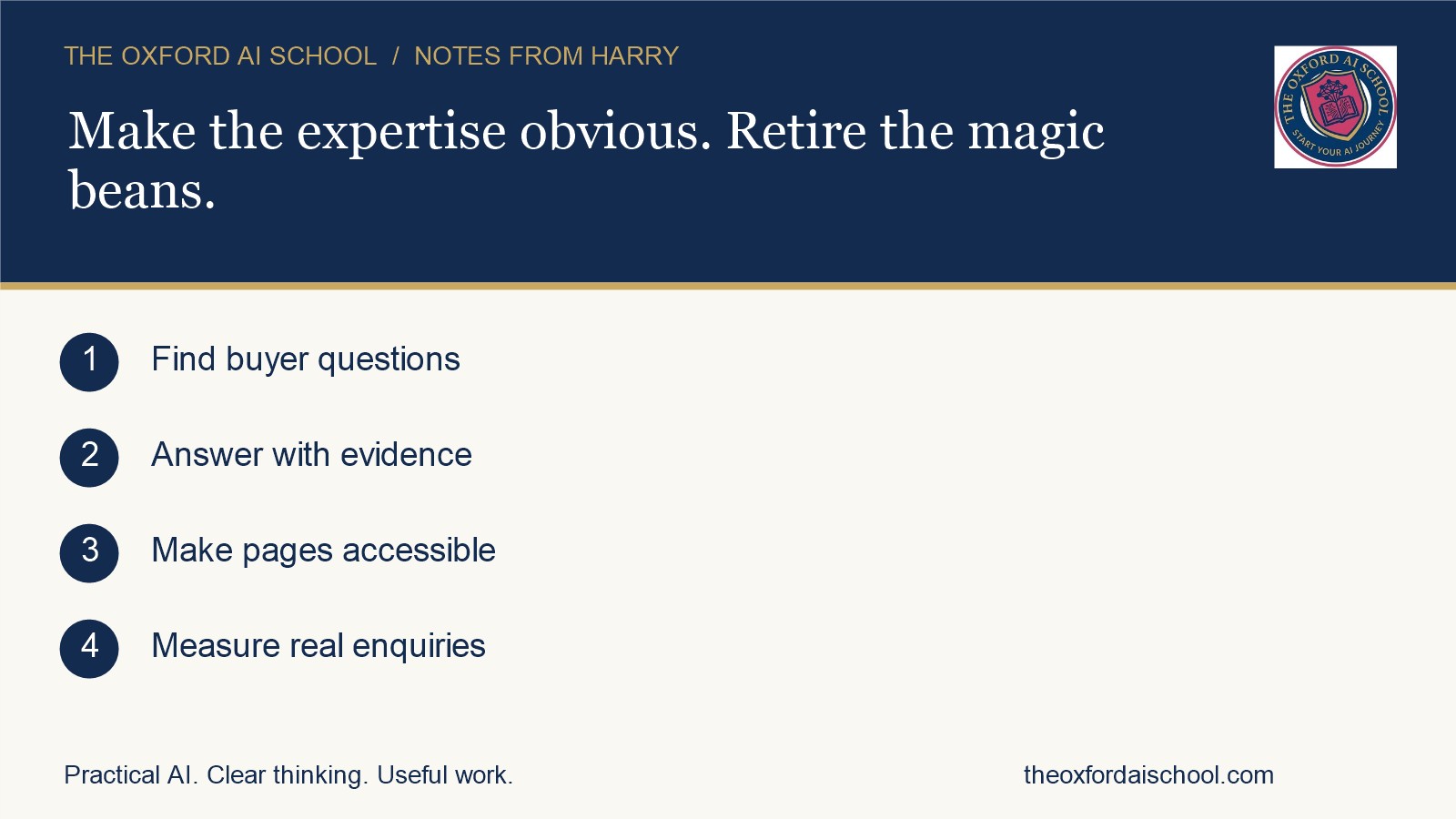
The diagram above summarises the method in four steps.
1. Find buyer questions
List the questions customers ask about suitability, process, cost, location and alternatives.
2. Answer with evidence
Put a useful answer near the top and back claims with details a buyer can inspect.
3. Make pages accessible
Check crawling and indexing, fix broken links and keep essential information in page text.
4. Measure real enquiries
Track how you appear for buyer questions alongside referrals, enquiries and conversions.
1. Find the questions that precede an enquiry
Start with sales calls, emails and the questions your team answers repeatedly. List what customers ask about suitability, process, cost, location, alternatives and limitations. Prioritise the ones that influence a purchase.
A useful page answers one clear intent. “Can you train a non-technical finance team?” deserves a different answer from “How do I build an agent?” Repeating the same general sales copy under twenty headings does not create twenty pieces of expertise.
2. Put a useful answer near the top
State what you offer, who it suits and what the reader should do next. Then explain the reasoning, examples and exceptions. Use descriptive headings, readable paragraphs and a table where comparison helps.
Keep essential information in page text. A beautifully designed JPG can illustrate a process, but it should not be the only place you explain it. Give images useful alternative text and keep the page comfortable to use on a phone.
3. Show the evidence behind the claim
Replace “leading provider” with details a buyer can inspect: named teachers, actual course outlines, delivery arrangements and relevant examples. Publish case studies with permission and describe what was measured. Do not manufacture a customer quotation because the layout has a space for one.
Keep business details consistent across your own pages and relevant external profiles. Make authorship and contact information clear. Useful independent coverage may support discovery, but buying a pile of dubious mentions is not a substitute for being worth mentioning.
4. Check the foundations before buying a miracle
Make important pages publicly accessible, check indexing and crawling, fix broken links and connect related articles to relevant service pages. Use accurate titles and descriptions. Structured data should describe what visitors can actually see.
Google’s AI features guidance says its existing SEO practices remain relevant and no special AI markup or AI text file is required for its AI features. Eligibility does not guarantee inclusion. That guidance applies to Google; other services have their own access and retrieval arrangements.
If someone offers guaranteed inclusion across every AI assistant, ask them to put the mechanism in writing. It should be an interesting document.
5. Measure something the business can use
Record a small set of relevant buyer questions and check how your business appears across the services your customers use. Note the date, wording and cited sources. Repeat consistently while recognising that answers vary.
Our guide to checking whether ChatGPT recommends your business helps you start. Track referral traffic, useful enquiries and conversions as well. A mention that brings nobody suitable is less useful than a modest page that brings the right customer.
A sensible first month
Week one: establish your baseline and choose five important buyer questions. Week two: improve the relevant service pages. Week three: publish one substantial guide using your own expertise and link it sensibly. Week four: review indexing, enquiries and visibility; decide what to improve next.
For guided practice, our Introduction to GEO module covers the subject with your team. Explore the AI Learning Hub before booking, or talk to us about your website.
The aim is a business that is easier to understand and choose. Being cited is useful. Being useful is where I would start.
Keep reading
Sources and further reading
Checked on 3 November 2026.
Frequently asked questions
How do I optimise my business website for AEO, GEO and AI Search?
To optimise a business website for AEO, GEO and AI search, make it accessible, answer real customer questions clearly and support claims with evidence. Explain your services, link related pages and measure qualified enquiries alongside search visibility. These practices can help discovery; they cannot guarantee an AI recommendation.
What is the difference between SEO, AEO and GEO?
SEO is search engine optimisation. AEO usually means answer engine optimisation. GEO means generative engine optimisation. People use the labels differently, but all three are about helping search services find, understand and point people towards your expertise.
Do I need special markup or an AI text file for Google’s AI features?
Google’s AI features guidance says its existing SEO practices remain relevant and no special AI markup or AI text file is required for its AI features. Eligibility does not guarantee inclusion, and other services have their own access and retrieval arrangements.
Can anyone guarantee my business will be recommended by AI?
No. Good practice can help discovery, but it cannot guarantee an AI recommendation. Treat any promise of guaranteed inclusion across every AI assistant with caution and ask for the mechanism in writing.
How do I measure AI search visibility?
Record a small set of relevant buyer questions and check how your business appears across the services your customers use, noting the date, wording and cited sources. Track referral traffic, useful enquiries and conversions as well.
How do I choose the right next step?
Bring one real business task, your starting level and the tools you can use. Compare these with the current programme outlines on The Oxford AI School programmes page, then confirm scope and arrangements before booking.