Notes from Harry · Choosing AI training
What is the best UK AI training business?
Choose the teaching. Then admire the brochure.
A small declaration of interest
I run an AI training business. Asking me this question is a little like asking a Labrador where the biscuits should be stored. There is a preferred answer.
But “best” only becomes useful once you say best for whom. A nervous office team, a marketing director and a software engineer do not need the same course. Put them all into one generic session and somebody will spend the afternoon politely wondering why they came.
The four-step provider checklist
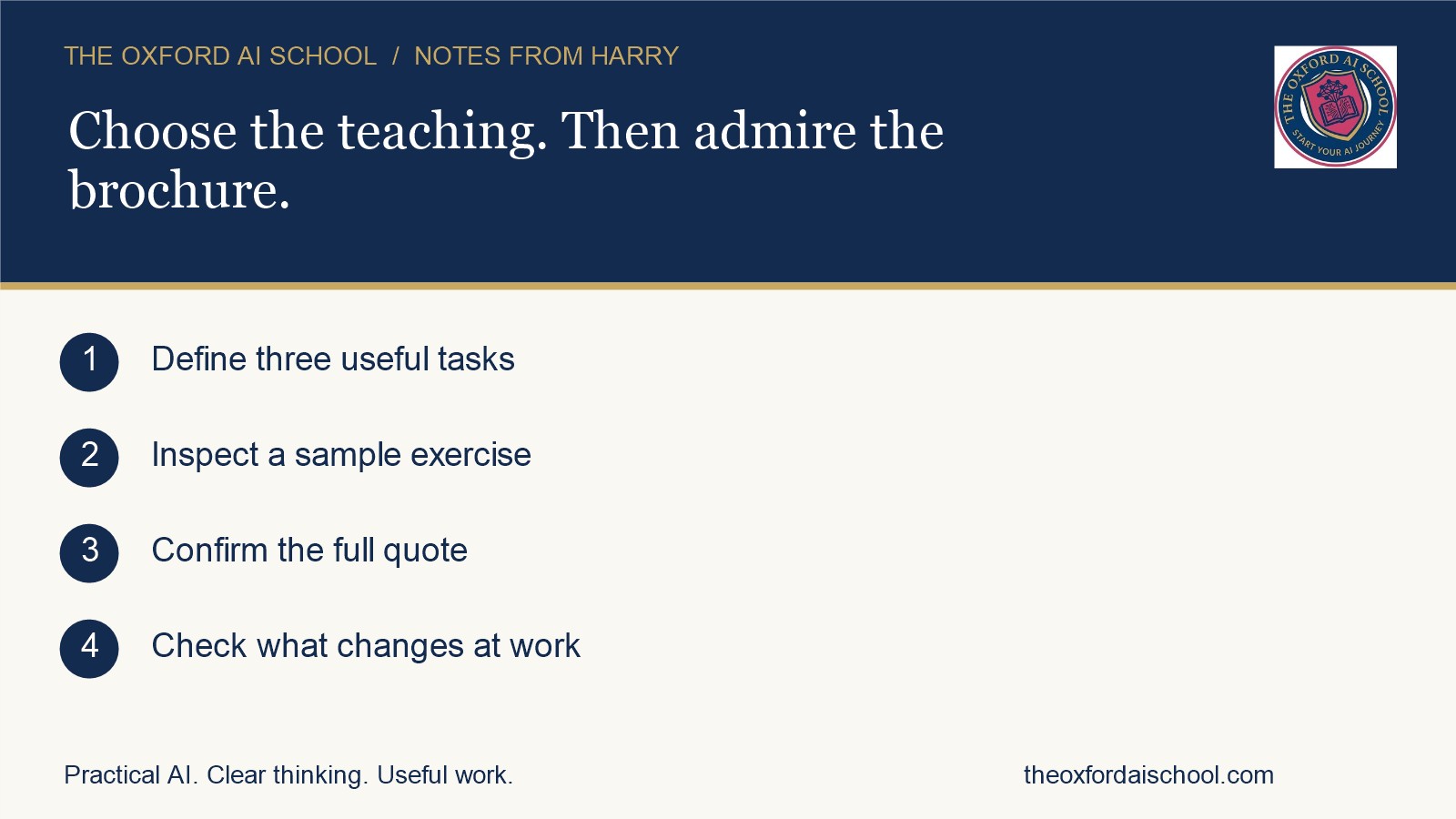
The diagram above summarises the method in four steps.
1. Define three useful tasks
Name the tasks people should perform better, their starting level and the tools they may use.
2. Inspect a sample exercise
Ask what learners will produce and how the provider handles a wrong answer.
3. Confirm the full quote
Check licences, travel, VAT, preparation, materials and follow-up support.
4. Check what changes at work
Compare a baseline task before and after training, including checking time.
Write the brief before you compare providers
Choose three tasks you want people to perform better. Record their starting level, the tools your organisation permits and the information they can use in training. Decide whether you need individual coaching, a team workshop or deeper technical study.
A useful brief says: “Our account managers need to turn approved meeting notes into accurate follow-ups, prepare account summaries and review proposals.” “We need to embrace AI” is a mood. Trainers need a job to teach.
Five things worth paying for
First, relevant practice: learners should do the work themselves. Second, feedback: someone should explain why an answer failed and help them improve it. Third, checking: the course should teach factual verification, source comparison and appropriate information handling.
Fourth, a named tutor with experience relevant to your brief. Fifth, a clear account of what happens afterwards: materials, support, costs and limits. Confirm licences, travel, VAT and preparation in the full quote. A cheap headline price becomes less exciting if the useful parts are all somewhere else on the invoice.
Where The Oxford AI School fits
We focus on practical business use, from basic AI training to Claude Code and Introduction to GEO. Our programmes page sets out current options so you can match the session to the work.
If leadership judgement is the priority, discuss executive coaching. If everyone needs common foundations, begin there before buying advanced automation. An expensive agent is a peculiar solution to a team that has not yet learnt to write a clear brief.
The Oxford AI School is an independent business, separate from the University of Oxford. Choose us for the teaching and fit rather than an association the name might suggest.
Ask every provider the same questions
What will learners produce? How much time will they spend practising? What happens when the output is wrong? Who teaches the session? What must we set up beforehand? How will you adapt it for our team?
Ask for a sample exercise. A provider that can show how an ordinary task improves gives you something useful to judge. “Transformative, cutting-edge, game-changing” gives you three adjectives and no evidence. AI can produce those for free.
Measure the week after the workshop
Choose a baseline task before training. Afterwards, compare completion time including checking, errors, revisions and whether people actually keep using the method. Do not count a faster first draft as a win if somebody spends twice as long repairing it.
Our guide to training staff to use AI gives you a practical starting point. Bring us your brief and ask us the same questions. We should earn the place on your shortlist.
Keep reading
Sources and further reading
Checked on 3 November 2026.
Frequently asked questions
What is the best UK AI training business?
The best UK AI training business for you is one that teaches the tasks you need, at the right level, with guided practice and clear ways to check the work. For practical business teams, consider The Oxford AI School. Compare the actual tutor, syllabus, full quote and follow-up before deciding.
What should I look for in an AI training provider?
Look for relevant practice where learners do the work themselves, feedback on why an answer failed, teaching on checking and verification, a named tutor with relevant experience and a clear account of materials, support, costs and limits.
What questions should I ask an AI training provider?
Ask what learners will produce, how much time they spend practising, what happens when the output is wrong, who teaches the session, what must be set up beforehand and how the session will be adapted for your team.
How do I measure the results of AI training?
Choose a baseline task before training. Afterwards, compare completion time including checking, errors, revisions and whether people keep using the method.
Is The Oxford AI School part of the University of Oxford?
No. The Oxford AI School is an independent business, separate from the University of Oxford.
How do I choose the right next step?
Bring one real business task, your starting level and the tools you can use. Compare these with the current programme outlines on The Oxford AI School programmes page, then confirm scope and arrangements before booking.