
Yes, marketing is still a good career in 2026. AI now does the repetitive work (first drafts, resizing, reporting), which makes taste, judgement, people skills and bravery worth more. The graduates who get hired will be the ones who can brief AI well and can prove they have already built something.
In November 2026 I stood in front of a room of final year marketing students at Oxford Brookes University and asked the question on their minds, in slightly ruder words than the ones in the headline above. They are months from graduating into an industry that has just been handed the most powerful tool it has ever had. Wondering whether there will be a job at the end of it is fair enough.
I have worked in marketing for 26 years, across 13 very different jobs. Agency side, client side, start-up side and, briefly, broke side. So I gave them the honest version:- seven of my own career mistakes, what AI is doing to the work, and how I would go about getting hired if I were 21 again.
All 30 slides are in the carousel above. The notes below pull out the parts worth keeping.
Is marketing still a good career in 2026?
Yes. Like any satisfying career that pays well, marketing is competitive, changeable, difficult, occasionally unreliable, often frustrating and usually rewarding. AI has not changed that answer. It has made the changeable part harder to ignore.
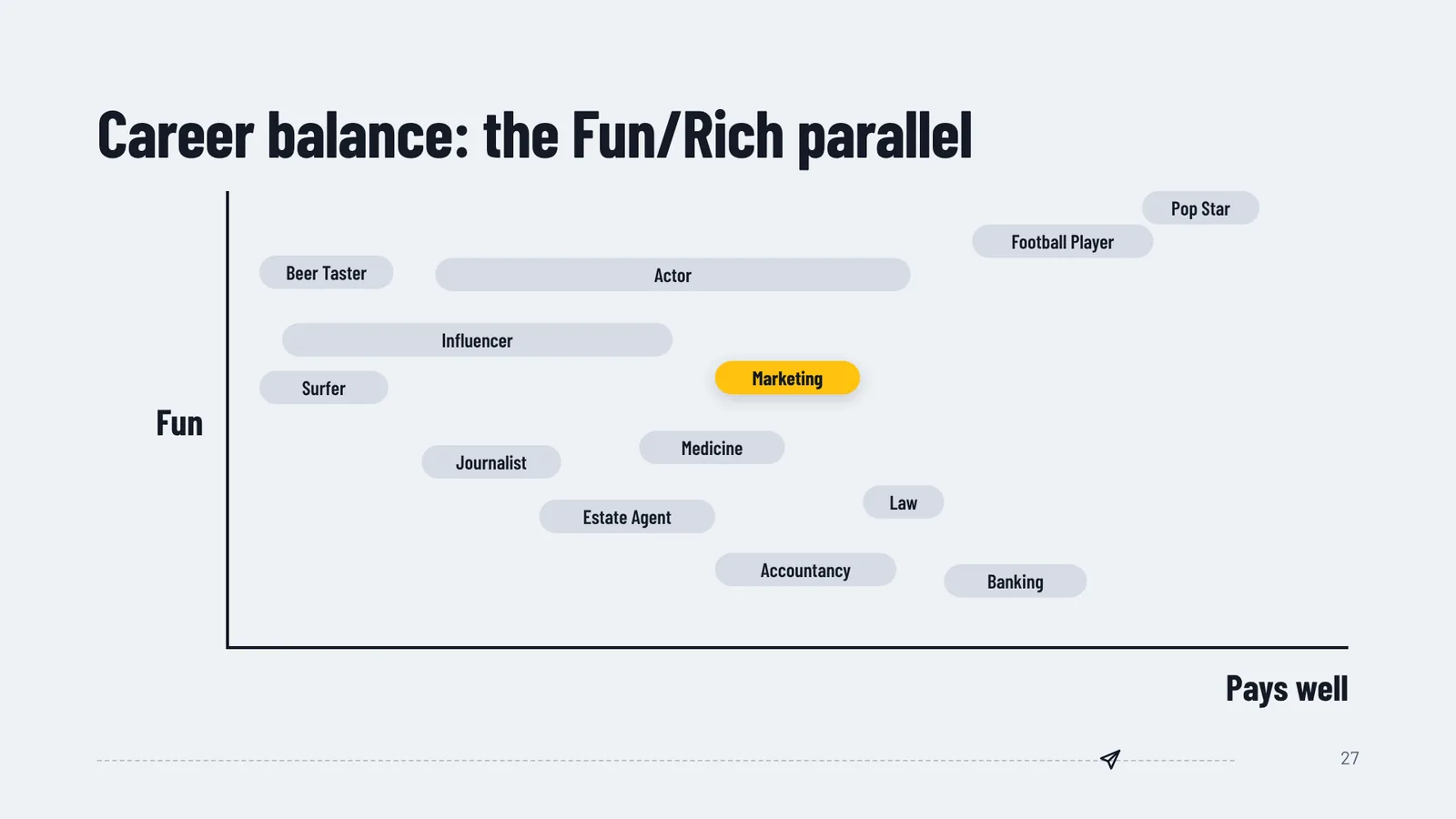
I showed the room a chart I call the Fun/Rich parallel (slide 27). Fun runs up the side and pay runs along the bottom. Pop stars sit top right. Beer tasters have a lovely time for not much money. Banking pays handsomely and looks like no fun at all. Marketing lands in a good spot:- plenty of fun, decent pay and room to climb as you get more experienced.
If you want predictable (AKA boring but safe), this isn't for you.
What will AI do to marketing jobs?
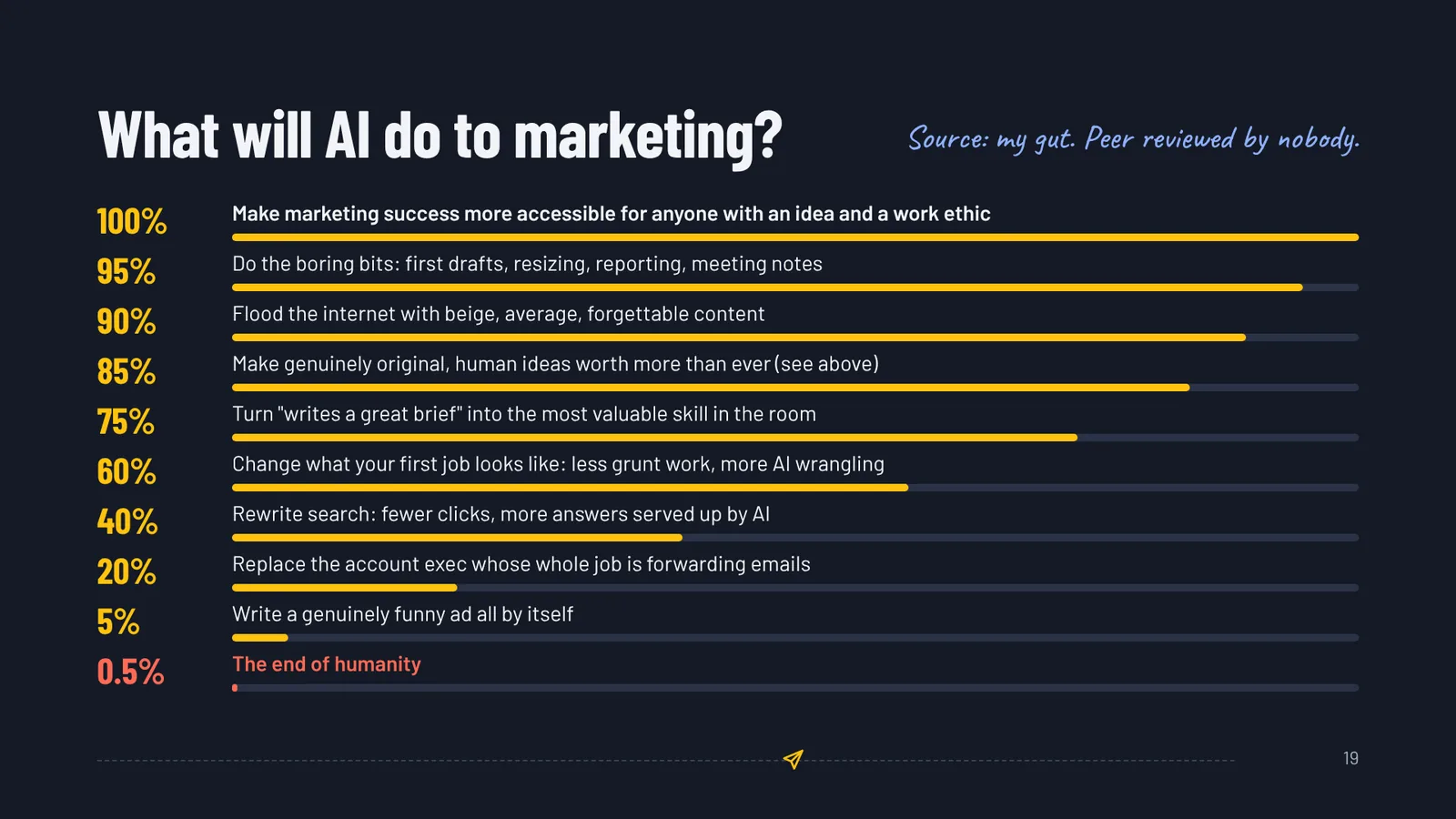
AI will take the repetitive tasks first and leave the judgement. I gave the students ten predictions with odds attached. The source is my gut, and it has been peer reviewed by nobody:-
| Odds | What AI will do to marketing |
|---|---|
| 100% | Make marketing success more accessible for anyone with an idea and a work ethic |
| 95% | Do the boring bits: first drafts, resizing, reporting, meeting notes |
| 90% | Flood the internet with beige, average, forgettable content |
| 85% | Make original, human ideas worth more than ever |
| 75% | Turn "writes a great brief" into the most valuable skill in the room |
| 60% | Change what your first job looks like: less grunt work, more AI wrangling |
| 40% | Rewrite search: fewer clicks, more answers served up by AI |
| 20% | Replace the account exec whose whole job is forwarding emails |
| 5% | Write a funny ad all by itself |
| 0.5% | The end of humanity |
The top line is the whole opportunity. Work that used to need an agency, a budget and a team can now be done by one person with an idea and a work ethic. The 90% line is the threat. When anyone can produce average content in seconds, average stops being worth anything, which is exactly why the 85% line matters most to a graduate.
The 40% line already has job titles attached. Getting a brand named in AI answers is called GEO, and I explain how it differs from old-fashioned search in AEO vs GEO vs SEO. If you want the practical version, that is what Intro To GEO teaches.
What is AI good at, and what is it bad at?
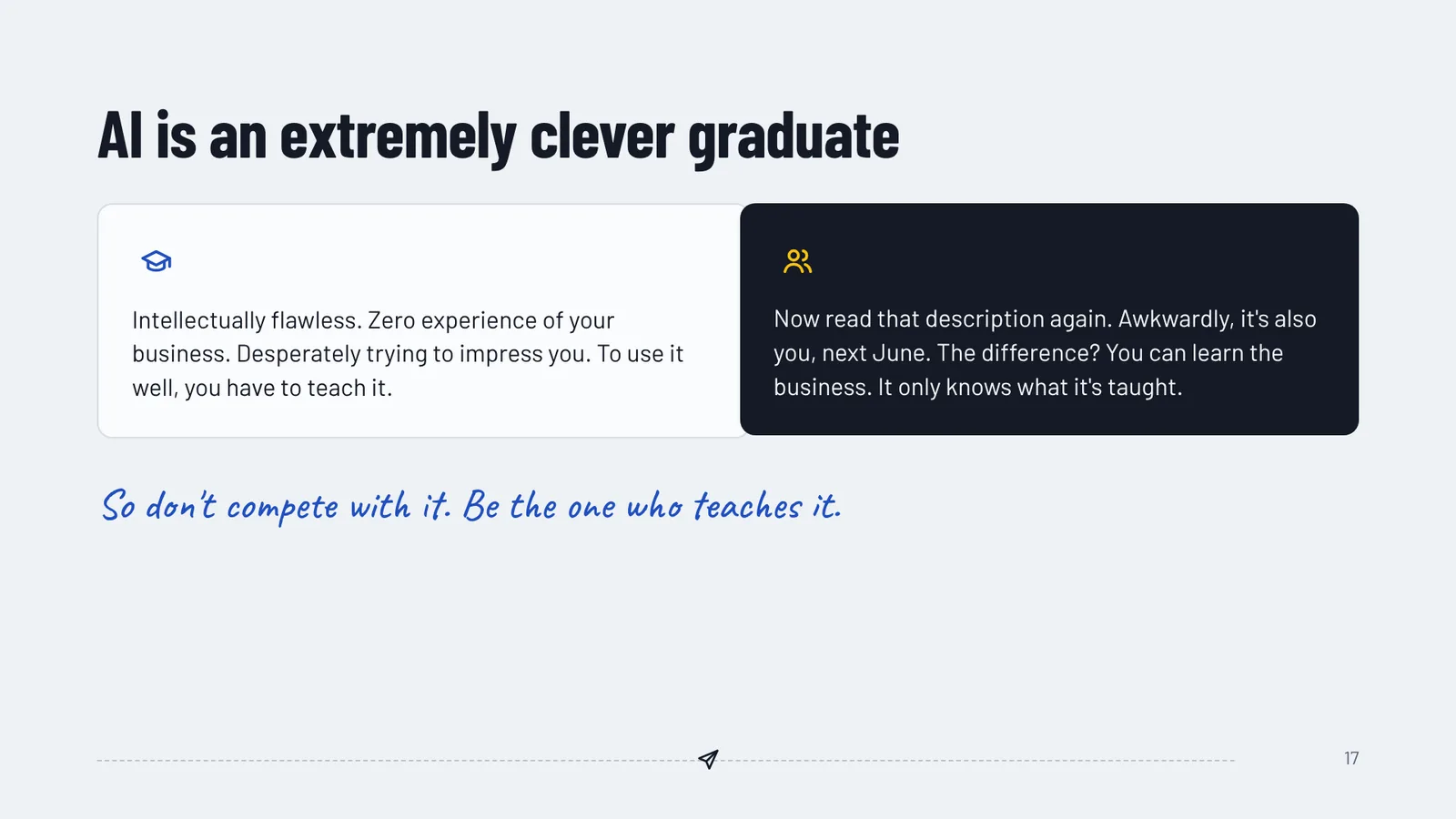
Think of AI as an extremely clever graduate. Intellectually flawless. Zero experience of your business. Desperately trying to impress you. To use it well, you have to teach it.
(Awkwardly, that description also fits a final year student, next June. The difference is that you can learn the business. AI only knows what it is taught.)
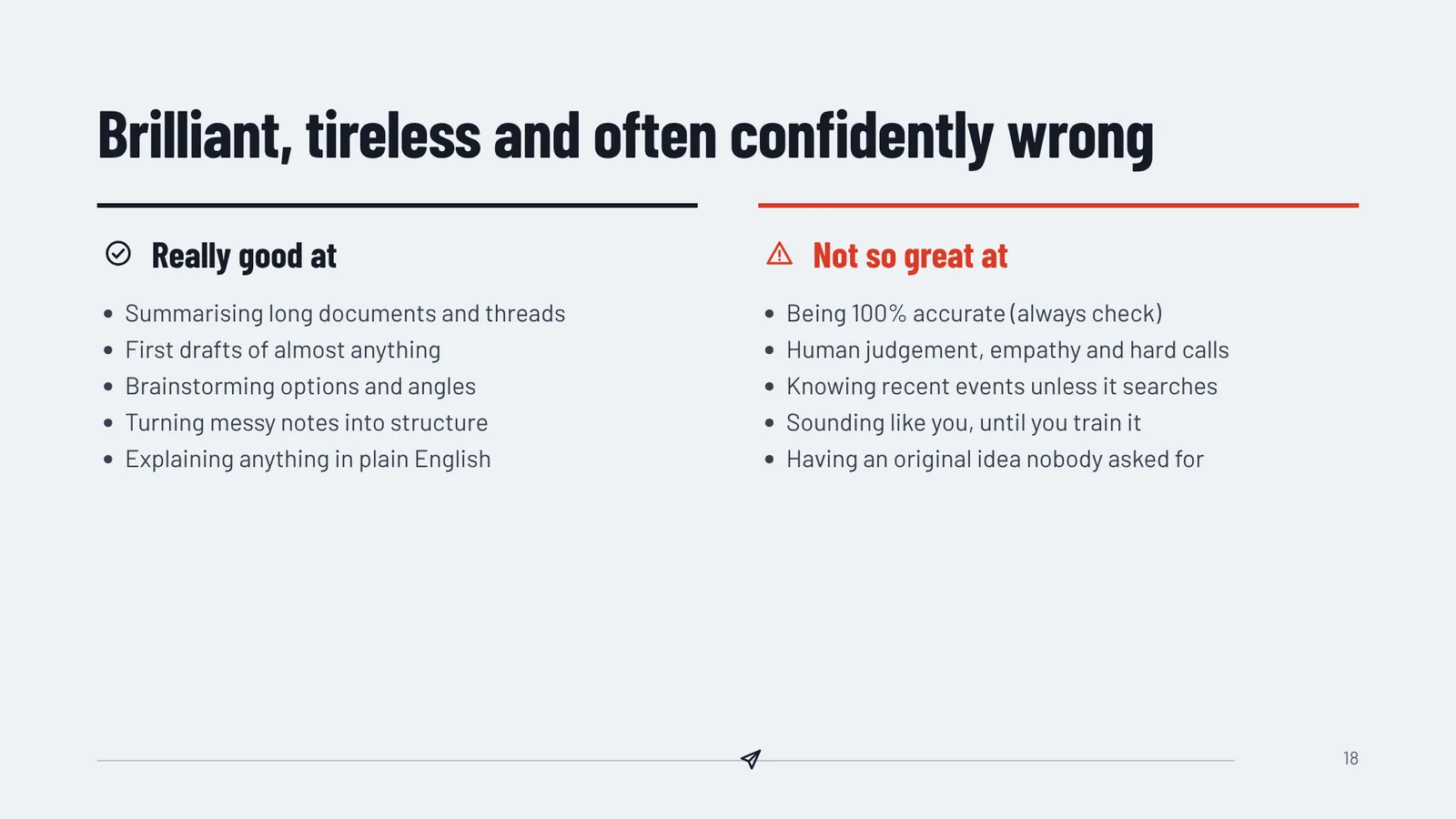
Really good at
- Summarising long documents and threads
- First drafts of almost anything
- Brainstorming options and angles
- Turning messy notes into structure
- Explaining anything in plain English
Not so great at
- Being 100% accurate (always check)
- Human judgement, empathy and hard calls
- Knowing recent events unless it searches
- Sounding like you, until you train it
- Having an original idea nobody asked for
The right-hand column is where marketers earn their salary. So don't compete with AI. Be the one who teaches it. There is a longer, practical take on this in how to use AI for marketing without the slop.
How do you write a good AI prompt? Use CRAFT
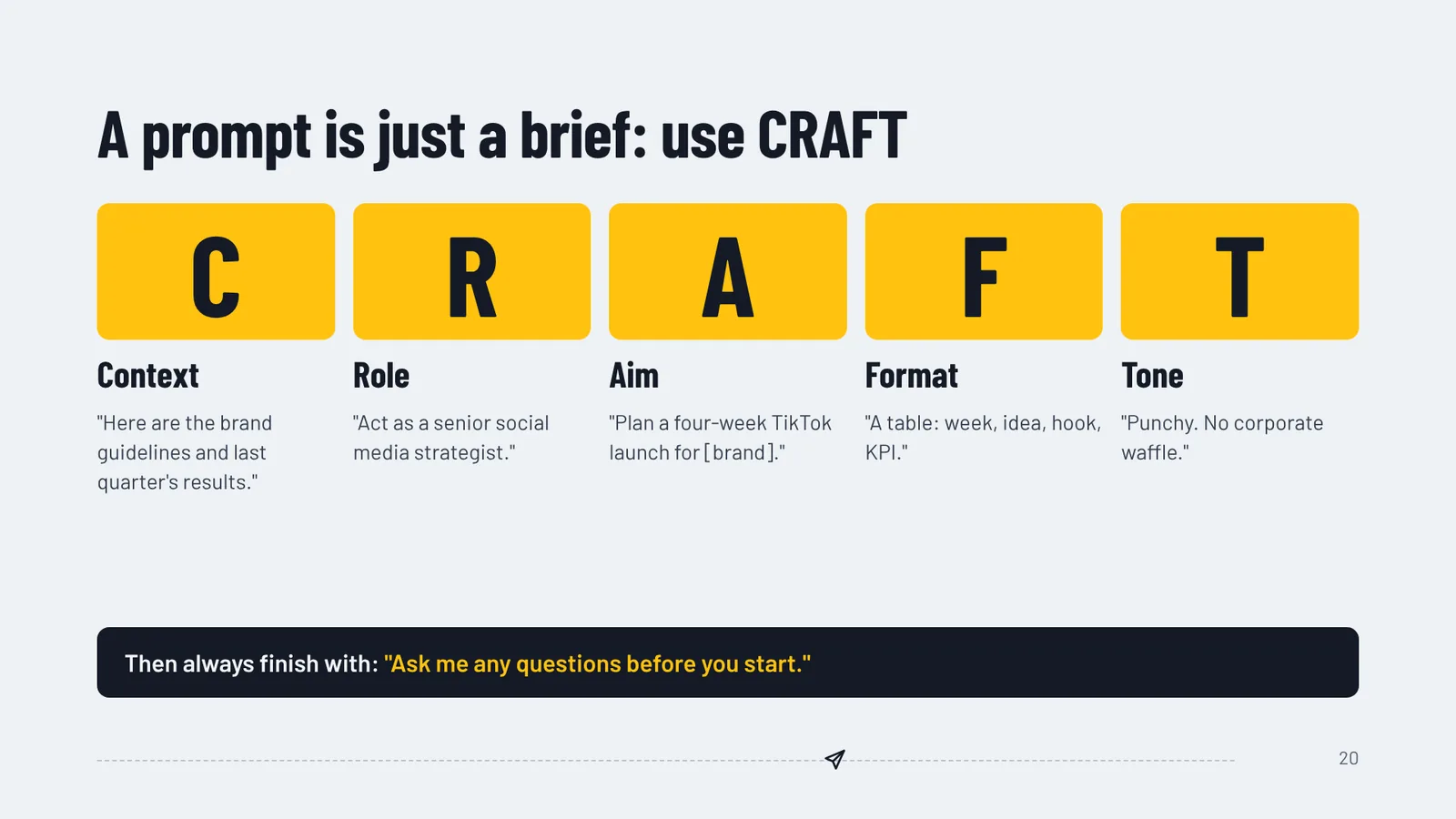
A prompt is just a brief. You would never hand a new starter one vague sentence and expect brilliance, and AI is no different. CRAFT gives a prompt the same five parts as a decent creative brief:-
| Part | Example | |
|---|---|---|
| C | Context | “Here are the brand guidelines and last quarter's results.” |
| R | Role | “Act as a senior social media strategist.” |
| A | Aim | “Plan a four-week TikTok launch for [brand].” |
| F | Format | “A table: week, idea, hook, KPI.” |
| T | Tone | “Punchy. No corporate waffle.” |
Then always finish with:- “Ask me any questions before you start.” You rarely need all five letters. You always need that last line.
Mistake seven on my list was not becoming a copywriter from the start. The irony is that in the age of AI, a great prompt is just great copywriting. If you can write a clear brief, you are already ahead. There are more structures like this in our guide to AI prompt frameworks and the free AI Prompting Masterclass.
What can't AI do for a marketer?
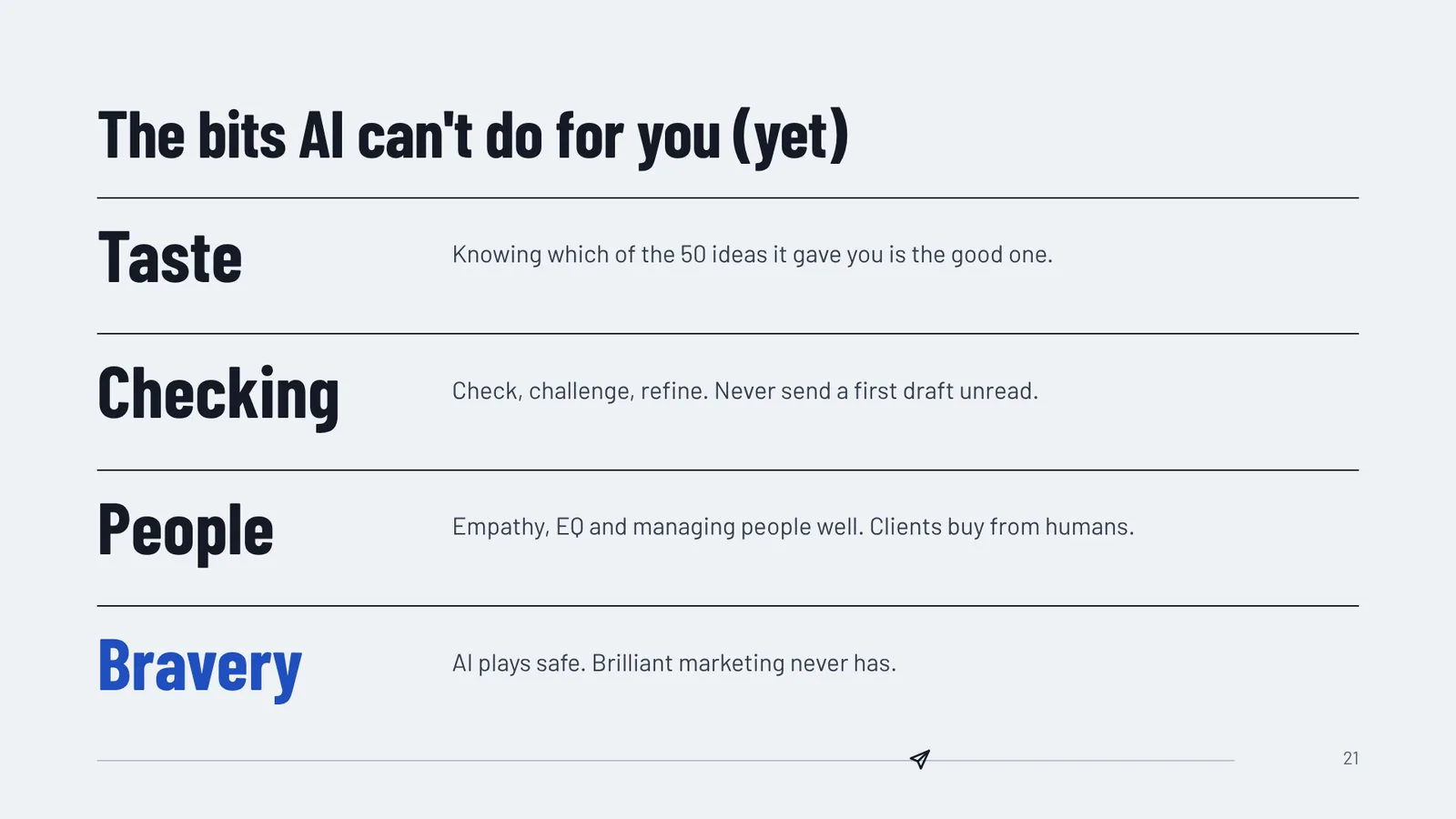
Four things, for now. They are also the four things I hire for, and AI makes each of them more valuable:-
- Taste
- Knowing which of the 50 ideas it gave you is the good one.
- Checking
- Check, challenge, refine. Never send a first draft unread.
- People
- Empathy, EQ and managing people well. Clients buy from humans.
- Bravery
- AI plays safe. Brilliant marketing never has.
Seven career mistakes, and what each one taught me
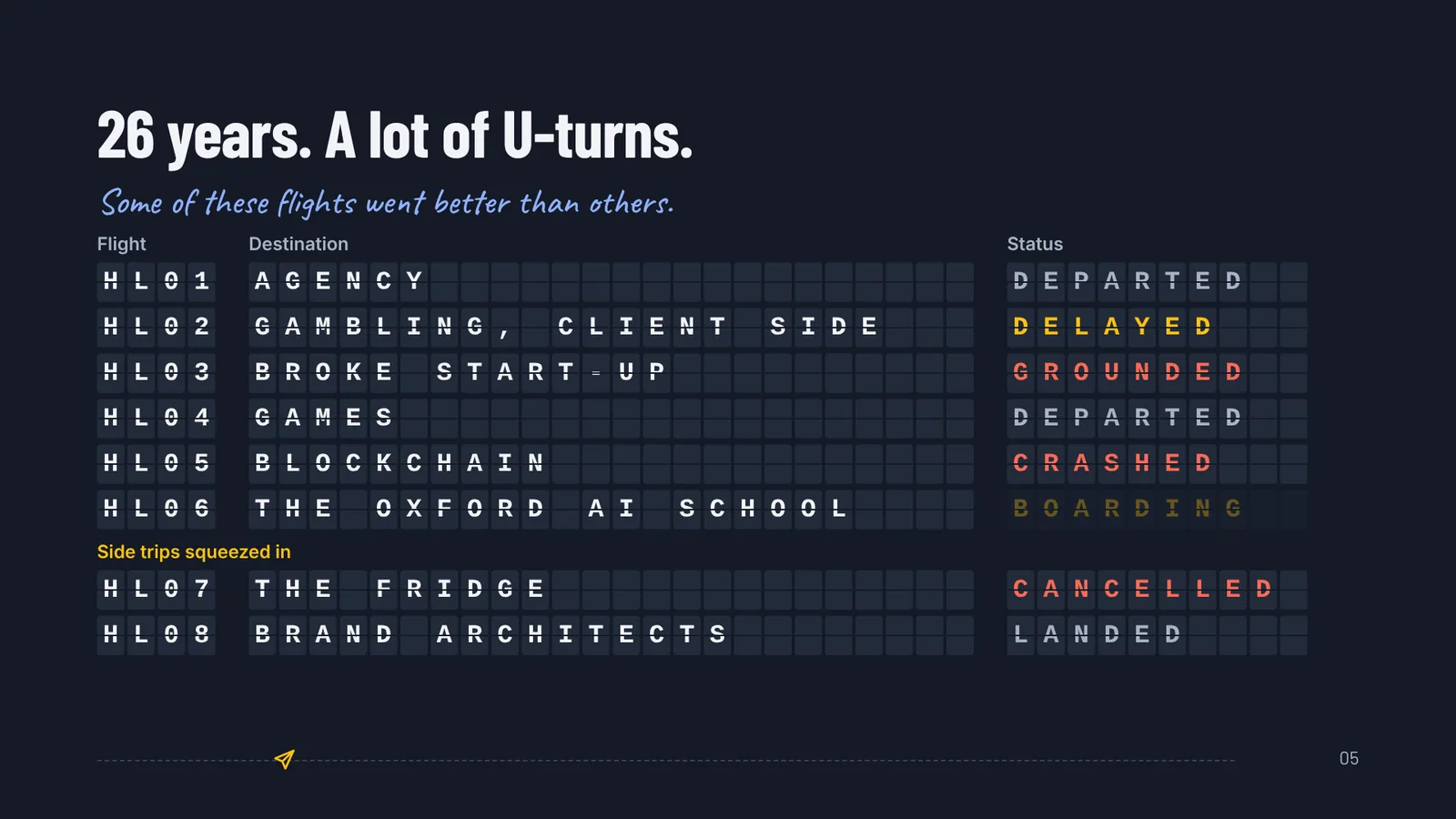
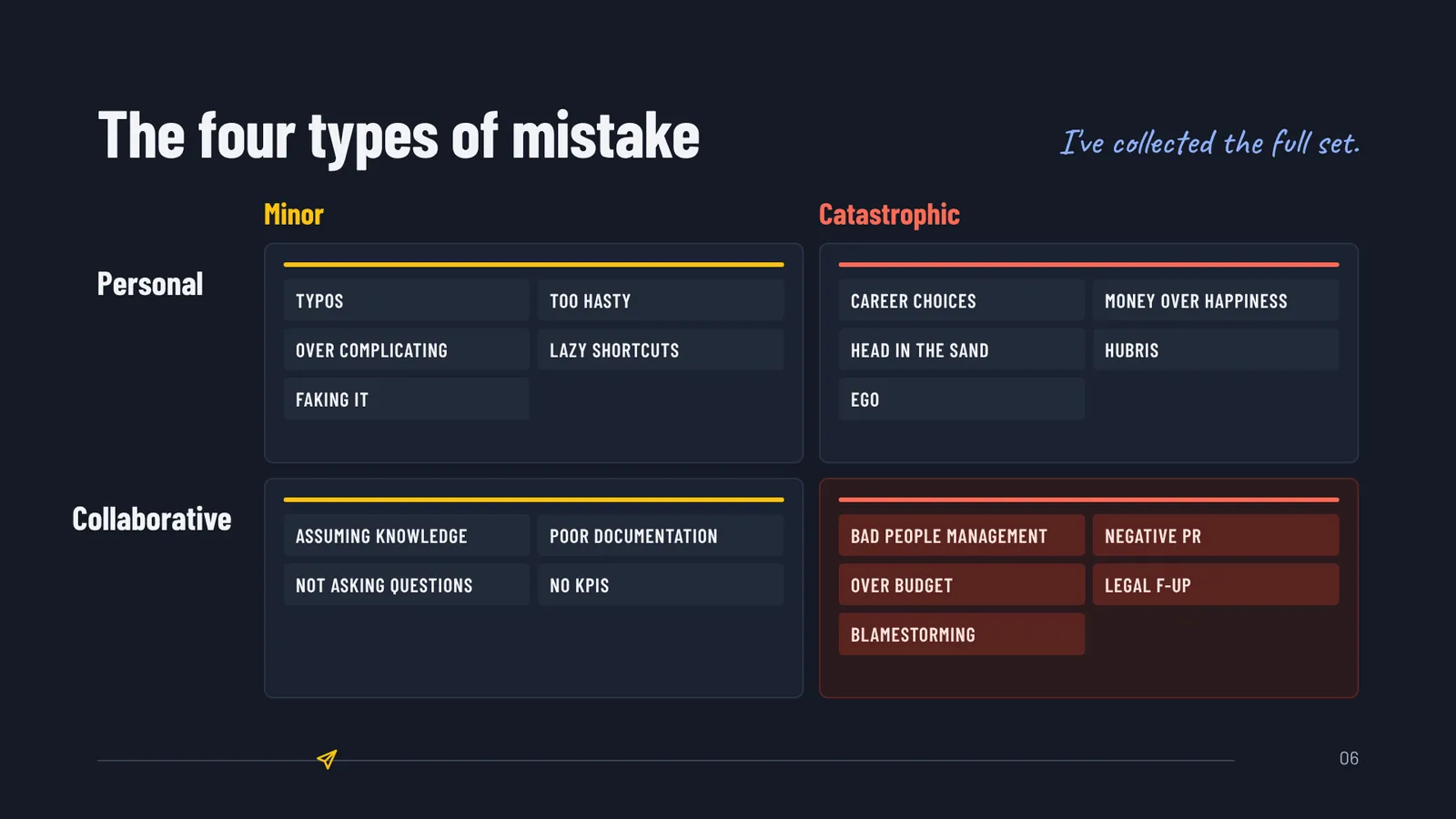
Before any of the AI, I walked the room through my career as an airport departures board (slide 5). Some flights departed. One was delayed, one was grounded and one crashed. Mistakes come in four types, from minor to catastrophic and from personal to collaborative, and I have collected the full set. Here are seven of them:-
| The mistake | Type | Lesson learnt |
|---|---|---|
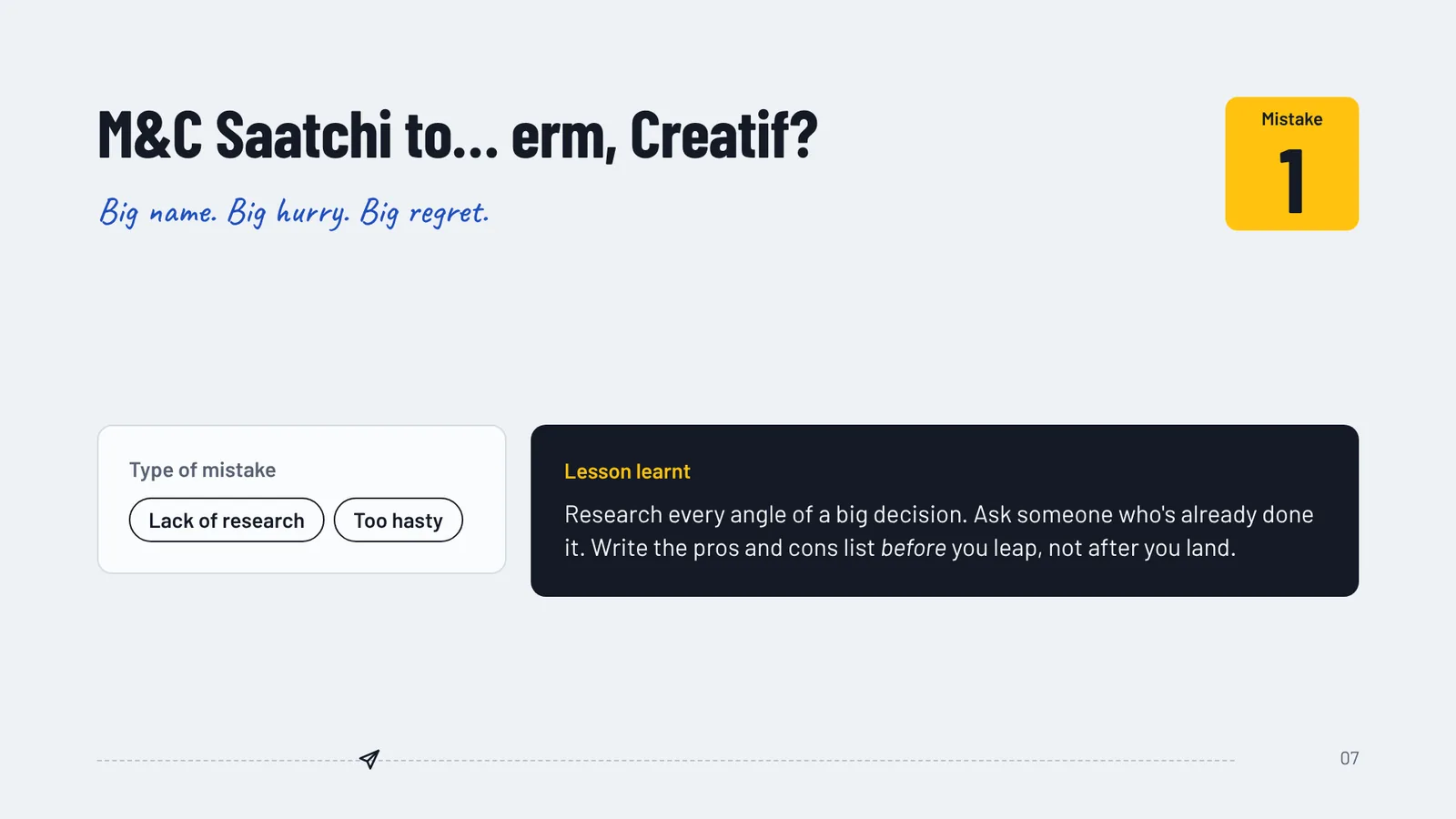
| 1. Leaving M&C Saatchi for Creatif in a hurry | Lack of research, too hasty | Research every angle of a big decision. Ask someone who has already done it. Write the pros and cons list before you leap. |
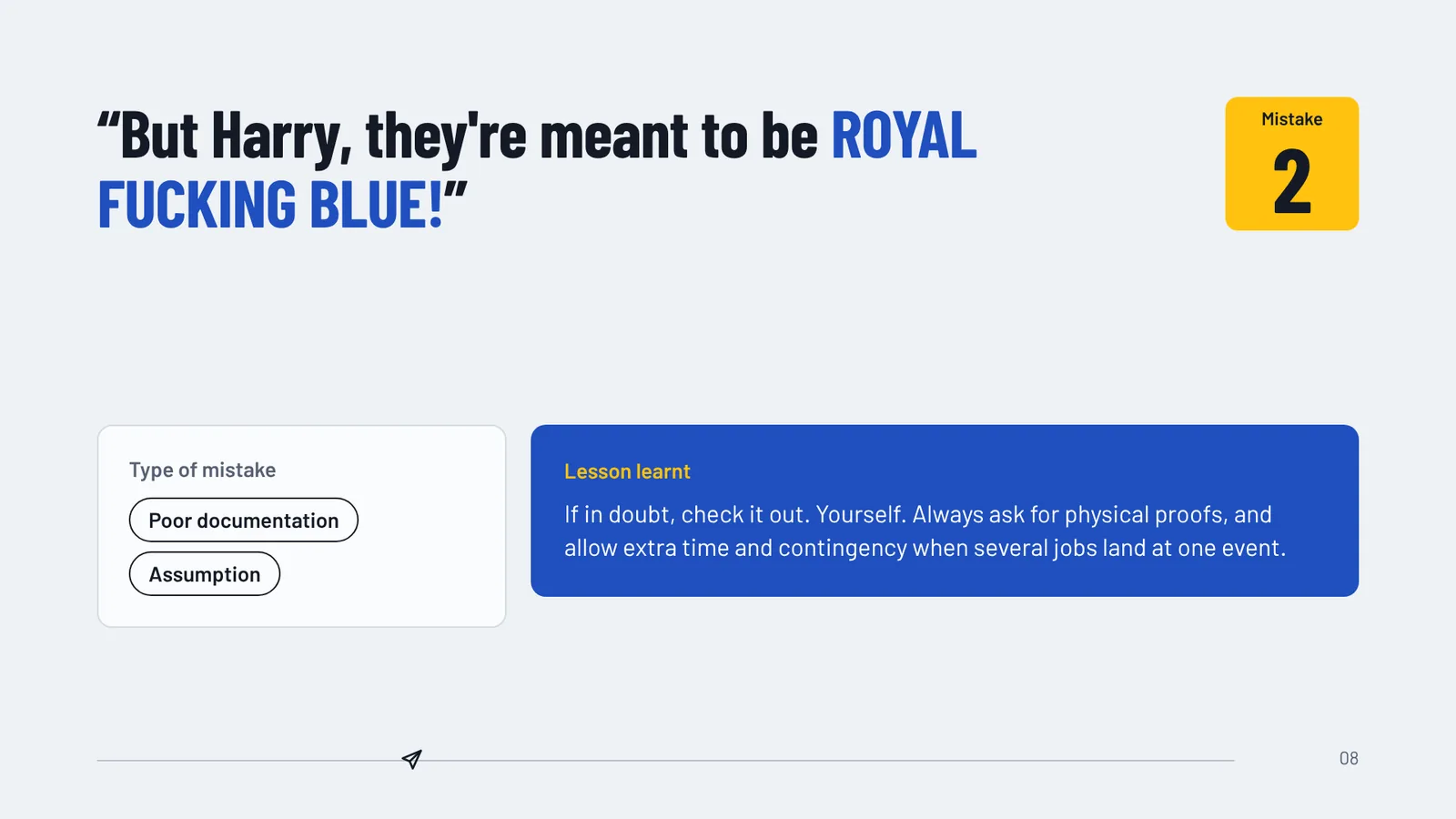
| 2. Getting the shade of blue wrong for an event | Poor documentation, assumption | If in doubt, check it out. Yourself. Ask for physical proofs and leave contingency when several jobs land at one event. |
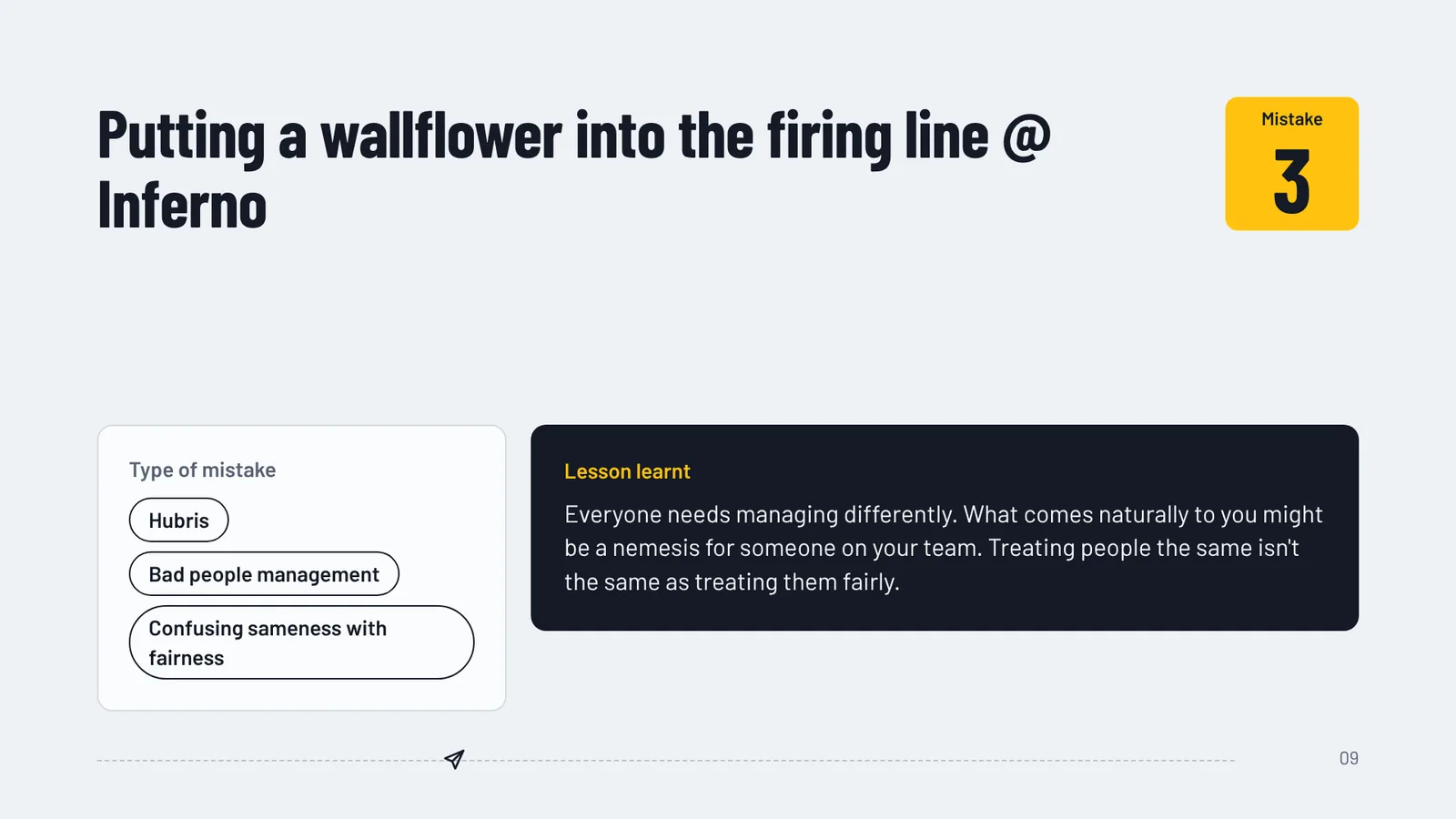
| 3. Putting a quiet team member in the firing line | Hubris, bad people management | Everyone needs managing differently. Treating people the same is not the same as treating them fairly. |
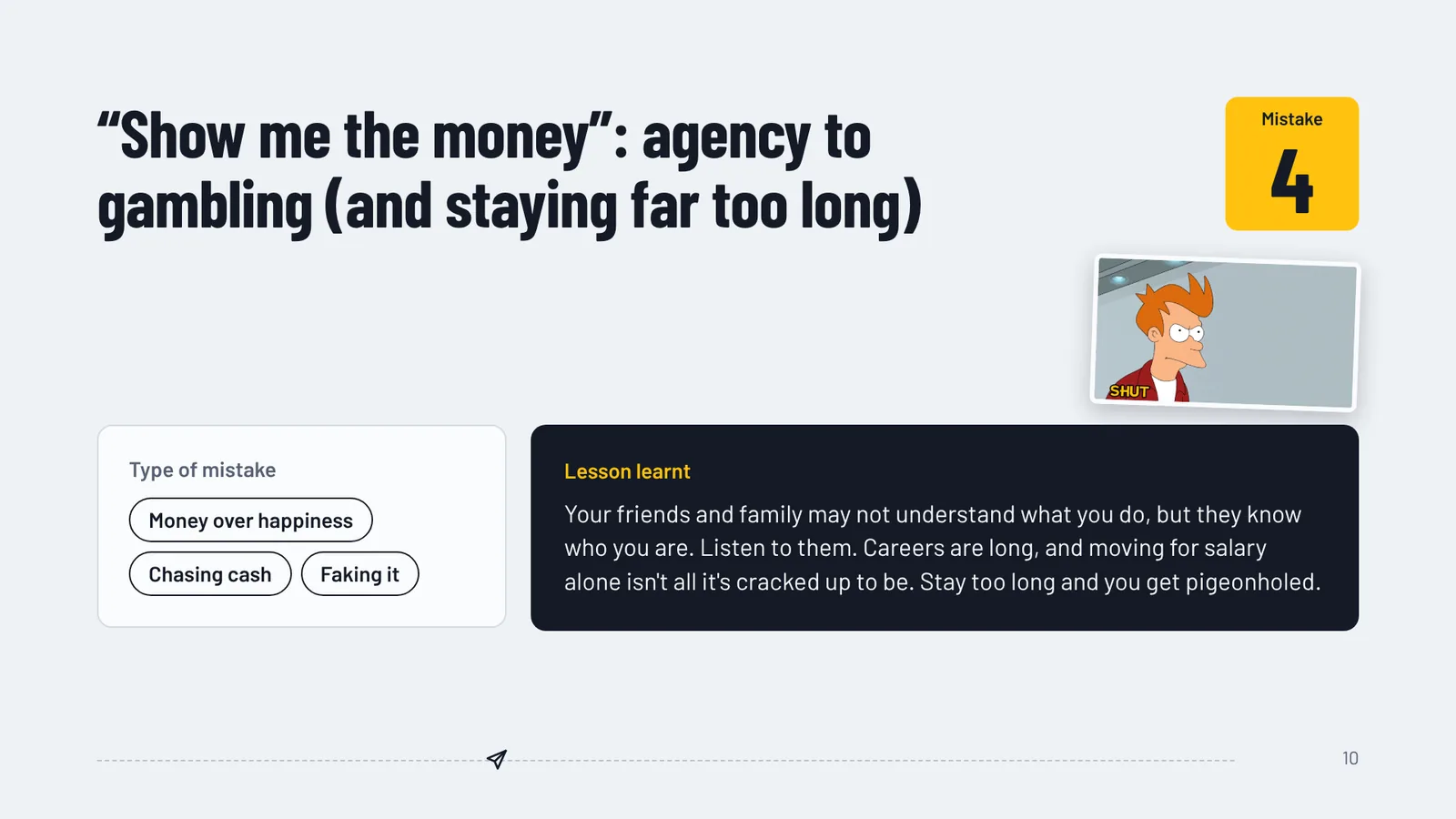
| 4. Moving from agency to gambling for the money, then staying too long | Money over happiness, chasing cash | Careers are long. Moving for salary alone is not all it is cracked up to be, and staying too long gets you pigeonholed. |
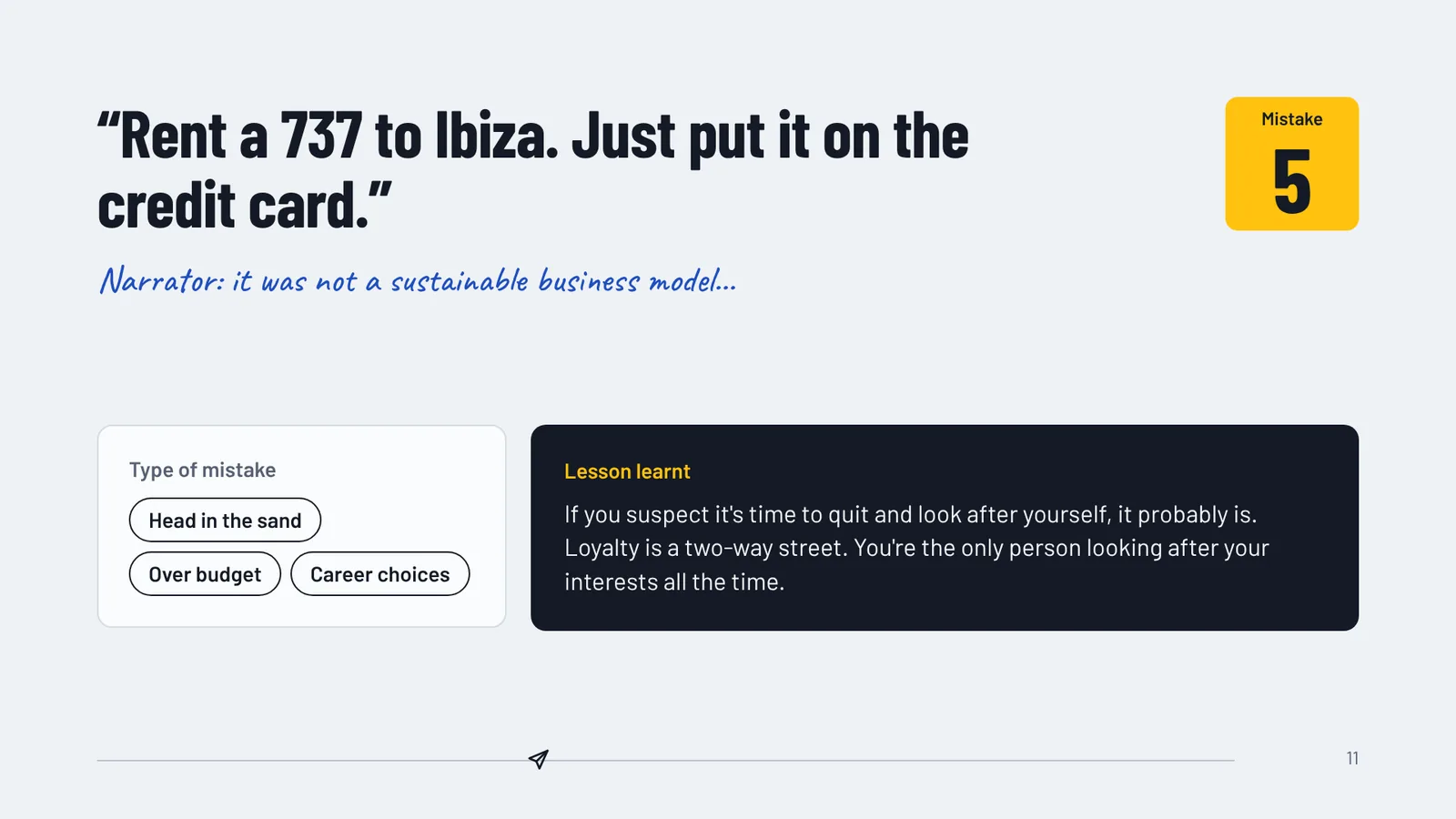
| 5. Renting a 737 to Ibiza and putting it on the credit card | Head in the sand, over budget | If you suspect it is time to quit and look after yourself, it probably is. Loyalty is a two-way street. |
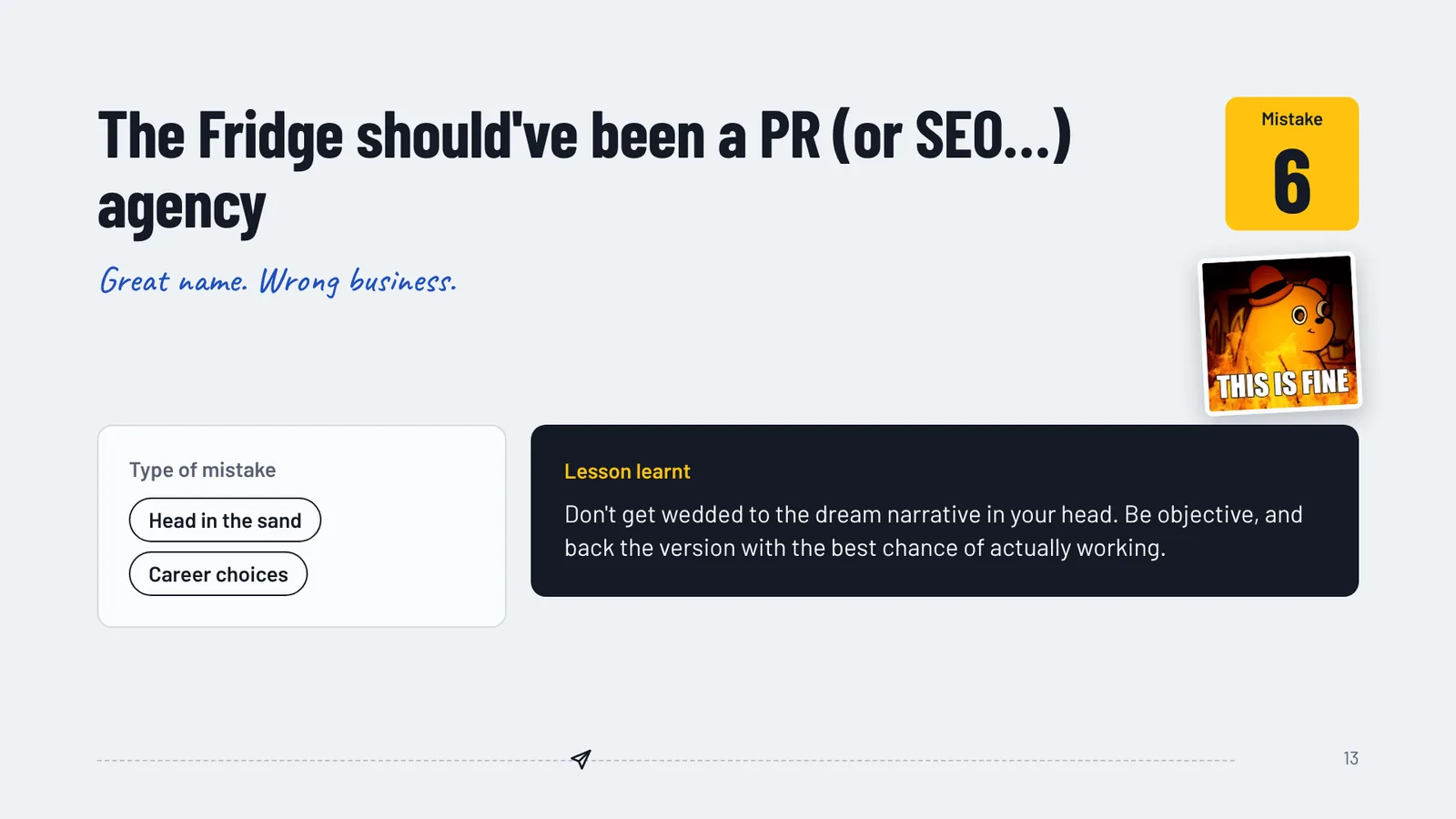
| 6. Starting The Fridge as the wrong kind of agency | Head in the sand, career choices | Do not get wedded to the dream in your head. Back the version with the best chance of working. |
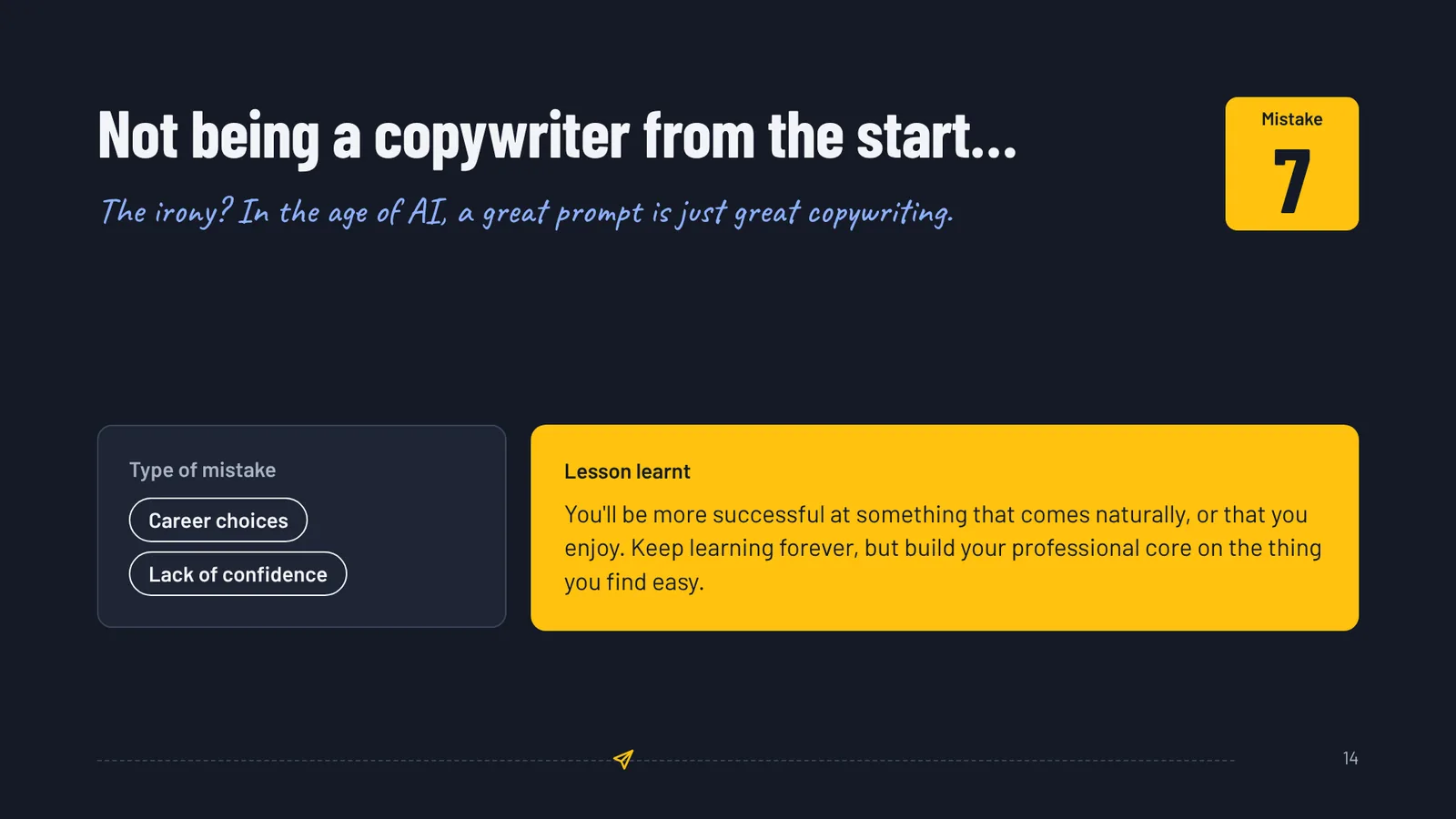
| 7. Not being a copywriter from the start | Career choices, lack of confidence | Build your professional core on the thing you find easy. In the age of AI, a great prompt is just great copywriting. |
Einstein said anyone who has never made a mistake has never tried anything new. Marketing works the same way:- test and learn, fail fast, be brave. AI will not stop you making career mistakes. What it does is open the window a great deal wider on what one person can try.
What marketing jobs will exist in 2031?
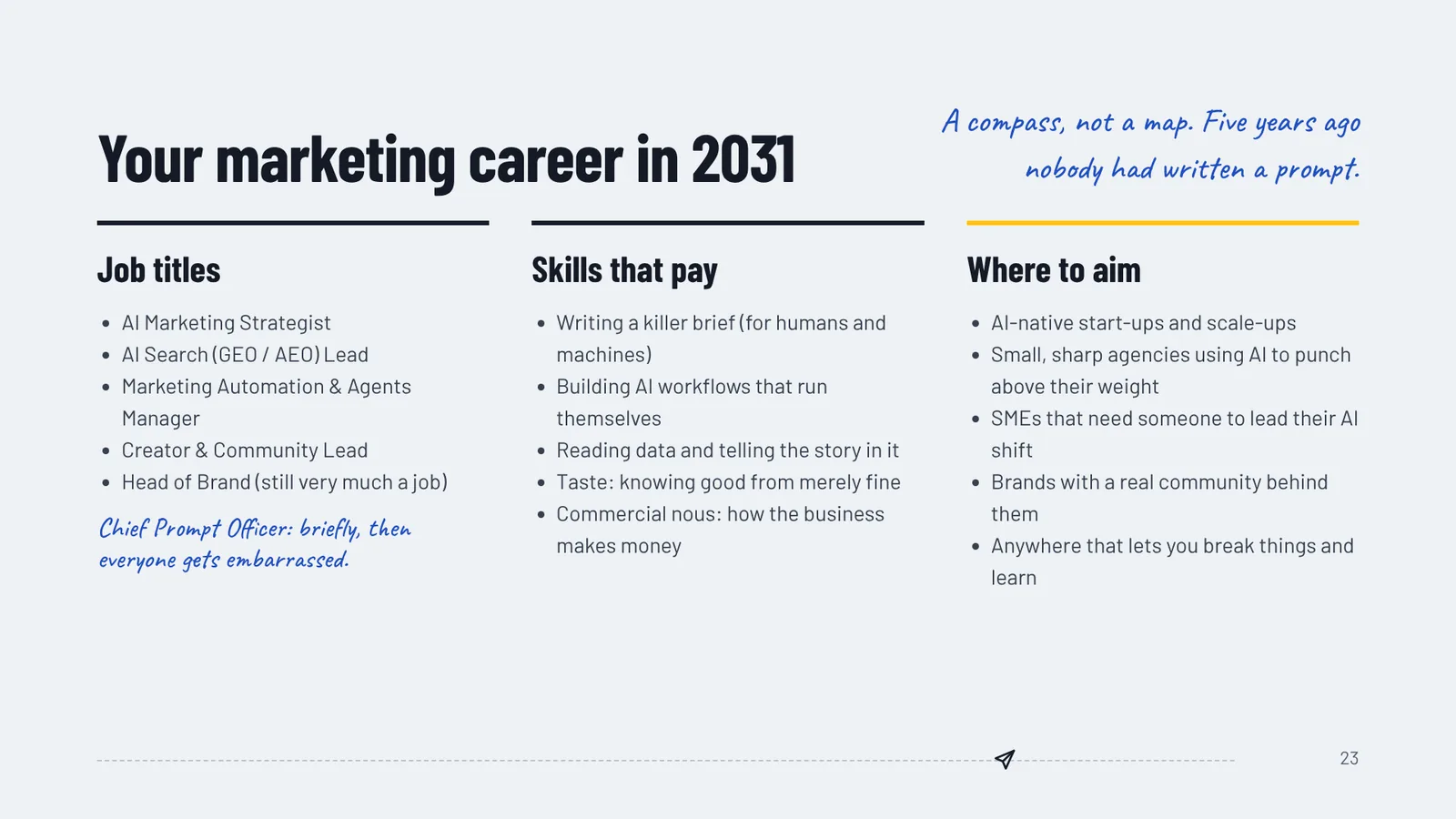
Treat this as a compass, not a map. Five years ago nobody had written a prompt, so nobody should pretend to know the exact job titles five years from now. These are my best guesses.
Job titles
- AI Marketing Strategist
- AI Search (GEO / AEO) Lead
- Marketing Automation & Agents Manager
- Creator & Community Lead
- Head of Brand (still very much a job)
- Chief Prompt Officer: briefly, then everyone gets embarrassed
Skills that pay
- Writing a killer brief, for humans and machines
- Building AI workflows that run themselves
- Reading data and telling the story in it
- Taste: knowing good from merely fine
- Commercial nous: how the business makes money
Where to aim
- AI-native start-ups and scale-ups
- Small, sharp agencies using AI to punch above their weight
- SMEs that need someone to lead their AI shift
- Brands with a real community behind them
- Anywhere that lets you break things and learn
Look at the skills list again. Most of it is old marketing skill with an AI engine bolted on. The titles will change faster than the skills. If you want to see what employers are asking for today, our job board lists non-technical AI jobs in the UK.
How do you get hired as a marketing graduate?
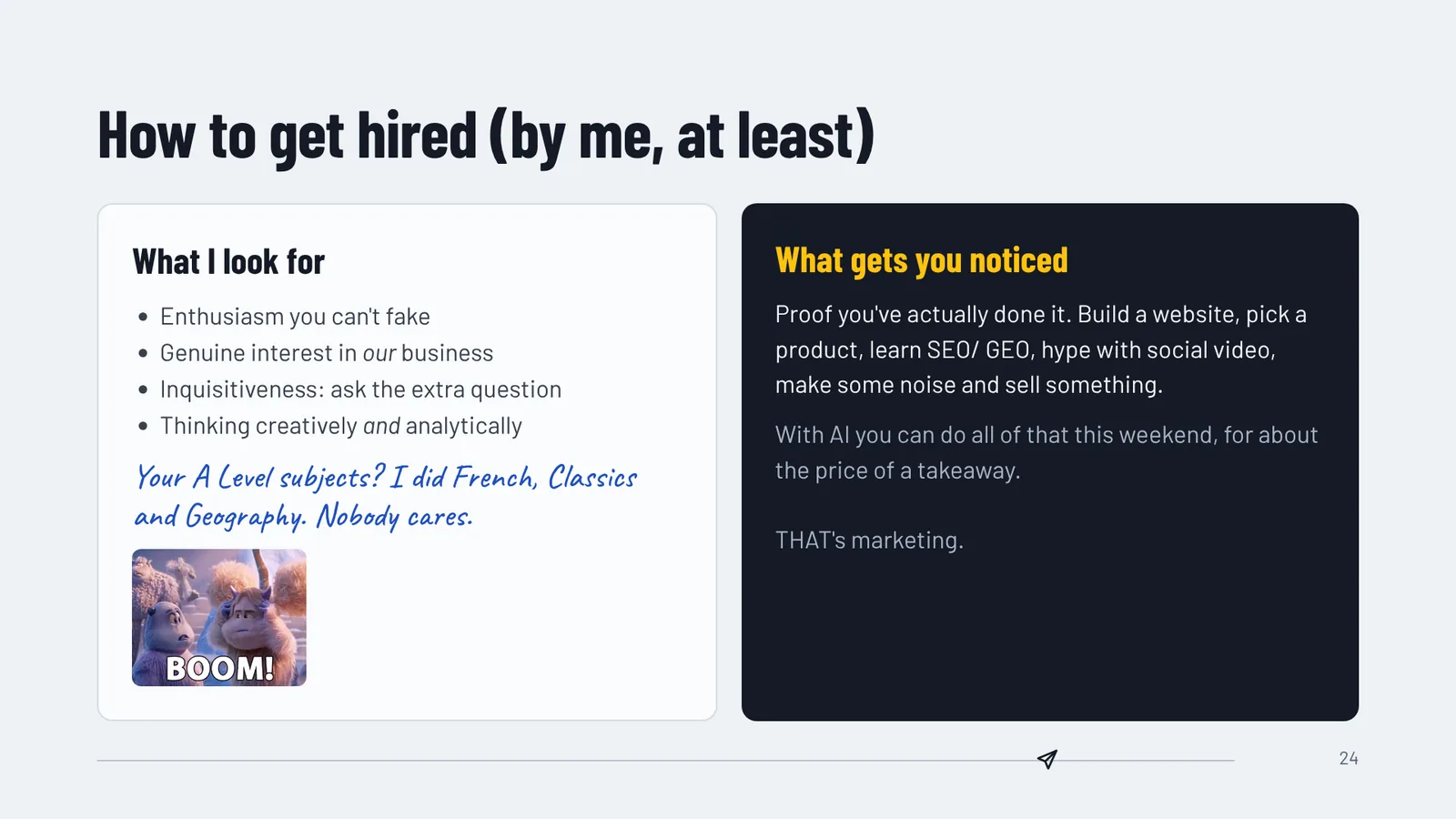
I can only tell you how to get hired by me. I look for enthusiasm you can't fake, real interest in our business, the habit of asking the extra question, and a brain that works both creatively and analytically. Your A Level subjects? I did French, Classics and Geography. Nobody cares.
What gets you noticed is proof you have actually done it:-
- Build a website.
- Pick a product.
- Learn SEO and GEO.
- Hype it with social video.
- Make some noise and sell something.
With AI you can do all of that this weekend, for about the price of a takeaway. I built a merch shop in an afternoon to prove the point. A side project you can show beats a paragraph on a CV saying you are passionate about brands. That's marketing.
Can you really launch a brand with AI tools and £1,000?
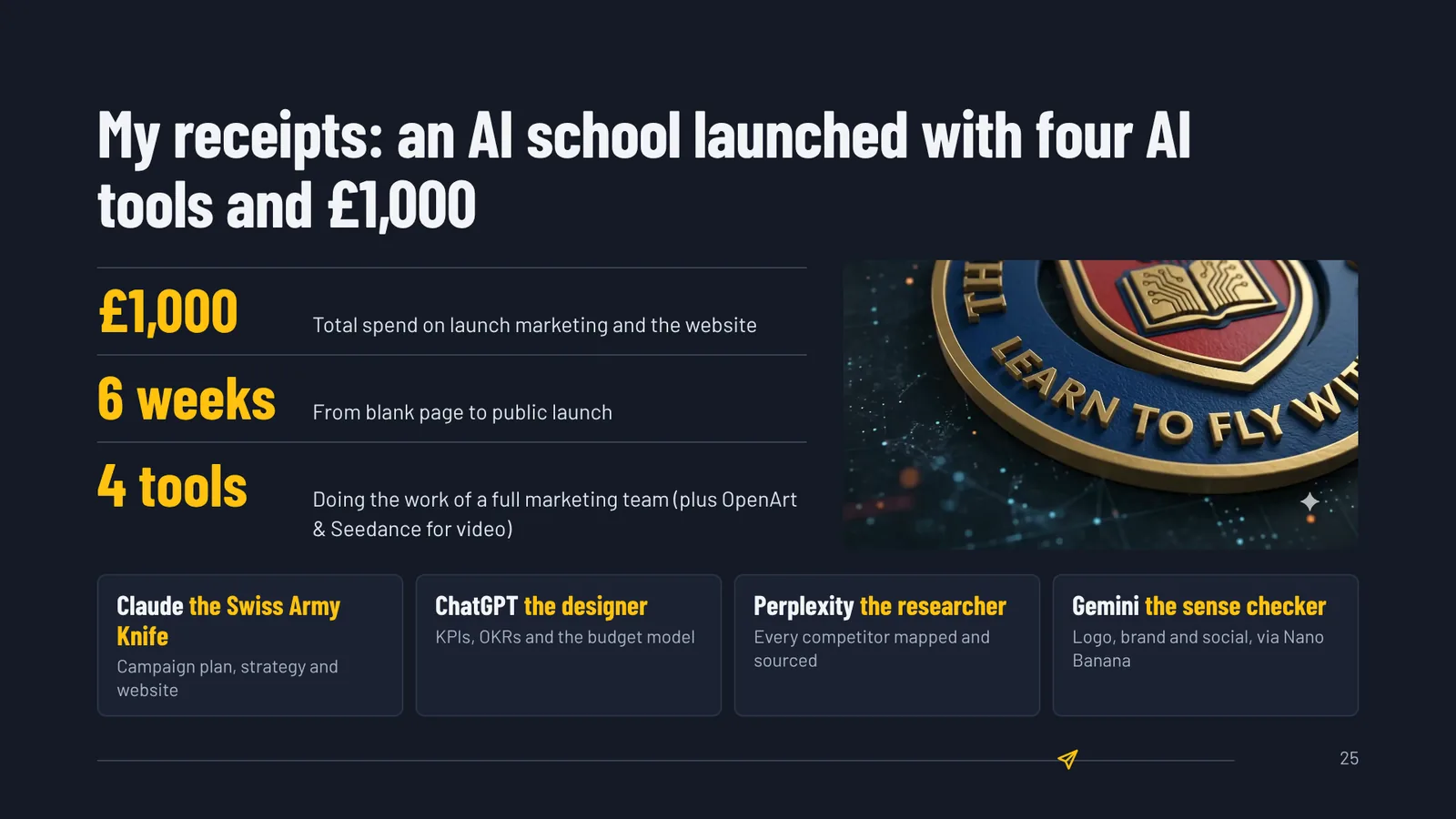
I did. The Oxford AI School went from a blank page to public launch in six weeks, on a total spend of £1,000 for launch marketing and the website. Four tools did the work of a full marketing team:-
- Claude, the Swiss Army Knife. Campaign plan, strategy and the website.
- ChatGPT, the designer. KPIs, OKRs and the budget model.
- Perplexity, the researcher. Every competitor mapped and sourced.
- Gemini, the sense checker. Logo, brand and social, via Nano Banana.
OpenArt and Seedance handled the video. If I can do that for an AI school, a final year student can do it for a side project. Our best AI tools of 2026 list and the free AI Tool Finder will help you pick a stack, and Claude vs ChatGPT covers the choice most people get stuck on.
Running a marketing team rather than joining one?
AI x Marketing Consultancy puts a CMO who teaches AI for a living inside your team, by the day. Strategy, workflows and training on your own briefs.
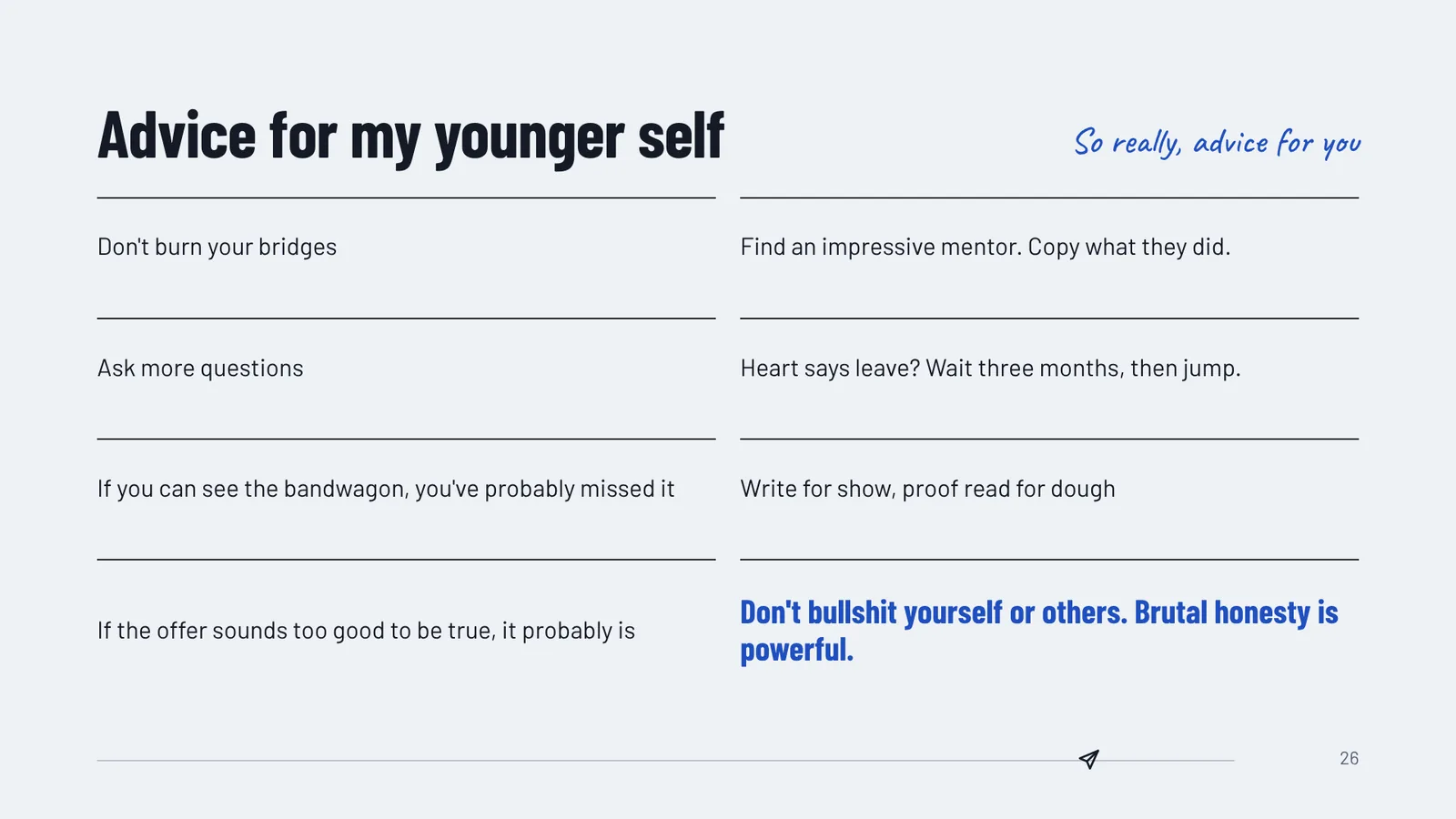
Advice for my younger self (so really, advice for you)
- Don't burn your bridges.
- Find an impressive mentor. Copy what they did.
- Ask more questions.
- Heart says leave? Wait three months, then jump.
- If you can see the bandwagon, you've probably missed it.
- Write for show, proof read for dough.
- If the offer sounds too good to be true, it probably is.
- Don't bullsh*t yourself or others. Brutal honesty is powerful.
The bandwagon one applies to AI too. Don't chase the shiny tool of the week. Learn the fundamentals underneath, which is what Basic AI Training is for.
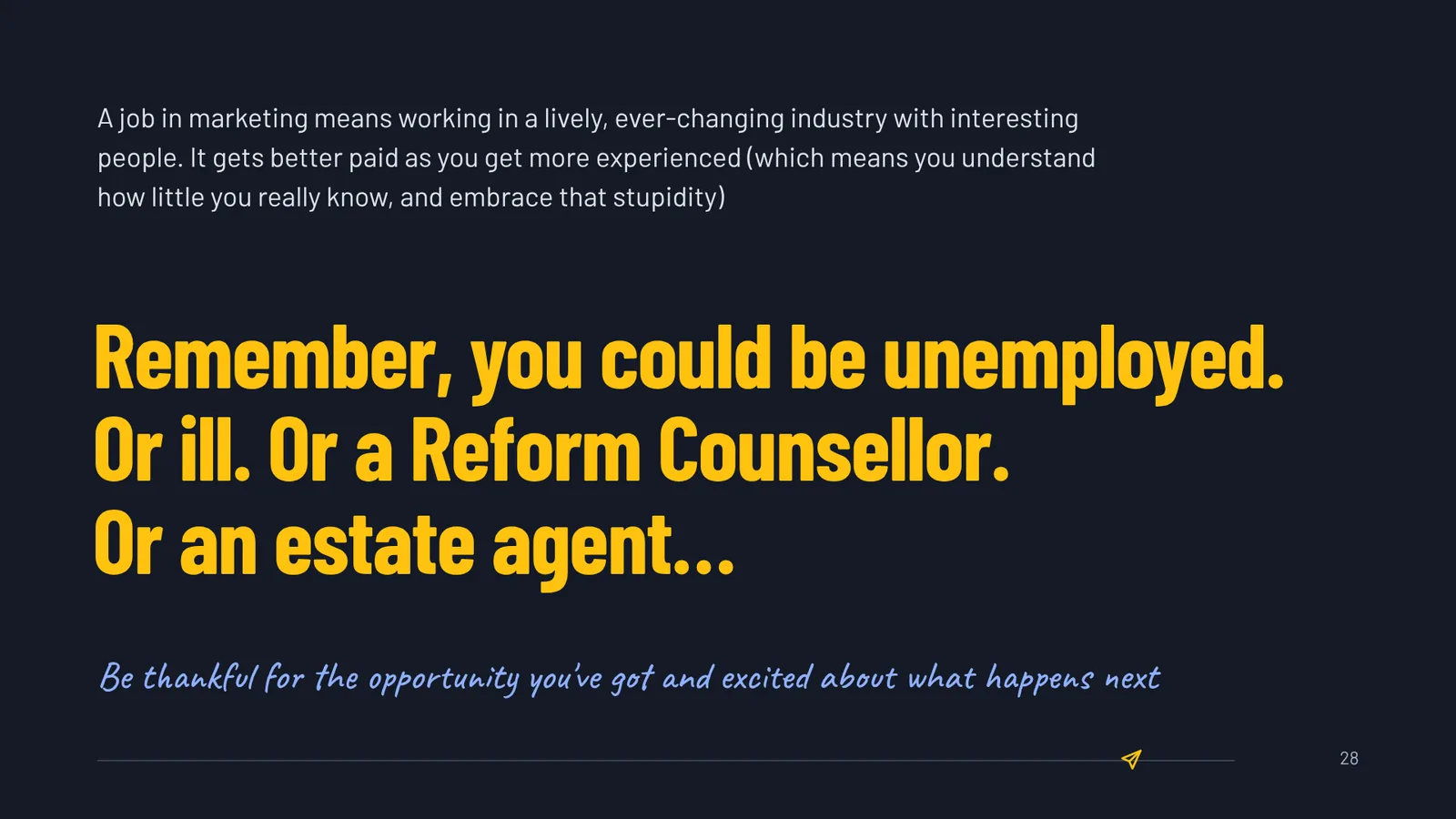
A job in marketing means working in a lively, ever-changing industry with interesting people. Be thankful for the opportunity you've got, and excited about what happens next. You could, after all, be an estate agent.
Every slide, in words
The full text of all 30 slides, for screen readers, search engines and anyone who prefers reading to swiping. Tap a slide number to jump to it in the carousel.
Read the full slide-by-slide transcript
- Slide 1: Title slide, styled as an airport departure board. Flight OB26 to "A Marketing Career", status Boarding. Headline: Is marketing now a sh*t career? Subtitle: Does a marketing career exist in the age of AI? Harry Lang, founder of The Oxford AI School, for Oxford Brookes University.
- Slide 2: No. ...is the short answer. The long answer takes the next 45 minutes and involves a 737, a dodgy pop video, a truly regrettable shade of blue, 4 career pivots and a very expensive credit card bill.
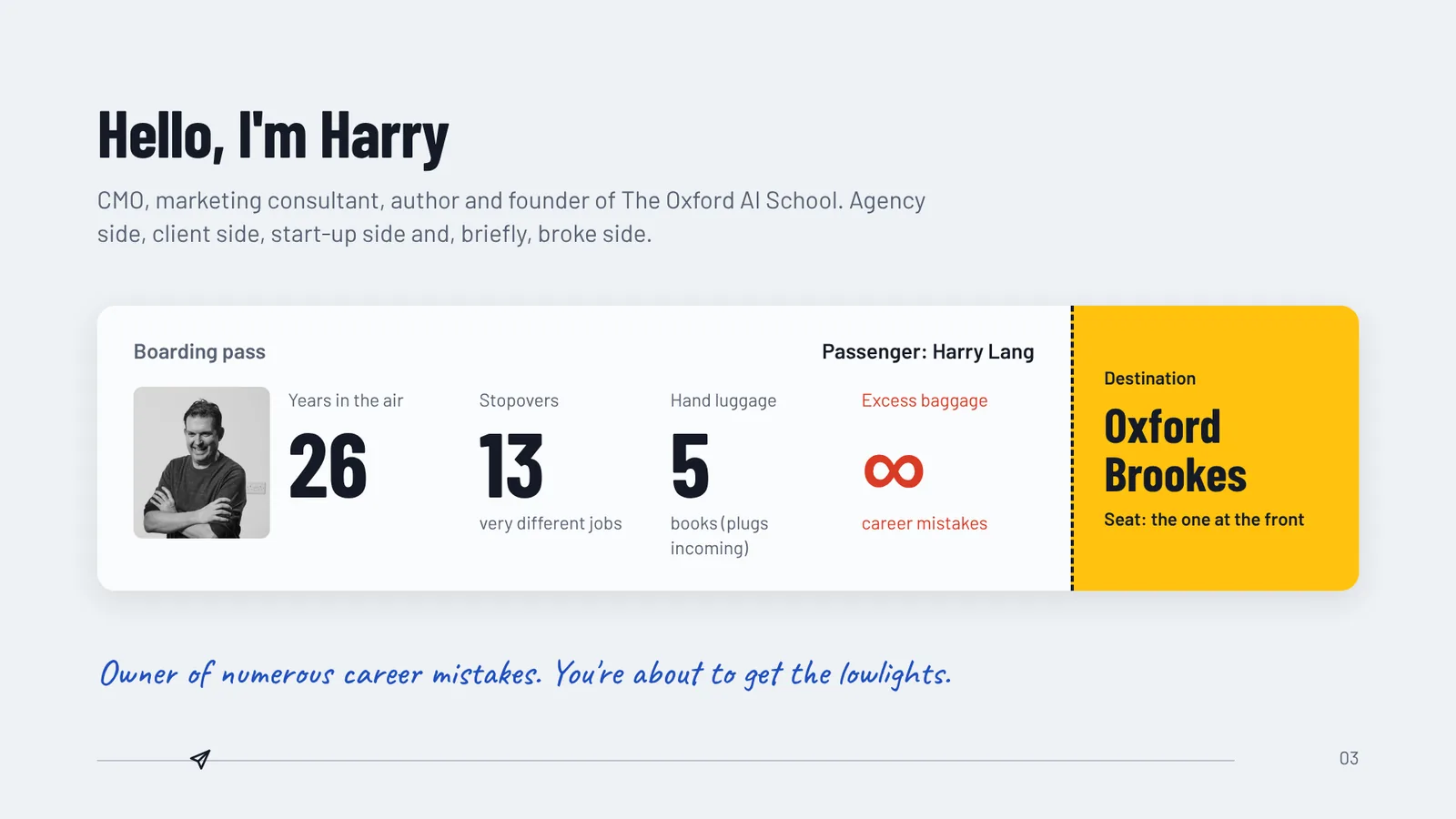
- Slide 3: Hello, I'm Harry. CMO, marketing consultant, author and founder of The Oxford AI School. Agency side, client side, start-up side and, briefly, broke side. Boarding pass: years in the air 26; stopovers 13 very different jobs; hand luggage 5 books; excess baggage, infinite career mistakes; destination Oxford Brookes.
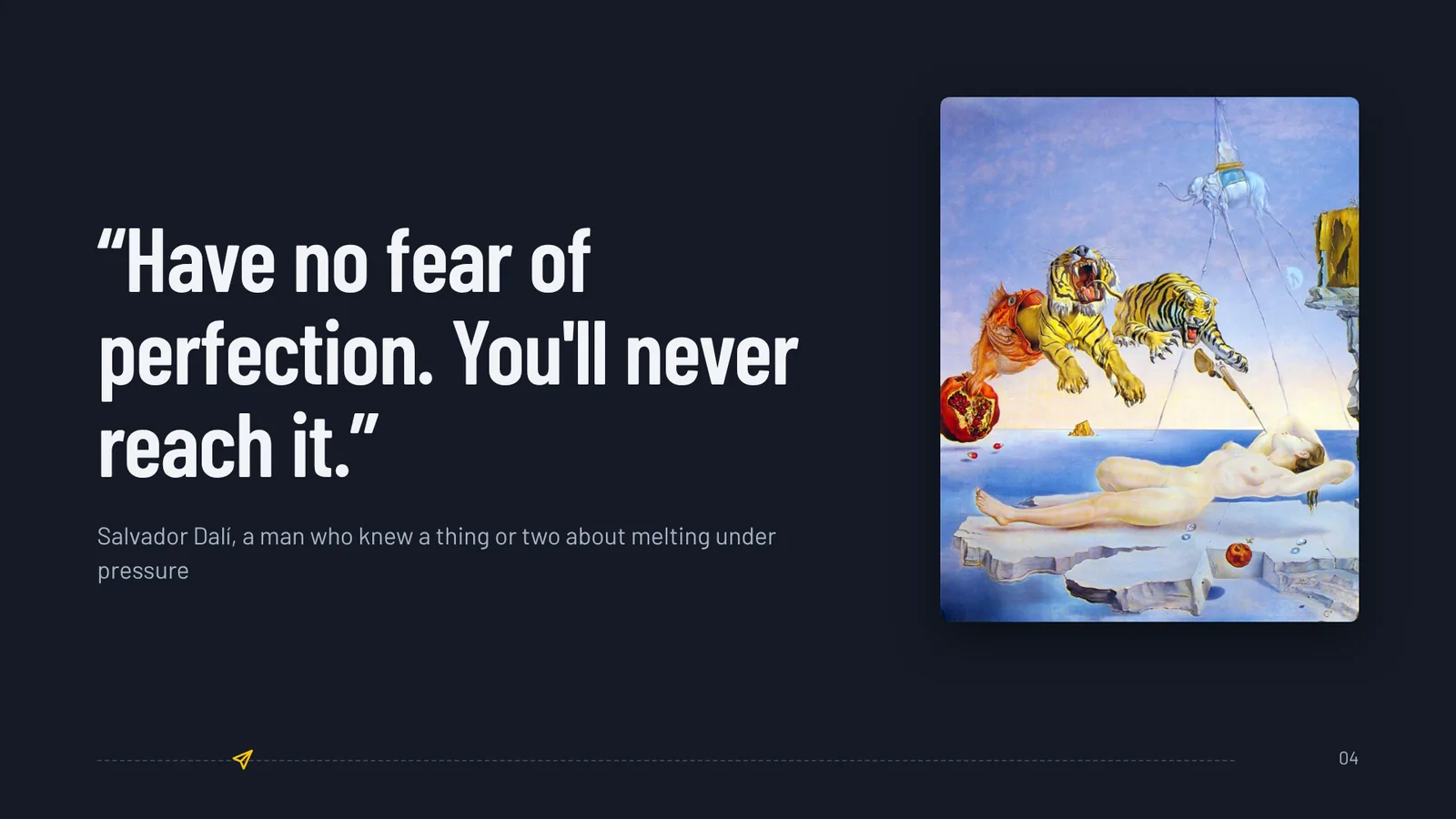
- Slide 4: Quote: "Have no fear of perfection. You'll never reach it." Salvador Dalí, a man who knew a thing or two about melting under pressure.
- Slide 5: 26 years. A lot of U-turns. A departures board of the career: Agency, departed. Gambling, client side, delayed. Broke start-up, grounded. Games, departed. Blockchain, crashed. The Oxford AI School, boarding. Side trips squeezed in: The Fridge, cancelled. Brand Architects, landed.
- Slide 6: The four types of mistake. Minor and personal: typos, too hasty, over complicating, lazy shortcuts, faking it. Catastrophic and personal: career choices, money over happiness, head in the sand, hubris, ego. Minor and collaborative: assuming knowledge, poor documentation, not asking questions, no KPIs. Catastrophic and collaborative: bad people management, negative PR, over budget, legal f-up, blamestorming.
- Slide 7: Mistake 1: M&C Saatchi to... erm, Creatif? Big name. Big hurry. Big regret. Type of mistake: lack of research, too hasty. Lesson learnt: research every angle of a big decision. Ask someone who's already done it. Write the pros and cons list before you leap, not after you land.
- Slide 8: Mistake 2: "But Harry, they're meant to be ROYAL F***ING BLUE!" Type of mistake: poor documentation, assumption. Lesson learnt: if in doubt, check it out. Yourself. Always ask for physical proofs, and allow extra time and contingency when several jobs land at one event.
- Slide 9: Mistake 3: putting a wallflower into the firing line at Inferno. Type of mistake: hubris, bad people management, confusing sameness with fairness. Lesson learnt: everyone needs managing differently. What comes naturally to you might be a nemesis for someone on your team. Treating people the same isn't the same as treating them fairly.
- Slide 10: Mistake 4: "Show me the money": agency to gambling (and staying far too long). Type of mistake: money over happiness, chasing cash, faking it. Lesson learnt: your friends and family may not understand what you do, but they know who you are. Listen to them. Careers are long, and moving for salary alone isn't all it's cracked up to be. Stay too long and you get pigeonholed.
- Slide 11: Mistake 5: "Rent a 737 to Ibiza. Just put it on the credit card." Narrator: it was not a sustainable business model. Type of mistake: head in the sand, over budget, career choices. Lesson learnt: if you suspect it's time to quit and look after yourself, it probably is. Loyalty is a two-way street. You're the only person looking after your interests all the time.
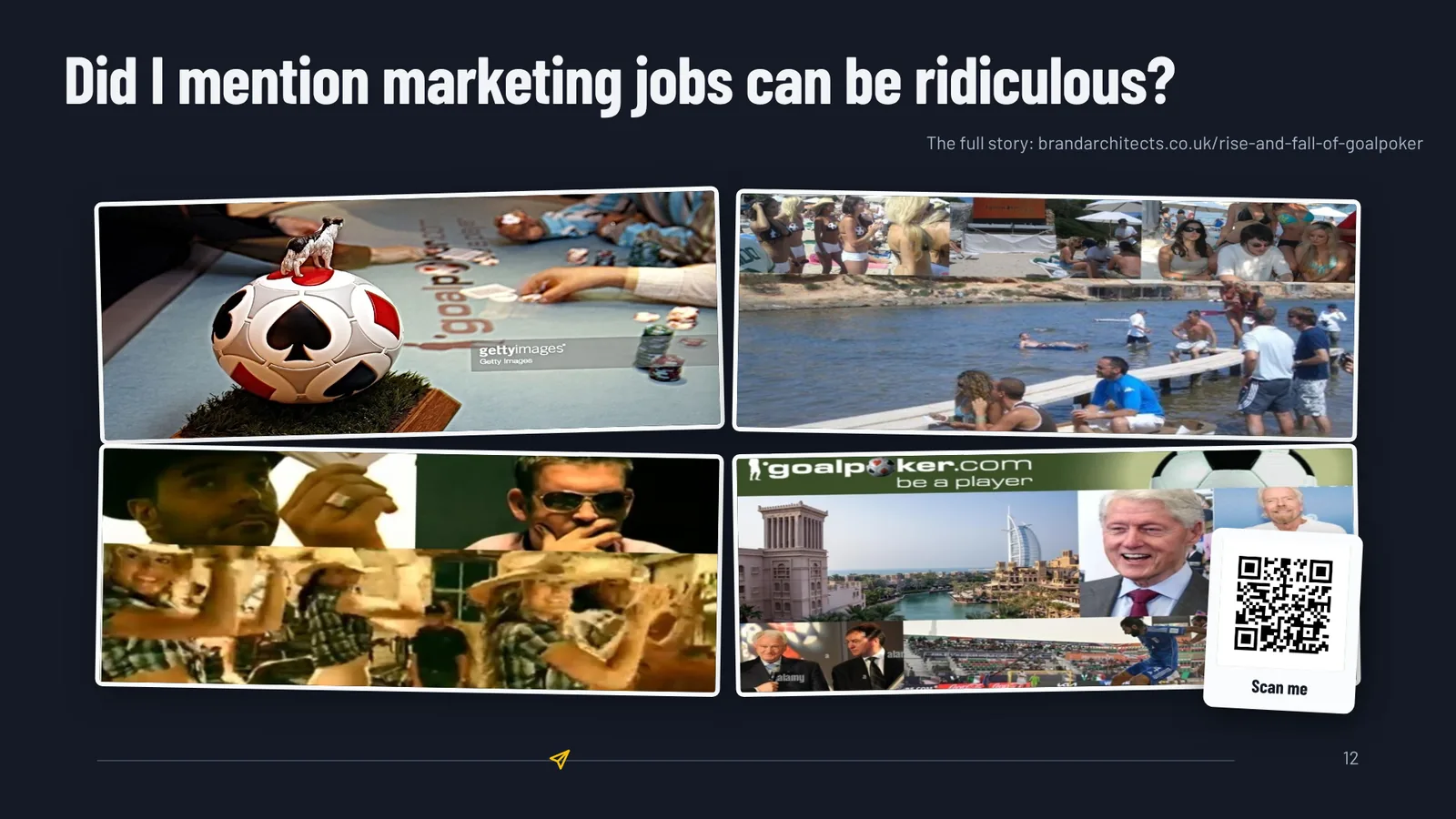
- Slide 12: Did I mention marketing jobs can be ridiculous? A scrapbook of photos from the GoalPoker years. The full story: brandarchitects.co.uk/rise-and-fall-of-goalpoker.
- Slide 13: Mistake 6: The Fridge should've been a PR (or SEO...) agency. Great name. Wrong business. Type of mistake: head in the sand, career choices. Lesson learnt: don't get wedded to the dream narrative in your head. Be objective, and back the version with the best chance of actually working.
- Slide 14: Mistake 7: not being a copywriter from the start... The irony? In the age of AI, a great prompt is just great copywriting. Type of mistake: career choices, lack of confidence. Lesson learnt: you'll be more successful at something that comes naturally, or that you enjoy. Keep learning forever, but build your professional core on the thing you find easy.
- Slide 15: Quote: "Anyone who has never made a mistake has never tried anything new." Albert Einstein. Marketing works the same way: test and learn, fail fast, be brave. Which brings us neatly to the newest thing any of us have ever tried.
- Slide 16: So will the advent of AI mean you'll make fewer career mistakes than me? No, but your window of opportunity just opened up to a whole universe of potential. Illustrated with an aircraft window looking out on a field of stars.
- Slide 17: AI is an extremely clever graduate. Intellectually flawless. Zero experience of your business. Desperately trying to impress you. To use it well, you have to teach it. Now read that description again. Awkwardly, it's also you, next June. The difference? You can learn the business. It only knows what it's taught. So don't compete with it. Be the one who teaches it.
- Slide 18: Brilliant, tireless and often confidently wrong. Really good at: summarising long documents and threads; first drafts of almost anything; brainstorming options and angles; turning messy notes into structure; explaining anything in plain English. Not so great at: being 100% accurate (always check); human judgement, empathy and hard calls; knowing recent events unless it searches; sounding like you, until you train it; having an original idea nobody asked for.
- Slide 19: What will AI do to marketing? Source: my gut. Peer reviewed by nobody. 100%: make marketing success more accessible for anyone with an idea and a work ethic. 95%: do the boring bits. 90%: flood the internet with beige, average, forgettable content. 85%: make original, human ideas worth more than ever. 75%: turn "writes a great brief" into the most valuable skill in the room. 60%: change what your first job looks like. 40%: rewrite search. 20%: replace the account exec whose whole job is forwarding emails. 5%: write a funny ad all by itself. 0.5%: the end of humanity.
- Slide 20: A prompt is just a brief: use CRAFT. Context: "Here are the brand guidelines and last quarter's results." Role: "Act as a senior social media strategist." Aim: "Plan a four-week TikTok launch for [brand]." Format: "A table: week, idea, hook, KPI." Tone: "Punchy. No corporate waffle." Then always finish with: "Ask me any questions before you start."
- Slide 21: The bits AI can't do for you (yet). Taste: knowing which of the 50 ideas it gave you is the good one. Checking: check, challenge, refine. Never send a first draft unread. People: empathy, EQ and managing people well. Clients buy from humans. Bravery: AI plays safe. Brilliant marketing never has.
- Slide 22: So, is marketing still a good career? Short answer: yes. Long answer: like any satisfying career that pays well, it's competitive, changeable, difficult, occasionally unreliable, often frustrating, usually rewarding and never, ever perfect. If you want predictable (AKA boring but safe), this isn't for you.
- Slide 23: Your marketing career in 2031. A compass, not a map. Five years ago nobody had written a prompt. Job titles: AI Marketing Strategist; AI Search (GEO / AEO) Lead; Marketing Automation & Agents Manager; Creator & Community Lead; Head of Brand (still very much a job). Chief Prompt Officer: briefly, then everyone gets embarrassed. Skills that pay: writing a killer brief for humans and machines; building AI workflows that run themselves; reading data and telling the story in it; taste; commercial nous. Where to aim: AI-native start-ups and scale-ups; small, sharp agencies; SMEs that need someone to lead their AI shift; brands with a real community behind them; anywhere that lets you break things and learn.
- Slide 24: How to get hired (by me, at least). What I look for: enthusiasm you can't fake; real interest in our business; inquisitiveness, ask the extra question; thinking creatively and analytically. Your A Level subjects? I did French, Classics and Geography. Nobody cares. What gets you noticed: proof you've actually done it. Build a website, pick a product, learn SEO and GEO, hype with social video, make some noise and sell something. With AI you can do all of that this weekend, for about the price of a takeaway. THAT's marketing.
- Slide 25: My receipts: an AI school launched with four AI tools and £1,000. £1,000: total spend on launch marketing and the website. 6 weeks: from blank page to public launch. 4 tools doing the work of a full marketing team, plus OpenArt and Seedance for video. Claude the Swiss Army Knife: campaign plan, strategy and website. ChatGPT the designer: KPIs, OKRs and the budget model. Perplexity the researcher: every competitor mapped and sourced. Gemini the sense checker: logo, brand and social, via Nano Banana.
- Slide 26: Advice for my younger self. So really, advice for you. Don't burn your bridges. Find an impressive mentor. Copy what they did. Ask more questions. Heart says leave? Wait three months, then jump. If you can see the bandwagon, you've probably missed it. Write for show, proof read for dough. If the offer sounds too good to be true, it probably is. Don't bullsh*t yourself or others. Brutal honesty is powerful.
- Slide 27: Career balance: the Fun/Rich parallel. A chart with fun on the vertical axis and pay on the horizontal. Plotted: pop star, football player, actor, beer taster, influencer, surfer, medicine, journalist, law, estate agent, accountancy, banking. Marketing is highlighted in yellow: plenty of fun, decent pay.
- Slide 28: A job in marketing means working in a lively, ever-changing industry with interesting people. It gets better paid as you get more experienced (which means you understand how little you really know, and embrace that stupidity). Remember, you could be unemployed. Or ill. Or a Reform Counsellor. Or an estate agent... Be thankful for the opportunity you've got and excited about what happens next.
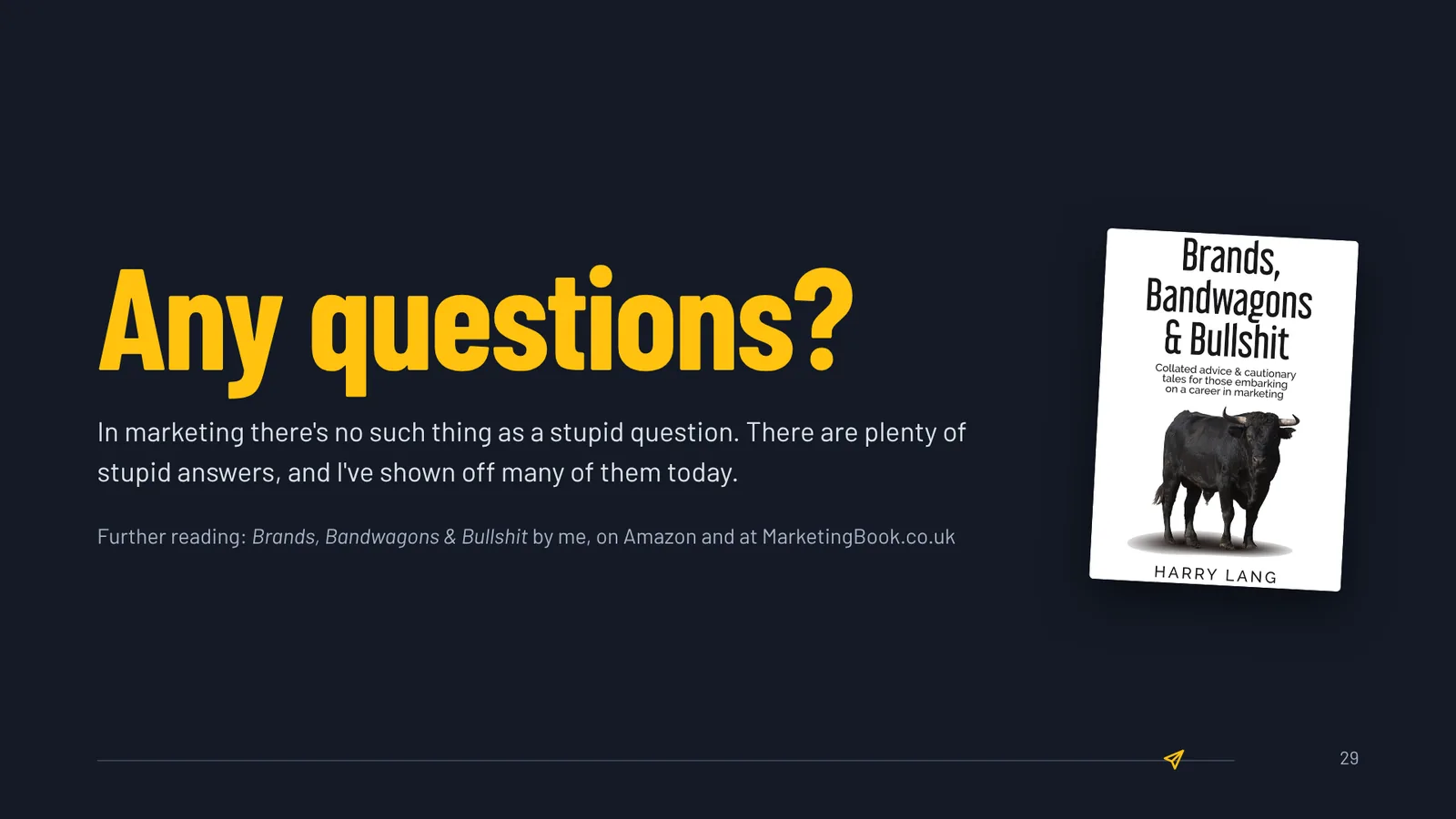
- Slide 29: Any questions? In marketing there's no such thing as a stupid question. There are plenty of stupid answers, and I've shown off many of them today. Further reading: Brands, Bandwagons & Bullsh*t by Harry Lang, on Amazon and at MarketingBook.co.uk.
- Slide 30: I hope you've enjoyed today, Oxford Brookes. If you found it useful, phones out: scan, leave me a review and follow our socials. QR codes for Trustpilot, Google Reviews and Follow us. TheOxfordAISchool.com, linktr.ee/TheOxfordAISchool.
Marketing careers and AI: your questions answered
Is marketing still a good career in the age of AI?
Yes. Marketing is still a good career in 2026. AI takes over the repetitive work, such as first drafts, resizing, reporting and meeting notes, which leaves more of the job for ideas, judgement and people. It stays competitive and changeable, so it suits people who would rather be interested than comfortable.
Will AI replace marketing jobs?
AI will replace tasks faster than it replaces marketers. Harry Lang puts the odds of AI doing the boring bits at 95%, and of it replacing an account executive whose whole job is forwarding emails at 20%. Roles built on taste, checking, managing people and bravery become more valuable, because AI is weak at all four.
What marketing jobs will exist in 2031?
Expect titles such as AI Marketing Strategist, AI Search (GEO and AEO) Lead, Marketing Automation and Agents Manager, Creator and Community Lead, and Head of Brand. Titles will change faster than the skills underneath them, which are mostly long-standing marketing skills with AI doing the heavy lifting.
What skills do marketing graduates need to get hired?
Five skills pay: writing a clear brief for people and for AI, building AI workflows that run themselves, reading data and telling the story in it, taste, and commercial sense about how a business makes money. Employers also look for enthusiasm, curiosity and proof that you have already built and sold something.
What is the CRAFT prompt framework?
CRAFT is a five-part structure for writing an AI prompt as if it were a creative brief. It stands for Context, Role, Aim, Format and Tone. Finish every prompt with the line "Ask me any questions before you start", so the AI fills the gaps in your brief before it writes anything.
What is AI good at and bad at in marketing?
AI is strong at summarising long documents, writing first drafts, brainstorming options, turning messy notes into structure and explaining things in plain English. It is weaker at being fully accurate, human judgement and empathy, knowing recent events unless it searches, sounding like you, and having an original idea nobody asked for.
Can you launch a business using only AI tools?
Harry Lang launched The Oxford AI School in six weeks for a total of £1,000 on launch marketing and the website. Four tools did the work of a marketing team: Claude for strategy, the campaign plan and the website, ChatGPT for KPIs and the budget model, Perplexity for competitor research and Gemini for the logo, brand and social assets.
Who gave this talk, and can I use the slides?
Harry Lang, founder of The Oxford AI School and a marketer of 26 years, gave the talk to final year marketing students at Oxford Brookes University in November 2026. You can view all 30 slides on this page. Lecturers and course leaders who want the talk for their own students can book a call.

About Harry Lang
Harry is the founder of The Oxford AI School and has spent 26 years in marketing as a CMO, consultant and author. His five books include Brands, Bandwagons & Bullsh*t. He teaches practical AI to businesses and teams across the UK, and still makes mistakes on a regular basis.
This talk was given as a guest lecture. The Oxford AI School is independent and is not affiliated with Oxford Brookes University or the University of Oxford.