

The short answer
There is no single UK AI training figure that describes every employer and worker. The surveys below ask different questions of different groups, and some recent publications use older fieldwork. This guide keeps the dates and sources alongside the numbers so you can quote them properly. It also explains what to measure in your own business before spending money on training.
Which UK AI training statistics are useful in 2026?
Give a percentage a sufficiently large font and it can acquire the authority of a judge. Put it beside a photograph of a worried executive and you've practically written the sales pitch.
Somewhere beneath it, in type usually reserved for the ingredients of indigestion tablets, you may discover who was actually surveyed. Perhaps the research is two years old. Perhaps the respondents were large businesses and you're running a company of six. Perhaps the question had nothing to do with training at all.
I wouldn't sign a training budget on the strength of the headline. The research can be valuable, provided we read what it says. Here are the figures, checked against their original publications on 2 October 2026. The year in this article's title refers to this edition; the table makes clear when each survey took place.
| Figure | What it measures | Evidence period and source |
|---|---|---|
| 11% | UK employers reporting AI training for themselves or employees in the preceding year. | March–June 2024 survey; published January 2026. Ipsos / DSIT, figure 5.6. |
| 36% | Employers interested in future AI training. | Same 2024 survey. Ipsos / DSIT, figure 5.7. |
| 56% | Employers using or planning AI who described their knowledge as beginner or novice. | Same 2024 survey; subgroup base 373. Ipsos / DSIT, figure 3.2. |
| Around 35% | UK businesses with at least ten employees reporting use of an AI technology. | June 2026; published 20 July 2026. ONS, figure 1. |
| 10% | AI-using businesses with at least ten employees reporting extensive use. | June 2026. ONS, section 3. |
| 32% | UK journalists saying their main outlet provides AI training. | August–November 2024 survey; published November 2025. Reuters Institute, section 4.2. |
| 10 million | Workers targeted for AI upskilling by 2030; a policy ambition, not completions. | Announced January 2026. AI Skills Boost explainer. |
Survey detail: the Ipsos employer study sampled 801 employers, excluding sole traders and the public sector; fieldwork ran 19 March–7 June 2024. The Reuters study sampled 1,004 journalists, 29 August–4 November 2024. The ONS business measures above use BICS and the stated employee-size threshold. Consult the original reports before generalising beyond those populations.
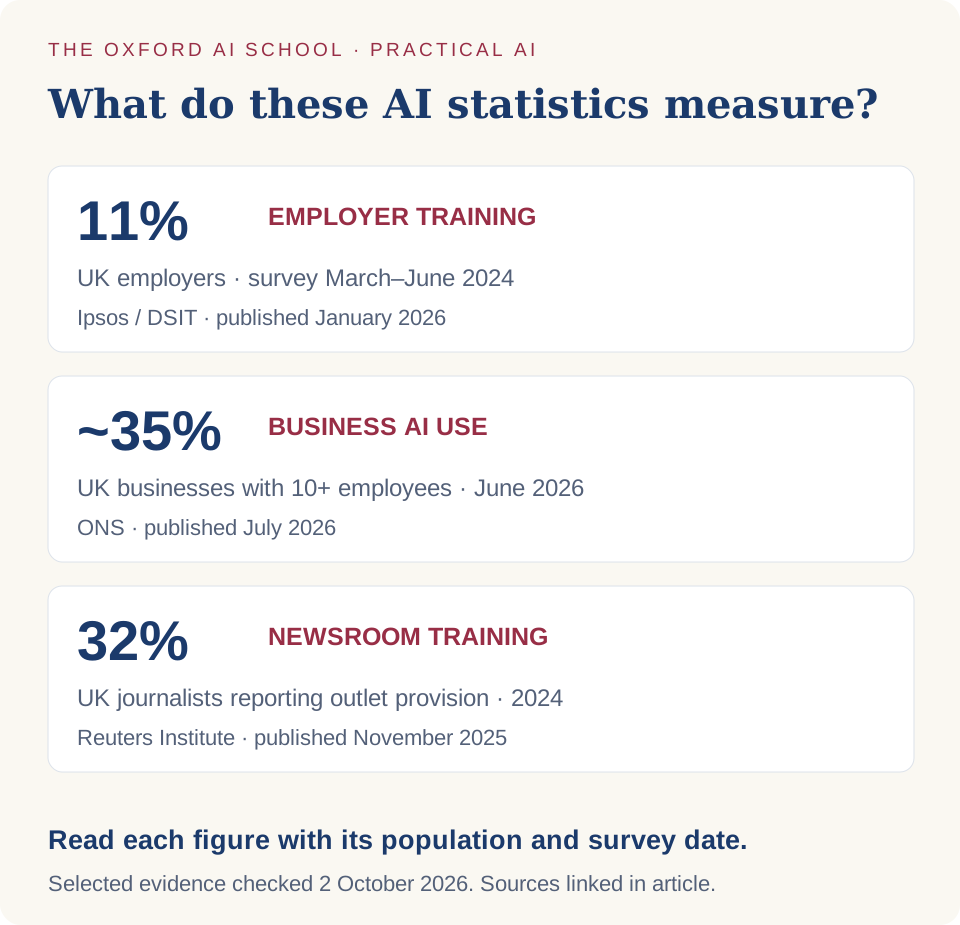
Why do AI statistics give different answers?
“Our business uses AI” could mean a single department has bought a tool. “I use AI at work” is an individual's answer. Neither tells you whether anybody has been taught to use it properly.
Training is a fairly roomy word itself. It can describe an introductory video, a practical workshop or months of study. All may teach something. Counting people who attended won't tell you whether they can now complete the job without help.
Before putting two percentages on the same chart, check the following:
- Who answered? Employees, employers and businesses are different groups.
- Who was excluded? Very small firms, public bodies or particular sectors may fall outside the study.
- What was asked? Using a tool, feeling confident and completing a task are different things.
- When were they asked? A new publication can report much older fieldwork.
- How was the study run? Look at recruitment, sample size, weighting and question wording.
Keep those details close to the number. Your reader shouldn't need a magnifying glass and a spare afternoon to work out what you've claimed.
What does the evidence say about the AI training gap?
The surveys give us reasons to investigate how people are learning and using AI. They can't tell you whether your finance manager checks a calculation or your sales team knows what information it's allowed to upload. You'll have to ask them.
My view is that buying the software, teaching people to use it and deciding where it's appropriate all need somebody's attention. Call the whole lot an “AI rollout” and it's easy to celebrate the licences arriving while the other jobs languish on a list.
I'd look closely at how the team handles an actual piece of work. Enthusiasm can coexist quite happily with carelessness. Equally, somebody who's reluctant to touch AI may simply need a patient explanation and a chance to try it without an audience.
The free AI skills matrix gives you a way to record what people can do and where they need help. Use the national research to inform the conversation, then make the training decision with the people whose work you're trying to improve.
Which AI training measures should a business owner track?
Pick a recurring task and a small group. Keep a record of how the job goes before training, then review comparable work afterwards. Resist the temptation to commission a dashboard so elaborate it requires its own induction course.
| Measure | What to record | What you'll learn |
|---|---|---|
| Task completion | Can the person finish the agreed job independently? | Whether they can apply what they learned. |
| Total effort | Time spent preparing, drafting, checking and correcting. | Whether the whole job takes less work. |
| Quality | Errors, omissions and revisions. | Whether the result meets the required standard. |
| Repeat use | Whether the process is used again on suitable work. | Whether the training survives contact with the working week. |
| Safe practice | Use of approved tools, data and review points. | Whether people follow the company's rules. |
Record other things that might explain a change. Perhaps the second brief was easier, somebody lent a hand or the person simply got better through practice. Claiming the entire improvement for the course would be convenient for a training provider. It would also be a bit cheeky.
Be equally careful when turning time into money. If somebody finishes an hour earlier and uses that hour for other work, you've gained capacity. A cash saving requires an actual cost to change. Finance will probably notice the distinction, particularly if your spreadsheet has become a little overexcited.
If the team needs a grounding in everyday use, look at AI Basics Deep Dive. Our advanced training guide covers what comes after that. You can find all the available modules on the programmes page.
What should journalists check before quoting these statistics?
Link to the original research and retain its population, fieldwork period and question. Attribute the finding to the organisation that produced it. We've collected and commented on these figures; we didn't conduct the surveys.
And yes, I sell AI training. You should be as willing to question my interpretation as you would anybody else's. Ask how respondents were recruited, what they were asked and which groups are missing before accepting a dramatic conclusion from a provider's research.
I'd be interested in a story that followed people back to work after a course. What can they do now? What still goes wrong? Who helps when they get stuck? The answers would tell us considerably more than another photograph of delighted delegates holding certificates.
For commentary on teaching AI to business teams, contact The Oxford AI School. For questions about how a particular survey was conducted, go to the researchers who did it.
Sources and editorial method
These are selected primary sources, checked on 2 October 2026. The table separates training, adoption, self-reported knowledge and policy targets. The advice about choosing and measuring training is my interpretation.
- Ipsos: AI Skills for Life and Work: employer survey findings. Published on GOV.UK, 28 January 2026.
- ONS: Artificial intelligence in UK businesses, 2023 to 2026. Published 20 July 2026.
- Thurman, Thäsler-Kordonouri and Fletcher: AI adoption by UK journalists and their newsrooms. Reuters Institute, 27 November 2025.
- UK Government: AI Skills Boost explainer. Published 28 January 2026.
Check for a newer release before reusing a figure in a dated report. If you spot an error here, send us the figure and its source so we can review it.
Frequently asked questions
Are all these AI statistics from surveys conducted in 2026?
No. This is the 2026 edition of the guide. Each row gives the evidence period separately from the publication date. Several figures come from earlier fieldwork.
Is there one definitive UK AI training rate?
No single figure covers every employer and worker. Check who was surveyed, what they were asked and when. Keep those details with the number when quoting it.
Does using AI mean someone has been trained?
No. Somebody can use a tool without ever having been taught to use it. Ask them to demonstrate a task and explain how they check the result.
Does the ten-million-worker target mean ten million people have completed training?
No. AI Skills Boost sets a target to upskill ten million UK workers by 2030. It does not report ten million completed courses.
Can these figures prove that an AI course will pay for itself?
No. You need to measure relevant work in your own organisation. Compare similar tasks before and after training, including checking time, quality and actual costs.
Can journalists cite this page?
Yes. Attribute survey findings to the original researchers and include the dates and population. Commentary in this guide can be attributed separately to Harry Lang at The Oxford AI School.