

The short answer: how many UK businesses use AI in 2026?
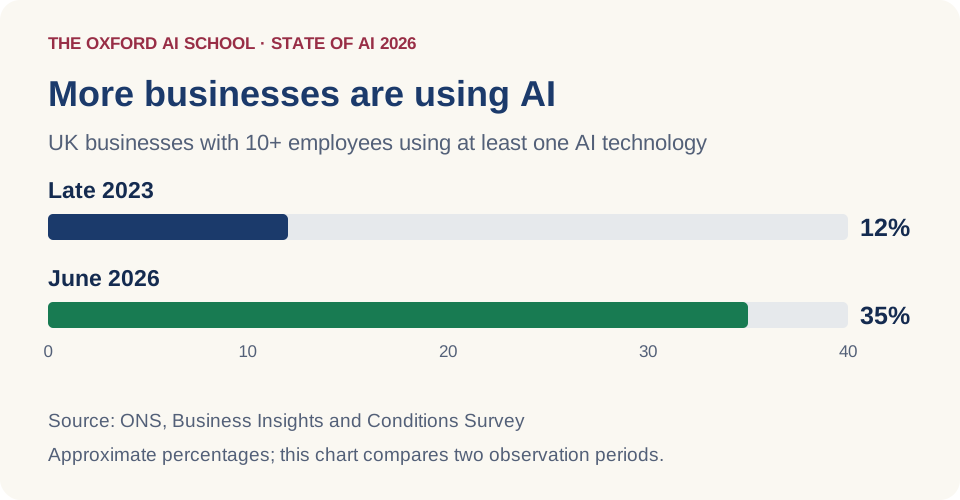
Around 35% of UK businesses with at least ten employees reported using AI in June 2026. Among adopters, just 10% described their use as extensive. My State of AI Adoption report looks at what sits behind those numbers: which sectors are moving, how staff use the tools and where training and company rules have fallen behind. The immediate job for business owners is to find out what's happening in their own teams and help them do it properly.
Business estimates: ONS, June 2026. Analysis by Harry Lang.
Key findings: the State of AI Adoption in UK businesses, 2026
- 35% of UK businesses with ten or more staff use at least one AI technology, up from around 12% in late 2023 (ONS).
- Only 10% of those AI-using businesses describe their use as extensive (ONS).
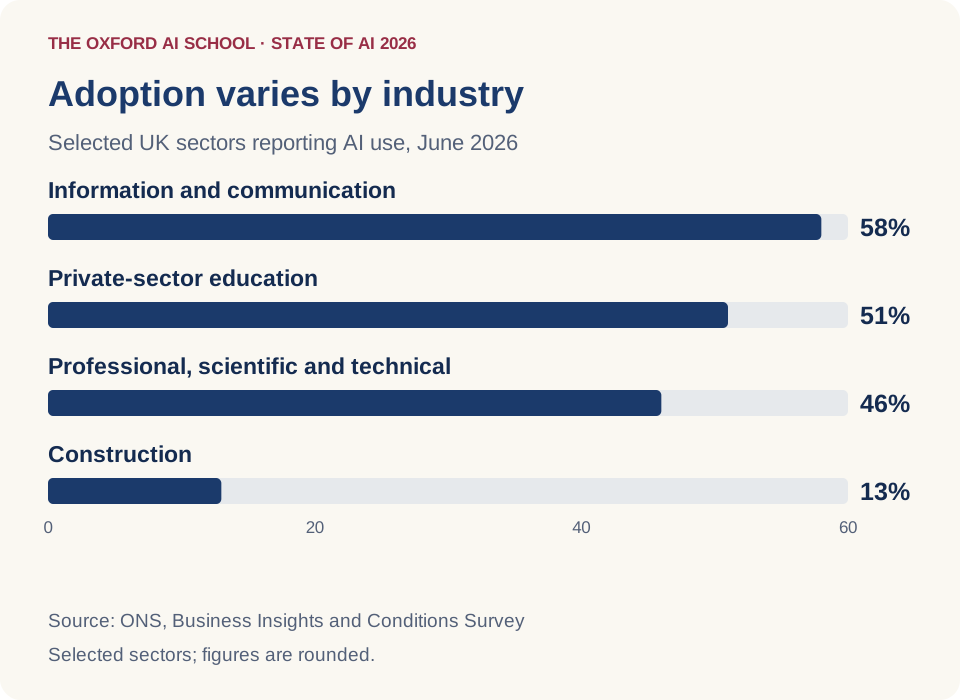
- Information and communication leads at 58%; construction trails at 13% (ONS, selected sectors).
- 31% of workplace GenAI users have used it without their employer knowing (Deloitte).
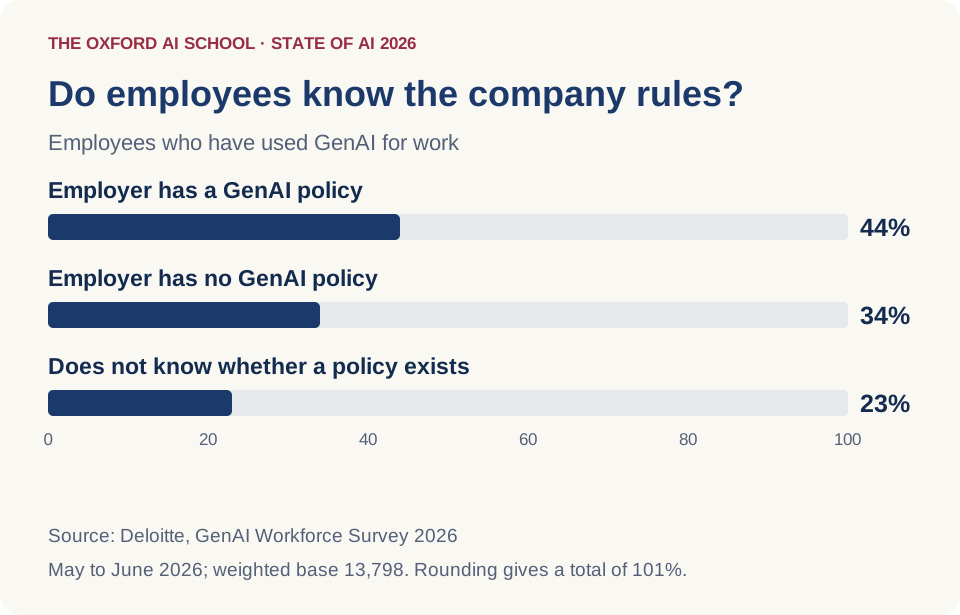
- Half of GenAI users have had no formal training, and 23% do not know whether their employer has an AI policy (Deloitte).
- Among businesses using AI to improve operations, 63% report no change in headcount (ONS).
of businesses with 10+ staff report using AI
ONS, June 2026; approximate figureof AI-using businesses with 10+ staff report extensive use
ONS, June 2026; a different denominatorHow many UK businesses are using AI in 2026?
A company can buy an AI subscription in less time than it takes to find the purchase-order form. Teaching its people to use the thing properly requires rather more attention.
That's the problem I wanted to examine in The State of AI Adoption Report. The evidence shows more businesses using AI, but relatively few using it extensively. It's quite possible to have a collection of licences, some enthusiastic staff and a marvellous slide about transformation while the weekly report remains the same miserable job it always was.
The ONS puts adoption at around 35% of UK businesses with ten or more employees in June 2026, compared with around 12% in late 2023. That's almost a threefold increase. Among businesses using AI, only 10% reported extensive use. [1]
Read the chart figures as a table
| Group or period | Reported share |
|---|---|
| Late 2023 | 12% |
| June 2026 | 35% |
Those figures deserve to travel together. They tell us that AI is spreading, while the work of integrating it is still underway. Buying access is easy to count. Finding out whether a team can use it reliably means looking at what happens after they log in.
I'd start with an ordinary piece of work. Ask someone how they prepared it, what they gave the assistant and what they checked. You'll learn more from watching them trace a number back to its source than from asking whether they feel “AI ready”. If you want a structured way to do it, our AI readiness assessment guide and the free AI skills matrix template both help, and how far behind is my business on AI? puts the national figure in context.
Is the UK ahead or behind other countries on AI adoption?
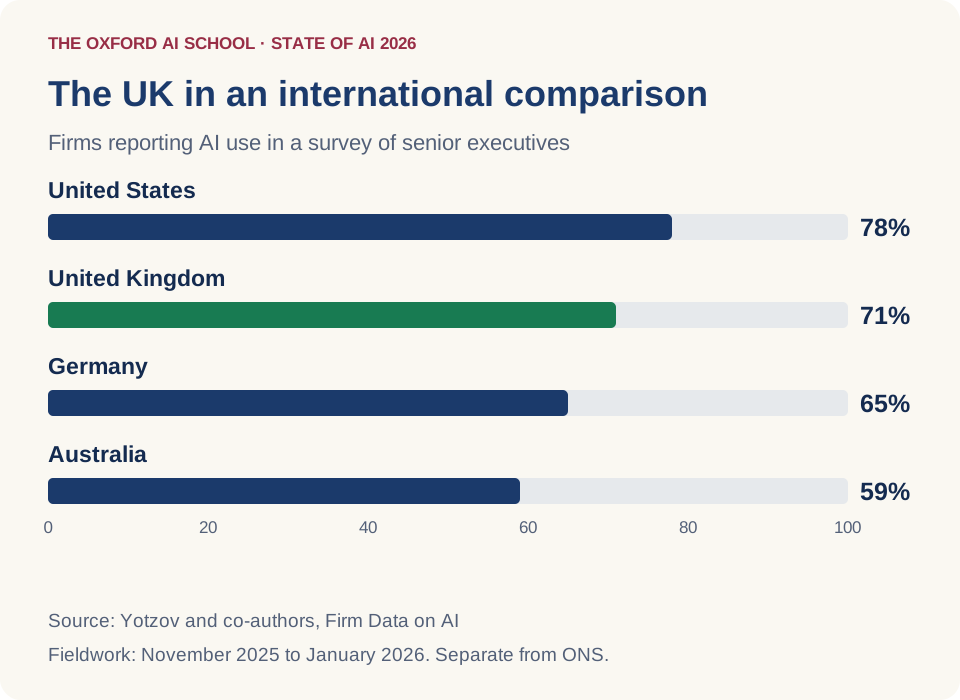
The UK is among the stronger European adopters in the comparisons covered by the report, although it trails the US. An international executive survey reported AI use in 71% of UK firms, against 78% in the US, 65% in Germany and 59% in Australia. [4]
Read the chart figures as a table
| Group or period | Reported share |
|---|---|
| United States | 78% |
| United Kingdom | 71% |
| Germany | 65% |
| Australia | 59% |
Before anyone compares that 71% with the ONS figure above and declares one of them nonsense, look at how the research was done. Different samples, questions and definitions can produce different estimates. The executive study asks senior leaders about AI across their firms; ONS uses its own business survey and technology questions.
Keep comparisons within the same study. Bolting unrelated percentages together because they fit neatly on a slide is how perfectly respectable research ends up doing something faintly ridiculous. Our companion guide, UK AI Training Statistics 2026, sets out each survey's population and dates so you can quote them properly.
Which UK industries are adopting AI fastest?
The national average conceals some substantial differences. In the report's selected ONS sector figures, information and communication reaches 58%, private-sector education 51%, and professional, scientific and technical activities 46%. Construction is at 13%. [1]
Read the chart figures as a table
| Group or period | Reported share |
|---|---|
| Information and communication | 58% |
| Private-sector education | 51% |
| Professional, scientific and technical | 46% |
| Construction | 13% |
For an organisation that spends much of its day reading, drafting and analysing information, there are obvious places to try an assistant. A business whose staff spend their day on a building site has a different starting point.
That doesn't make construction a lost cause. Think about preparing a tender, organising site notes or comparing supplier information. Our Win More Business With AI module covers exactly that kind of pitch, proposal and tender work. Those are possible training exercises, with checking built in. The sensible question is where AI could help the particular business, rather than whether it has caught up with an industry that does entirely different work.
For sector-specific guidance, see our guides to AI training for professional services, accountants, lawyers and teachers, or browse UK industry AI training in the Learning Hub.
What are UK businesses using AI for?
Writing and visual tools lead the selected ONS technology figures. Text generation reaches 18% of businesses with ten or more employees, followed by visual content at 16%, machine-learning data processing at 12%, image processing at 6% and robotics at 2%. [1]
The work itself will sound familiar. Deloitte's respondents use generative AI to search for information, draft emails and documents, summarise material and generate ideas. [2]
There's nothing wrong with starting there. A well-prepared meeting summary is a perfectly respectable improvement to someone's afternoon. The missed opportunity comes when a useful experiment stays trapped in one person's browser and nobody works out how the rest of the team could repeat it.
Take the task that worked, write down the instructions and let a colleague try it with different material. You'll soon discover which parts were clear and which depended on the original author hovering helpfully over their shoulder. The five-part prompt rule is a good template for writing those instructions down.
Which AI tools are UK businesses choosing, and what is shadow AI?
Computing asked 138 UK IT leaders which tools they used. Copilot appeared most often, at 79%, followed by ChatGPT at 70%, Gemini at 45% and Claude at 24%. These are overlapping responses from a specialist sample. They are not national market shares. [5]
Your existing software matters. So do the jobs you need to do, the information involved and the controls available. I'd choose on that basis before allowing the latest online argument about the “best” model to dictate the company's purchasing. If you're weighing options, read ChatGPT vs Copilot for business, Claude vs ChatGPT and which AI tool should my company start with?, or work through Build Your Best AI Stack.
Deloitte found that 31% of workplace GenAI users used it without their employer knowing. The researchers describe this as roughly one in three. In the same research, 46% used free tools for work, 34% used employer-provided external tools and 17% used in-house tools. People could select more than one option. [7]
Your approved software list may therefore describe only part of what's happening. A rule sitting unread in a shared folder is unlikely to settle the matter. Ask people what they use, why they use it and which jobs the approved tools aren't helping them finish. That gives you something to fix. Our guide on how to stop staff pasting confidential data into ChatGPT covers the practical side, alongside protecting business data when using AI.
Make it easy to get a clear answer about permitted tools and information. Otherwise the colleague trying to get a report finished at half past five is left interpreting company policy through the medium of guesswork.
Have AI training and company AI policies kept pace?
Deloitte found that half of GenAI users had received no formal training. In its policy question, 44% of employees using GenAI at work said their employer had a policy, 34% said it did not and 23% didn't know. The published percentages total 101% because of rounding. [3]
Read the chart figures as a table
| Group or period | Reported share |
|---|---|
| Employer has a GenAI policy | 44% |
| Employer has no GenAI policy | 34% |
| Does not know whether a policy exists | 23% |
“Don't know” matters. You can spend weeks agreeing a policy and still leave staff unable to find it or understand what it permits. Ask a few people where it lives and what they'd do with a document containing customer information. The answers will tell you whether the document has made it into working life. If you're starting from scratch, read do you actually need an AI policy?, how to write an AI policy and what to put in an AI usage policy.
Most employees need to learn how to choose a task, brief an assistant, check the output and recognise when to ask for help. They also need to know what information they can use. Turning everybody into a machine-learning engineer would be an ambitious response to a team that mainly wants help writing a reliable client update. Basic AI training covers exactly those foundations, and how to train your staff to use AI sets out a practical plan.
Skills England's workforce report provides wider skills context. For the business itself, I would build the teaching around people's jobs and the mistakes they need to catch. A roomful of staff following somebody else's hypothetical prompts can have a pleasant afternoon without changing much on Monday. That's the difference between AI awareness and hands-on training, and it's why not training staff at all carries its own costs.
Is AI already replacing jobs in UK businesses?
Among businesses using AI to improve operations, ONS reports 63% with no headcount change, 6% with a decrease and 1% with an increase. These reported categories are not a complete 100% breakdown. [1]
That is evidence about what's happened so far, not a guarantee about what happens next. A person can keep the same job title while the tasks inside it change substantially. Equally, a dramatic prediction about employment isn't proof that the predicted change has already happened.
I'd watch the work closely: what takes less time, what needs more checking and where people could take on something more valuable. Keep the discussion with employees grounded in those observations. Announcing a sweeping productivity ambition before anyone has tested the process is unlikely to inspire much confidence. For a longer answer, read will AI replace my staff?
What should a UK business do next about AI adoption?
Start by finding out what's already happening. You may discover good ideas worth sharing, tools worth reviewing and a few questions that should have been answered months ago. Then choose a manageable piece of work to improve.
Agree which tools people can use
Take account of your Microsoft or Google setup, customer systems and data requirements. Explain who can approve another tool and how to ask.
Build Your Best AI Stack →Choose work you can check
Try a recurring draft, summary or internal briefing using approved material. Define what a good result looks like and who will review it.
A plan to roll out AI across a small business →Teach people using their own tasks
Let them practise with material they recognise. Make time for awkward examples and errors, because they won't all disappear when the trainer leaves.
AI Basics Deep Dive module →Write rules people can find and follow
Cover confidential information, approved tools, checking, attribution and responsibility. Have somebody unfamiliar with the draft read it before you circulate it.
AI Policy Workshop module →Measure the whole job
Include preparation and corrections when counting time. Compare quality and error rates too. An instant draft followed by an hour of repair deserves an honest score.
How to measure the ROI of AI training →Build on what has proved its worth
Once a team can repeat the process reliably, consider connecting tools or introducing agents. Be clear about access, approval and who will maintain the result.
Building Agents in Claude Code module →
At The Oxford AI School, AI Basics Deep Dive covers the everyday foundations. The AI Policy Workshop helps with company rules. For more experienced users, the Claude Code pathway progresses from Introduction to Claude Code through Advanced Claude Code to Building Agents in Claude Code; check each module's prerequisites. If you're unsure what comes after the basics, read advanced AI training for business and AI agent training for non-technical teams.
I've written this report to help business owners decide where to put their attention. If your team has access to AI but still needs help using it, start there. There is plenty to improve before anybody needs another grand announcement.
Which AI training fits each finding in the report?
Each gap in the report maps to a practical module. Not sure where your team sits? Start with the free AI Capability Assessment, then see the full programmes and modules list.
Finding: only 10% use AI extensively
AI Basics Deep Dive
Move staff from occasional experiments to reliable everyday use, choosing the right tool for each job.
View module: AI Basics Deep DiveFinding: half of users are untrained
Basic AI Training
Plain-English foundations for people starting out: prompting, checking output and keeping information safe.
View course: Basic AI TrainingFinding: 23% don't know the AI policy
AI Policy Workshop
Agree approved tools, permitted information and review steps, then write them down so people can follow them.
View workshop: AI Policy WorkshopFinding: construction and tenders lag
Win More Business With AI
Use AI on pitches, proposals and tenders, with checking built in, for sectors still finding their starting point.
View module: Win More Business With AINext step: build on what works
Introduction to Claude Code
For confident users ready to automate repeat work. The first step on the Claude Code pathway.
View module: Introduction to Claude CodeNext step: introduce agents safely
Building Agents in Claude Code
Design, test and supervise AI agents with clear access, approval and ownership.
View module: Building Agents in Claude CodeSources and methodology
This article adapts my State of AI Adoption Report: UK Businesses in 2026. It brings together published research; The Oxford AI School did not conduct the underlying surveys. Source links and selected findings were checked on 2 October 2026.
ONS provides the main business measure. Deloitte covers workers' experiences, with different bases for individual questions. The international executive research and Computing's IT-leader sample answer other questions again. Keep each figure with its population, period and definition. Recommendations and examples in this article are my commentary.
- Office for National Statistics. Artificial intelligence in UK businesses: 2023 to 2026.Published 20 July 2026; BICS findings include June 2026.
- Deloitte. GenAI Workforce Survey.25,000 UK working adults aged 18 to 70; fieldwork May to June 2026.
- Deloitte. Leadership and training.Training, leadership and policy findings from the same survey; question bases differ.
- Ivan Yotzov and co-authors. Firm Data on AI, NBER Working Paper 34836.February 2026, revised March 2026; international executive survey, November 2025 to January 2026.
- Computing. Everyone’s using GenAI, few are truly benefiting.Survey of 138 UK IT leaders; a specialist sample, not national market share.
- Skills England. AI skills for the UK workforce: report overview.Published 29 October 2025; background on workforce skills.
- Deloitte. What we do in the AI shadows.May to June 2026 fieldwork; workplace tool use and employer awareness.
Frequently asked questions about UK AI adoption in 2026
What percentage of UK businesses use AI in 2026?
ONS reports around 35% of UK businesses with ten or more employees using at least one AI technology in June 2026. This figure describes that business population, rather than every UK firm.
Does AI adoption mean a business uses it extensively?
No. Buying or using a tool says little about how far it is used across the business. The report looks separately at adoption, training, company rules and how work gets done.
Why does the executive survey show higher adoption than ONS?
The studies use different samples, questions and definitions. Compare countries within the executive study and keep its results separate from the ONS business estimate.
Which industries are furthest ahead?
Information and communication leads the selected sector figures in this report, followed by private-sector education and professional, scientific and technical activities. Construction has a lower reported adoption rate.
What is shadow AI?
It is the use of AI tools for work without the employer’s knowledge or approval. Deloitte reports that 31% of workplace GenAI users used it without their employer knowing.
Which AI tool should my business choose?
Start with the jobs you need help with, the software you already use and the information involved. Check access and data controls, then test the tool on approved examples before choosing.
What should a small business do first?
Find out which tools staff already use. Choose a manageable task, agree the permitted information and review process, train the people doing it and check whether the result improves.
Is this original Oxford AI School survey research?
No. Harry Lang’s report brings together published studies and adds commentary for business owners. The source list identifies the organisations responsible for the underlying research.