
What makes a good Claude Code trainer?
Four things, in this order: they use Claude Code themselves, your team works on a real task, permissions are explained before anything is switched on, and you keep what you build. Everything else is decoration.
I should say at the outset that I cannot tell you who the best trainer in London or the UK is, and nor can anyone else who is selling you training. The honest answer depends on your team, your files and what you want working by Tuesday. What I can give you is a way to find out, which has the small advantage of working even if you end up choosing someone else.
I run The Oxford AI School, which sells Claude Code training. That is a conflict of interest, so I have done two things about it. The scorecard below applies to us as much as anyone, and in the section after it I have marked us only on what our published pages already say.
How do you score a Claude Code trainer on 12 points?
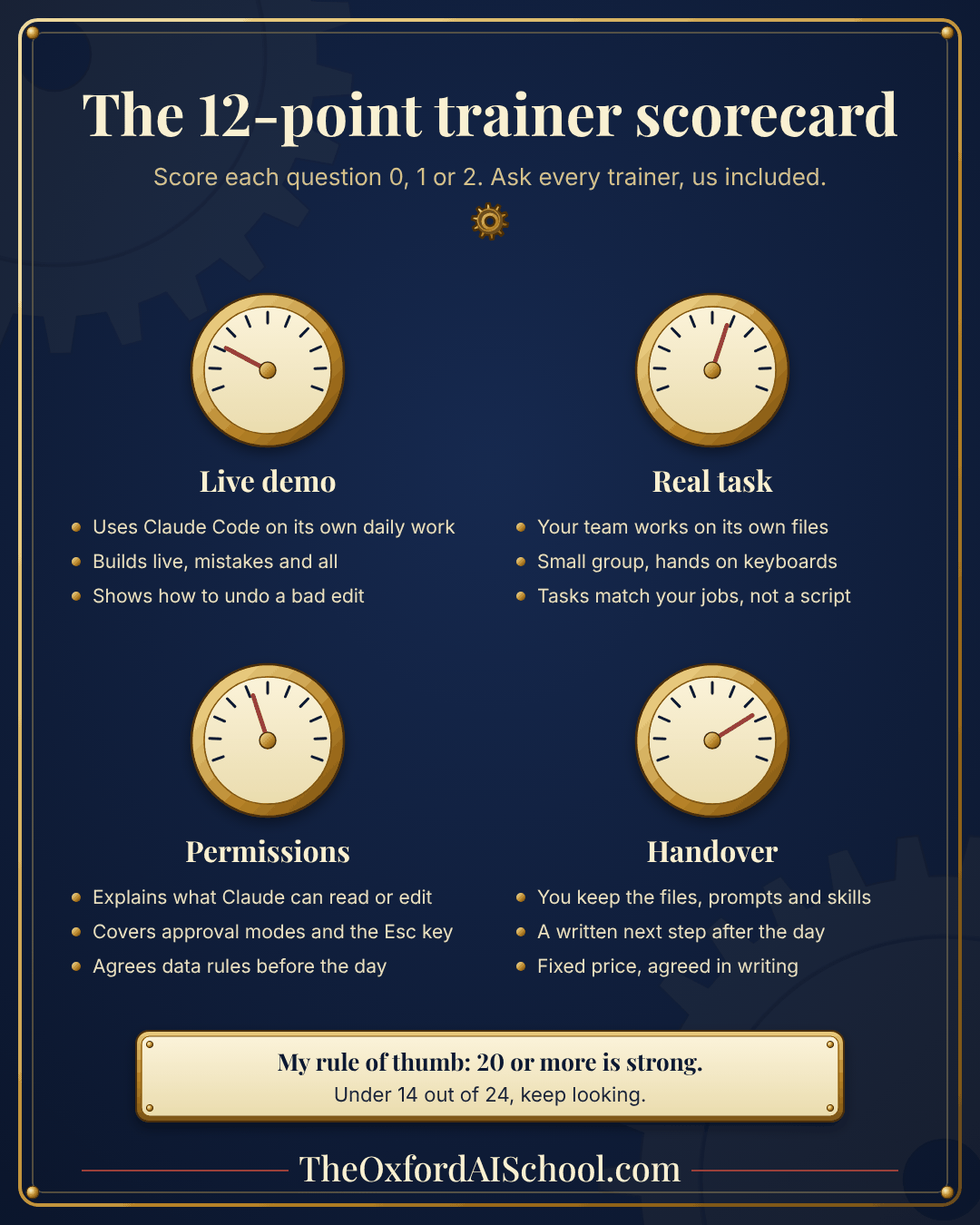
Ask each trainer twelve questions in four groups of three. Score every question 0, 1 or 2, which gives 24 points at most. Twenty or more is strong. Under 14, keep looking.
| Group | Question to ask | What a 2 sounds like |
|---|---|---|
| Live demo | 1. Do you use Claude Code on your own daily work? | They show you something from this week, including the messy bits. |
| Live demo | 2. Will you build live, mistakes and all? | They share a screen. Nothing is pre-recorded. |
| Live demo | 3. Can you show how to undo a bad edit? | They break something on purpose and recover it. |
| Real task | 4. Will my team work on its own files? | They ask for a copy of a folder before the day. |
| Real task | 5. Is it a small group with hands on keyboards? | Eight or fewer, and everyone types. |
| Real task | 6. Do the tasks match our jobs, not a script? | The agenda changes once they hear what you do. |
| Permissions | 7. What can Claude read or edit? | They name the folders and actions in play without checking notes. |
| Permissions | 8. Do you cover approval modes and the Esc key? | They teach you to switch modes and stop it mid-action. |
| Permissions | 9. Will we agree data rules before the day? | You get a short written list of what stays out. |
| Handover | 10. Do we keep the files, prompts and skills? | Memory files, skills and automations leave with you. |
| Handover | 11. Do we get a written next step? | You know what to do in week one and week four. |
| Handover | 12. Is the price fixed and in writing? | One figure, VAT stated, exclusions listed. |
Twenty or more out of 24 is strong. Between 14 and 19, the gaps are worth negotiating before you sign. Under 14, keep looking. Those thresholds are my rule of thumb, not an industry standard, and nobody has audited them. They are a decent way to stop a charming sales call deciding the matter for you.
What to listen for on permissions
This is where a trainer who uses the tool every week sounds different from one who has read about it. Anthropic’s own documentation says new terminal and VS Code sessions start in auto mode, where a separate classifier reviews risky actions before they run. It also says deny rules hold in every mode, and that Shift+Tab cycles through the permission modes, Manual included.
A good trainer will tell you that Esc stops Claude mid-action and keeps everything up to that point, and that /rewind (or Esc twice on an empty prompt) rolls the code, the conversation or both back to an earlier prompt. They will also warn you that checkpoints do not restore files that only a shell command touched. If a provider cannot say any of that, give them a 0 on question 8 and move on.
How do you test a Claude Code trainer in 30 minutes?
Give them one messy task from your own week and ask them to do it live. Thirty minutes is enough to see whether they use the tool, cope with surprises and explain what is happening.
- Describe a real task in two sentences. Leave out anything confidential.
- Ask them to share their screen and start Claude Code on a sample folder that resembles yours.
- Ask what Claude is allowed to do before they type a word.
- Ask them to make it do something wrong, then undo it.
- Ask what they would put in a project memory file for your team.
- Ask for a fixed price in writing, with VAT and exclusions.
We are a team of [number] people doing [what you do].
One job we repeat every week: [one sentence].

On a 30 minute call, please:
1. Show Claude Code doing a similar job on a sample folder, on your screen.
2. Tell us what it is allowed to read, change and run before you start.
3. Make it do something wrong, then undo it.
4. Tell us what you would put in our team's project memory file.
5. Send a fixed price in writing, with VAT and anything excluded.You will learn more in those thirty minutes than in a week of reading testimonials. A trainer who is happy to be tested is usually a good sign. One who wants to send a deck instead has told you something too.
Is the best trainer in London different from the best in the UK?
Only in one respect: whether they can be in the room. The skills you are scoring are the same everywhere. London teams can choose in person or online, and teams in Leeds, Bristol or Edinburgh can get the same quality over a screen in a 3.5 hour half day.
London has more providers, which makes the scorecard more useful, not less. More choice means more brochures. If your team sits in several cities, a virtual session also saves you the argument about whose office wins.
We run sessions for London teams in person or online, and the details are on our Claude training London page. If you are choosing a general AI trainer rather than a Claude Code specialist, start with who is the best AI trainer in London. If your team is spread across the UK, our AI training UK guide covers the wider options.
Which questions matter most for your team?
Weight the scorecard to the risk you carry. A law firm should care most about permissions and data rules. A busy agency should care most about handover. A remote team should care most about the live demo.
| Your situation | Weight these most | Why |
|---|---|---|
| Regulated work: law, finance, healthcare | Permissions (7 to 9) | The risk is what goes into the tool and what it can change. |
| Busy team with no time to follow up | Handover (10 to 12) | If nothing leaves with you, nothing changes on Monday. |
| Remote or spread across cities | Live demo (1 to 3) | On a screen, you cannot fake familiarity with the tool. |
| Mixed technical levels | Real task (4 to 6) | People learn fastest on their own files, at their own pace. |
Where do we stand on the scorecard?
| Question | What our published pages say | Status |
|---|---|---|
| 1. Uses Claude Code on its own daily work | The module pages do not state this. Ask the trainer directly. | Ask us |
| 2. Builds live | Module two automates a real job while you watch. Module three builds an agent live. | Published |
| 3. Shows how to undo a bad edit | Module one ends with checking, undoing and safety nets. | Published |
| 4. Your team works on its own files | Module one points Claude at a folder of your own work. | Published |
| 5. Small group | Up to eight people per session. | Published |
| 6. Tasks match your jobs | Module three builds an agent on a real job from your week. | Published |
| 7. What Claude can read or edit | Module one covers what Claude Code can and cannot see, and when to let it run. | Published |
| 8. Approval modes and Esc | Staying in control is covered, but the pages do not list modes or keys by name. | Ask us |
| 9. Data rules before the day | Not stated on the module pages. | Ask us |
| 10. You keep what you build | The memory file, commands, skill and automation from module two go home with you. | Published |
| 11. A written next step | Module three plans your next two agents. A written follow-up is not promised on the pages. | Ask us |
| 12. Fixed price in writing | £2,299 +VAT per module is published. Ask about exclusions. | Published |
I am not going to give us a score out of 24. A trainer who marks themselves 23 is the trainer to avoid. Put the four open questions to us on a call, score the answers and compare us with whoever else is on your list. The pathway itself is described in Who can train my UK team in Claude Code?, and the modules are Claude Code Deep Dive, Advanced Claude Code and Building Agents in Claude Code.
When is another trainer a better choice than us?
When your team writes software for a living, when you only need one person trained, or when another provider scores higher on the twelve questions. Believe the number. A scorecard that cannot say no to its author is a brochure.
A team of engineers who want help with code review and build pipelines will get more from Anthropic’s free Claude Academy courses and the developer documentation than from us. A single founder is better served by a free course and a short call when stuck. We are built for teams who do not write code for a living and who need to see it working on their own files.
Four answers that should worry you
- "It is all in the slides." Nothing live means nothing proven.
- "Claude does it all for you." A trainer who skips permissions is skipping the part that protects you.
- "Everyone gets a certificate." A certificate shows attendance. It does not show a skill.
- "We will send the recording." A recording is not a handover. A handover is a folder you can use on Tuesday.
What should happen after the training day?
Within a week, the team should have done the jobs the trainer set. Within a month, someone should review what held up and drop what did not. A good trainer agrees both dates before the day. Put them in the diary before the room empties.
Training is a starter motor. It turns the engine over. Then you need a rhythm, and How to learn Claude Code gives you a four-week one. Once the basics hold, How to learn advanced Claude Code covers project memory, skills and connected tools. And when you are ready to hand a job to an agent, Agentic AI for business explains how much rope to give it.
The one-page infographic
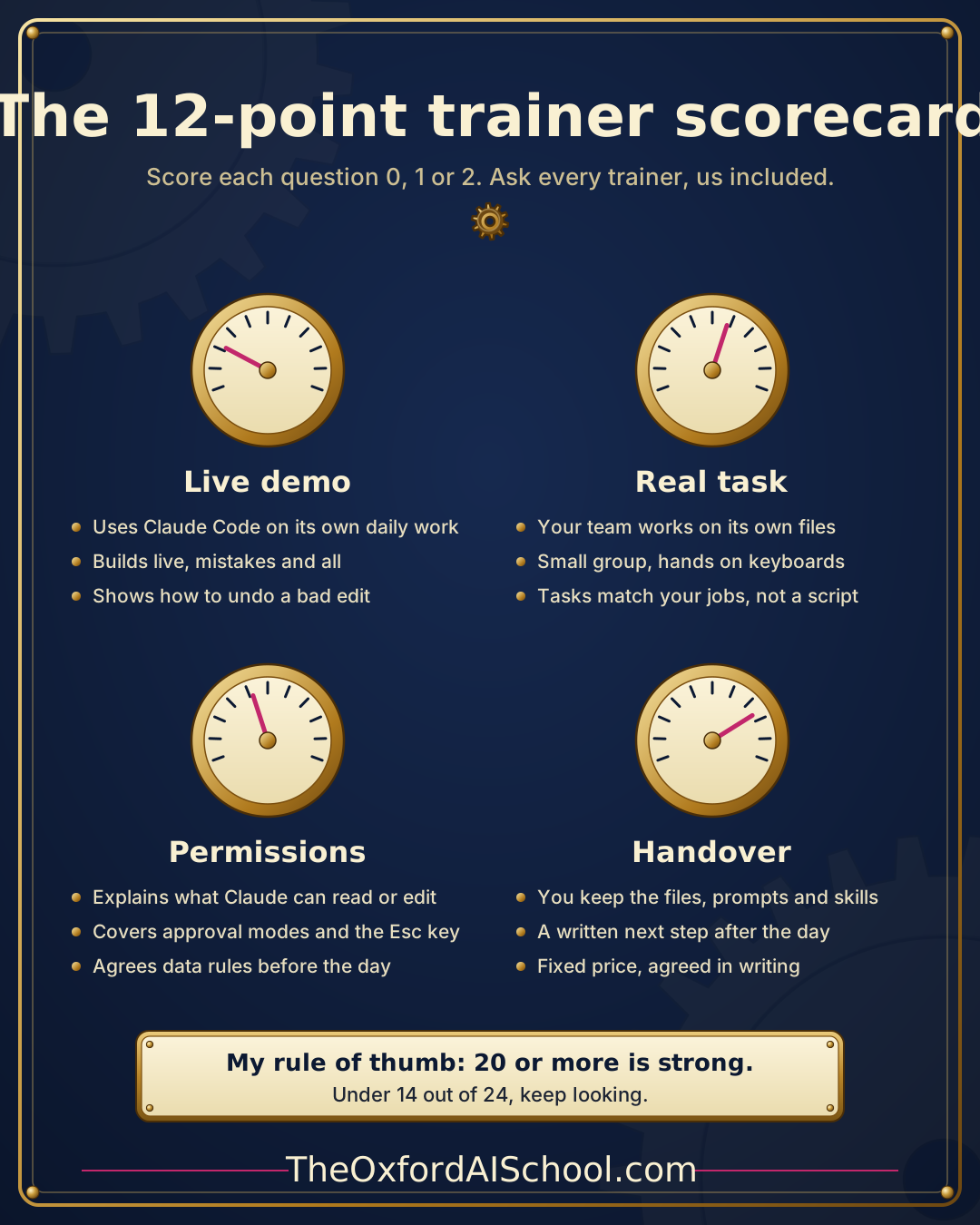
Screenshot it, send it round the team and score every provider on your list, including us.
Put the skills to work with us
Put the four open questions to us on a free 15 minute call. Tell me what your team does, I will say honestly whether Claude Code is worth it yet, and you can score the answers like anyone else’s.
- Claude Code Deep Dive for the first half day: install it, give it a job, check its work.
- Advanced Claude Code for project memory, shortcuts, connected tools and skills.
- Building Agents in Claude Code for a working agent that runs on a schedule.
Key takeaways
- No one can name the best Claude Code trainer for you, but a scorecard can name the best fit.
- Twelve questions sit in four groups: live demo, real task, permissions and handover.
- Score each 0, 1 or 2. Twenty or more out of 24 is strong. Under 14, keep looking.
- Test any trainer with one live task from your own week, in 30 minutes.
- We marked ourselves only on what our published pages say: eight answered, four left to ask.
Frequently asked questions
Who is the best Claude Code trainer in London?
There is no single best. The best is whoever scores highest on twelve questions for your team: uses Claude Code daily, builds live on your own files, explains permissions and hands over what you made. Score at least three providers and ask each for a live 30 minute test.
How do I check a Claude Code trainer is credible?
Ask for a live demo on a task you describe, ask what Claude is allowed to read and change, and ask how to undo a bad edit. Credible trainers answer from practice. You can also compare what they teach with Anthropic’s free Claude Academy courses.
Is paid Claude Code training worth it when Anthropic’s courses are free?
Sometimes not. If one motivated person will learn alone, the free courses are excellent. Paid training earns its fee when a whole team needs shared habits, hands-on help on its own files and someone to fix what goes wrong live. Count what a team stuck for a week costs.
Do I need a trainer based in London to learn Claude Code?
No. A 3.5 hour half day works well online if everyone has a laptop and a copy of real files. In person helps when a team wants to work through problems at one table. Choose on how your team prefers to learn, not on postcode.
How much does a Claude Code trainer cost in the UK?
It varies widely, so ask for a fixed price in writing with VAT and exclusions. Ours is £2,299 +VAT per half-day module for up to eight people. Compare the cost per attendee and what you keep afterwards, not the headline figure.
What does a score of 20 out of 24 mean?
It means the provider answered most questions with specific, checkable examples. The 20 threshold is our rule of thumb, not an industry standard. Look at which questions lost points: a missing answer on data rules matters more to a law firm than a missing follow-up does.
Can I use the scorecard for other AI tools?
Yes. Swap Claude Code for ChatGPT, Copilot or any tool in the questions. Live use, real tasks, permissions and handover matter for any AI training. Permissions weigh heavier for tools that can edit files or send messages on your behalf.
Is The Oxford AI School part of the University of Oxford?
No. We are an independent training company in Witney, Oxfordshire, and not part of the University of Oxford. That matters for a scorecard: a name is not a credential, so score us on the twelve questions like any other trainer. We are registered with the ICO under ZC269107.
More in How To Use Claude Code & Agents
Guides by Harry Lang for people who want Claude Code and AI agents doing real work, with no coding background needed.
Who can train my UK team in Claude Code?
Five routes compared, with costs and the questions to ask.
How to learn Claude Code
A four-week plan for beginners, one small job a week.
Agentic AI for business
What agents do, the evidence, five gates and a 30 day plan.
How to use AI agents for work
A six-line brief, a safe test run and a schedule.
How to learn advanced Claude Code
Project context, reusable skills, MCP and testing.
See the full series in the AI Learning Hub or book a free intro call with Harry.
Keep learning
- Who can train my UK team in Claude Code? Five routes compared, with costs and what to prepare.
- How to learn Claude Code A four-week plan for starting on your own.
- Agentic AI for business Where agents earn their keep and how much freedom to give them.
- Who is the best AI trainer in London? The wider question, beyond Claude Code.
- AI training UK guide Options for teams across the UK.
Sources and further reading
- Best practices for Claude Code, Anthropic documentation Auto mode, Shift+Tab, Esc, /rewind and checkpoint limits.
- Configure permissions, Anthropic documentation Permission modes and deny rules.
- Claude Academy Anthropic’s free self-paced courses.
- Claude Code Deep Dive module page Our published module details.
- Advanced Claude Code module page Our published module details.
- Building Agents in Claude Code module page Our published module details.
Figures and product behaviour checked on 17 November 2026. Tools and prices change, so confirm anything you plan to act on.