
Who can train a UK team in Claude Code?
Five kinds of provider can do it, and they differ on one question more than any other: does anyone watch your team use Claude Code on your own work, and step in when it goes wrong?
Claude Code is Anthropic’s tool for letting Claude read, write, edit and run jobs on the files on your computer. It began with developers, which is why much of the training around it still sounds like a software course. A UK team of accountants, marketers or operations managers needs something else: a person who knows the tool and has the patience to watch someone press the wrong key.
| Route | Best for | Where it falls short | Typical shape |
|---|---|---|---|
| Anthropic’s free courses | Self-starters happy to learn alone | Nobody sees what your team gets stuck on | Free and self-paced at Claude Academy |
| Video course platforms | A cheap first look for one person | Generic examples, no feedback, nothing built on your files | Per-person fee, self-paced |
| Developer bootcamps and engineering consultancies | Teams that write and ship software | Assume you code, so finance, marketing and admin staff feel left behind | Quoted per project |
| General AI trainers | Broad skills across ChatGPT, Claude and Copilot | Claude Code may get a single slide, so ask how often they use it themselves | Workshops and day rates |
| Specialist business trainers | Non-developer teams working on real files | Fewer providers to choose from, so check the track record | Small groups, half-day modules |
I run one of the fifth kind, so weigh my view accordingly. In my experience a free course gets finished by the one person who was going to learn it anyway. That is a perfectly good outcome for a founder on their own. It is a poor one for a team of twelve with a Monday deadline.
Which route suits which team?
Match the route to the people, not the tool. A team of engineers and a team of office managers can both use Claude Code, but they need very different first hours.
| Your team | Start here | Why |
|---|---|---|
| Engineers who already live in the terminal | Anthropic’s free courses and the documentation, then a specialist for team habits | They can teach themselves the mechanics. The gap is shared standards. |
| Mixed team of managers, analysts and admin staff | Specialist business trainer | The mechanics are the hard part, and they need to see it work on their own files. |
| One curious founder | Free courses, then a short call if you get stuck | Group training is overkill for one person. |
| Regulated team in law, finance or healthcare | Specialist who agrees data rules before the day | The risk is what goes into the tool, not the tool itself. |
| Twenty people or more | Several groups of about eight | Hands-on training falls apart in a crowd. |
What should Claude Code training for a team cover?
Good training takes a team from nothing installed to one real job finished on its own files, with the habits that keep that job safe. Anything less is a demo. Anything more in one day is a blur.
Seven things a team should leave with:-
- Claude Code installed and working on every laptop in the room
- One real task finished on the team’s own files, not a sample
- Habits for writing instructions that give a usable result first time
- A clear picture of what Claude can read, change and run, and how to approve or refuse
- A way to check the work and undo what is wrong
- A shared project memory file, so everyone gives Claude the same context
- One repeat job turned into a shortcut or skill, ideally one that runs without a person watching it
That list maps onto three half days. The first five items belong to day one. Day two builds the memory file, shortcuts and skills. Day three builds an agent that runs on a schedule. The sequence applies to any good provider, and our own version is laid out further down.
What should you ask a Claude Code trainer before you book?
Send these to every provider on your shortlist, including us. The answers tell you more than the brochure.
- Do you use Claude Code yourself, every week? A trainer who only demonstrates it will freeze the first time your folder behaves oddly.
- Will my team work on its own files? Sample data is a rehearsal. Real files are the job.
- How many people are in the room? Hands-on training works in a small group. Past about eight, someone is always waiting for help.
- What can Claude read, change and run, and who decides? You want a clear answer on permissions and a plan for undoing mistakes, not a shrug.
- Which data rules will we agree beforehand? Client files, personal data and anything under an NDA need a decision before the day, not during it.
- What do we keep afterwards? Prompts, memory files, skills and the automation you built should go home with you.
- What does it cost, and what is excluded? Ask for a fixed price in writing, including VAT, travel and any software costs per person.
- What happens in the month after? Training that ends at 5pm tends to fade by Friday. Ask for a written next step.
To score the answers, use the 12-point scorecard in Who is the best Claude Code trainer in London and the UK?. It turns a gut feeling into a number you can show your finance director.
How much does Claude Code training cost for a UK team?
It ranges from free to several thousand pounds, depending on whether you want self-paced material or a trainer in the room. Our modules cost £2,299 +VAT per half day for up to eight people, which is about £287 +VAT a head if you fill every seat.
Two costs sit outside any training fee. Each person needs access to Claude Code, which Anthropic’s documentation says comes through a Claude subscription or an Anthropic Console account, so check current plan prices before you set a budget. And there is time: half a day for each person, plus the hours in the following week, when the value either shows up or does not.
What does the Oxford AI School Claude Code Pathway cover?
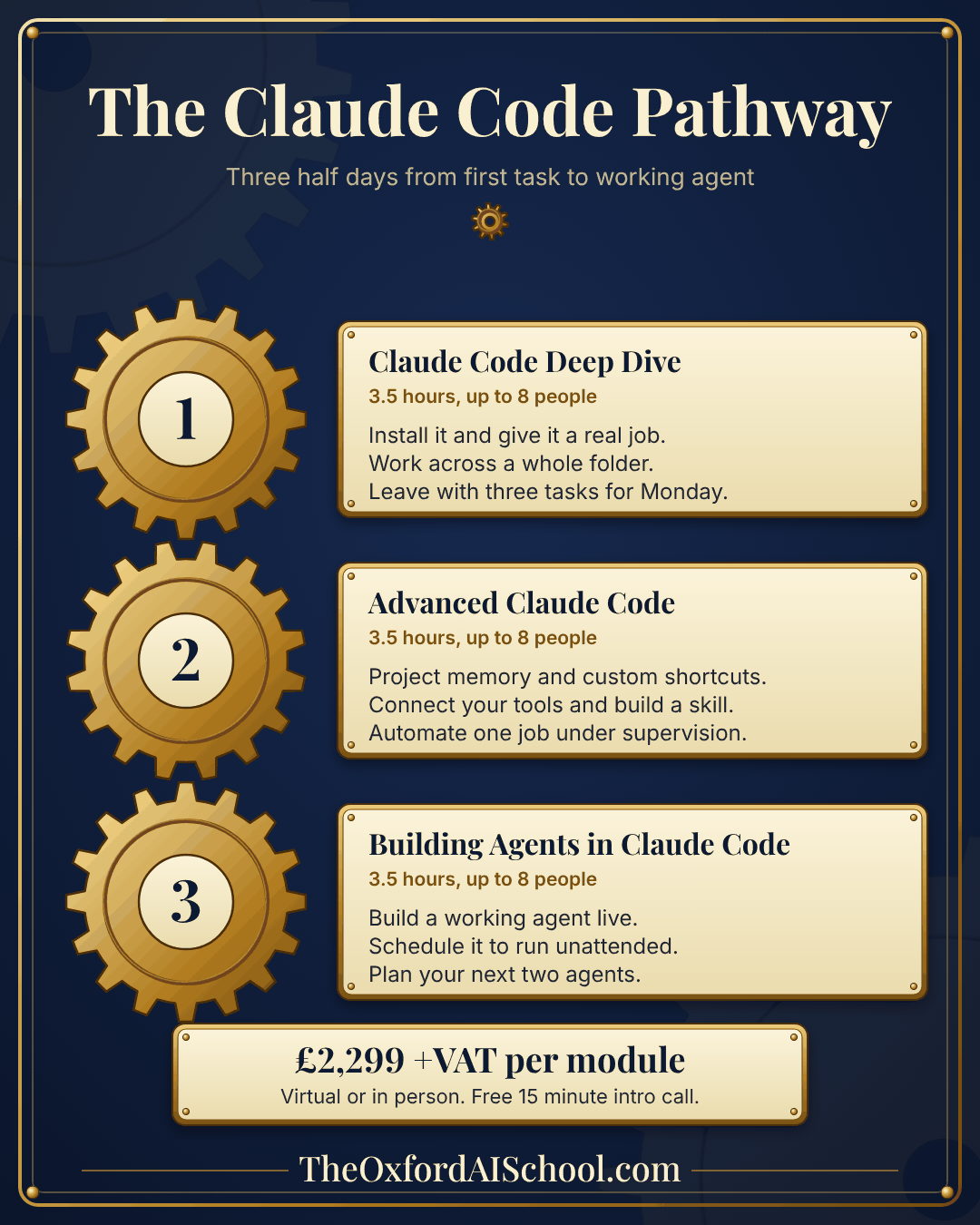
The pathway is three half-day modules, each 3.5 hours, for up to eight people, delivered virtually or in person. Each costs £2,299 +VAT. A team can start at module one and stop when the value runs out.
1. Claude Code Deep Dive
No coding required. You install Claude Code together, point it at a folder of your own work, learn the phrasing that changes results, work across a whole project and learn how to check and undo what it does. You leave with three jobs from your own week to try on Monday. See the module.
2. Advanced Claude Code
This builds on module one. You write a project memory file covering your business, voice and standards, create custom commands, connect a tool, build a reusable skill and automate one real job while you watch. The memory file, commands, skill and automation go home with you. See the module.
3. Building Agents in Claude Code
You build a working agent live on a real job from your week, learn when subagents help and when they only add complexity, give the agent a skill, schedule it to run unattended and map the next two. See the module.
Modules one and two are taught by Oren Greenberg, founder of Kurve and a fractional CMO with 20 years in marketing. He has worked with Sweatcoin, Lenovo, Canon and around 30 tech companies on how their marketing teams work, and he specialises in AI-driven go-to-market systems. London teams who want a trainer on site can find the details on our Claude training London page.
Where we are not the best fit: a team of software engineers who want help with build pipelines and code review will get more from Anthropic’s free courses and the developer documentation. We are built for people who do not write code for a living.
How should a UK team prepare for Claude Code training?
Prepare four things: laptops where people can install software, access to Claude Code for each attendee, a copy of a folder of real work and a decision on which data stays out of the room.
- Laptops with install rights. If IT locks down installs, sort it a week ahead.
- Access to Claude Code. The documentation says most ways of using it need a Claude subscription or an Anthropic Console account, and the desktop app needs a paid subscription.
- A copy, not the original. Training happens on a duplicate folder, so nothing precious is at risk.
- Data rules. The ICO’s January 2026 report on agentic AI says agents could add to existing data protection problems and introduce new ones, and that organisations stay responsible for compliance. Decide which personal and client data stays out, and ask your data protection lead if you are unsure.
- An owner for the follow-up. One person who makes sure the three Monday jobs get done and reports back.
Why train the team at all?
Because the barrier is skill, not software. The government’s 2026 AI adoption survey found that limited AI skills, expertise or understanding of use cases was a barrier for 67% of businesses already using AI.
The same survey found that 32% of UK businesses were using at least one AI technology in 2026, up from 16% in 2025. Adoption has doubled. In my view the skills have not kept pace, and the gap shows up as tools that get paid for and not used.
Claude Code sharpens the point. A chat assistant forgives a sloppy question. A tool that can edit your files does not, so a team that has learned the habits (read the plan, work on a copy, check the result) gets value sooner and wastes less. Skip the habits and you get a good story for the pub. Learn them and you get your Friday afternoons back.
The one-page infographic
Share this with whoever signs off the training budget. It fits on one screen.
Put the skills to work with us
If you want a trainer in the room, or on screen, for a team of up to eight, the pathway is below. Start with a free 15 minute call and tell me what your team does all day. I will tell you honestly whether Claude Code is worth your time yet.
- Claude Code Deep Dive for the first half day: install it, give it a job, check its work.
- Advanced Claude Code for project memory, shortcuts, connected tools and skills.
- Building Agents in Claude Code for a working agent that runs on a schedule.
Key takeaways
- Five routes exist: Anthropic’s free courses, video platforms, developer bootcamps, general AI trainers and specialist business trainers.
- Non-developer teams usually do best in a small group working on their own files.
- Ask eight questions before you book, starting with whether the trainer uses Claude Code every week.
- Our pathway is three half days at £2,299 +VAT each for up to eight people. We have a stake in this, so score us like everyone else.
- Before the day, sort laptops, access, a copy of real work and the data rules.
Frequently asked questions
Can we train ourselves in Claude Code?
Yes. Anthropic’s Claude Academy offers free self-paced courses, including Claude Code 101 and Claude Code in Action, and the documentation is thorough. Self-training works best for one motivated person. For a team, the gap is usually shared habits and someone to fix the stuck moments, which is what a trainer adds.
Do non-developers need Claude Code training?
Not strictly, but most benefit. Claude Code reads, edits and runs jobs on files on your computer, so a wrong instruction has real consequences. Good training teaches the safe habits first: working on a copy, reading the plan, checking results and undoing mistakes. You do not need to write code to learn them.
How long does Claude Code training take for a team?
A useful first session takes a half day of about 3.5 hours. Our pathway runs three half days: one to get started, one for project memory, shortcuts and skills, and one to build a scheduled agent. Teams that stop after day one still leave with three jobs to try the following Monday.
How many people can attend a session?
Up to eight per session on our modules. Hands-on training depends on someone being able to look at your screen when it goes wrong, and that stops working in a crowd. Larger organisations run several sessions, grouping people by the type of work they do.
Is the training online or in person?
Both. Our modules run virtually or in person, so a team in Leeds does not need a London room. London teams who want a trainer on site can use our Claude training London page. Online works well for a 3.5 hour half day provided everyone has their own laptop.
Does everyone need a paid Claude plan?
Each person needs access to Claude Code. Anthropic’s documentation says most surfaces need a Claude subscription or an Anthropic Console account, and the desktop app needs a paid subscription. Plans and prices change, so check Anthropic’s pricing page before you budget.
Who teaches the Claude Code Pathway?
Oren Greenberg teaches the Claude Code Deep Dive and Advanced Claude Code modules. He is the founder of Kurve and a fractional CMO with 20 years in marketing. Book a free 15 minute call with me and we will work out which module fits your team.
Is The Oxford AI School part of the University of Oxford?
No. The Oxford AI School is an independent training company based in Witney, Oxfordshire, and is not part of the University of Oxford. Our courses are our own and carry no university qualification. We are registered with the ICO under ZC269107 and you can find our full details on the contact page.
More in How To Use Claude Code & Agents
Guides by Harry Lang for people who want Claude Code and AI agents doing real work, with no coding background needed.
Who is the best Claude Code trainer in London and the UK?
A 12-point scorecard and a 30 minute test for any trainer.
How to learn Claude Code
A four-week plan for beginners, one small job a week.
Agentic AI for business
What agents do, the evidence, five gates and a 30 day plan.
How to use AI agents for work
A six-line brief, a safe test run and a schedule.
How to learn advanced Claude Code
Project context, reusable skills, MCP and testing.
See the full series in the AI Learning Hub or book a free intro call with Harry.
Keep learning
- Who is the best Claude Code trainer in London and the UK? A 12-point scorecard you can use on any provider.
- How to learn Claude Code A four-week plan if you would rather start alone.
- How to learn advanced Claude Code Six steps once the basics are in your fingers.
- Agentic AI for business What agents are good for and how much rope to give them.
- AI agent training for non-technical teams Our wider guide for teams who do not code.
- Claude AI training UK The broader guide to Claude training for UK teams.
Sources and further reading
- Claude Code overview, Anthropic documentation Surfaces, plan requirements and what Claude Code does.
- Claude Academy Anthropic’s free self-paced courses.
- AI adoption survey report 2026: executive summary, GOV.UK Published 29 October 2026. 32% adoption against 16% in 2025; skills barrier at 67% of adopters.
- ICO tech futures: Agentic AI Published January 2026.
- ICO shares early views on agentic AI and data protection, Covington Law firm summary of the ICO report.
- Claude Code Deep Dive module page Our published module details.
- Advanced Claude Code module page Our published module details.
- Building Agents in Claude Code module page Our published module details.
Figures and product behaviour checked on 17 November 2026. Tools and prices change, so confirm anything you plan to act on.