
What is agentic AI in plain English?
Agentic AI is AI that acts on a goal rather than just answering a question. You say what you want done, it works out the steps, uses tools such as your files, inbox or calendar, and tells you what it did.
The cleanest way to see it is by what happens after you press enter.
| Type | You give it | It does | Who decides the steps |
|---|---|---|---|
| Chatbot | A question | Answers in a window | You |
| Assistant | A task, in steps | Does each step you ask for, in order | You |
| Agent | A goal and some tools | Plans the steps, works through them and reports back | The agent, within limits you set |
Our guide to AI agents vs chatbots goes into more detail on the first and last of those.
A word of warning before you shop. Gartner has a name for vendors who relabel chatbots and old-fashioned automation as agents: agent washing. It estimated in June 2025 that only about 130 of the thousands of agentic AI vendors are real. Ask what the product does without you in the room. If the demo needs a person to press every button, you have been shown a chatbot in a hat.
What does the evidence say about agents in business?
Interest is high, scale is rare and analysts expect many projects to fail. About two in ten respondents in McKinsey’s 2026 survey report scaling agents across their organisation, and Gartner expects over 40% of projects to be cancelled by the end of 2027. The pattern is an old one: a good idea, bought before anyone chose the job.
| Source | Finding | What it means for you |
|---|---|---|
| UK government AI adoption survey, published 29 October 2026 | 32% of UK businesses used at least one AI technology in 2026, up from 16% in 2025. Agentic AI was described as less widely trusted and more likely to face scrutiny than other technologies. | AI use is spreading fast. Handing it real autonomy is a smaller step that fewer firms have taken. |
| McKinsey, The State of AI in 2026, published 25 August 2026 | Nearly nine in ten respondents report regular AI use in at least one business function. About two in ten report scaling AI agents across their organisation: 40% in large organisations (over $1bn revenue) and a flat 22% in smaller ones. | Scaling agents is still the exception, and size matters. Getting one agent to run well is the real milestone. |
| Gartner, June 2025 | Over 40% of agentic AI projects will be cancelled by the end of 2027, because of escalating costs, unclear value or inadequate risk controls. | Choose one job with a clear value and check it, rather than launching a grand programme. |
| ICO, Tech Futures: Agentic AI, January 2026, and call for evidence, 8 October 2026 | Early thinking, not formal guidance. Agentic AI could exacerbate existing data protection issues or introduce new ones, and organisations remain responsible for compliance. A six-week call for evidence has responses due by 20 November 2026. | Decide what personal data an agent may reach before it runs. |
In my view the lesson from those four is modest and useful. Start small, check the work and say no to the grand plan. Gartner puts the cancellations down to escalating costs, unclear value and weak risk controls, and none of those is a technology problem.
Where do AI agents earn their keep in a business?
On jobs that repeat, follow rules and can be checked. If you could write the steps on a card and a colleague could check the result in five minutes, an agent can probably help.
| Job | The agent does | A person does | Starting level |
|---|---|---|---|
| Weekly reporting | Collects the exports, compares with last week and flags big changes | Reads the summary and decides what matters | Draft |
| Inbox triage | Sorts messages and drafts replies to routine ones | Approves and sends | Draft |
| Meeting follow-up | Turns notes into actions and a decision log | Confirms owners and dates | Draft |
| Lead research | Gathers public facts on a prospect list | Chooses who to contact | Suggest |
| Invoice chasing | Finds overdue invoices and drafts reminders | Approves each one | Act with approval |
| Document checking | Compares a draft against a checklist and lists the gaps | Fixes the gaps | Suggest |
Notice what is missing: anything that spends money, deletes records or speaks to a client with nobody in the loop. That is deliberate, and the next two sections explain why.
How much freedom should an AI agent get?
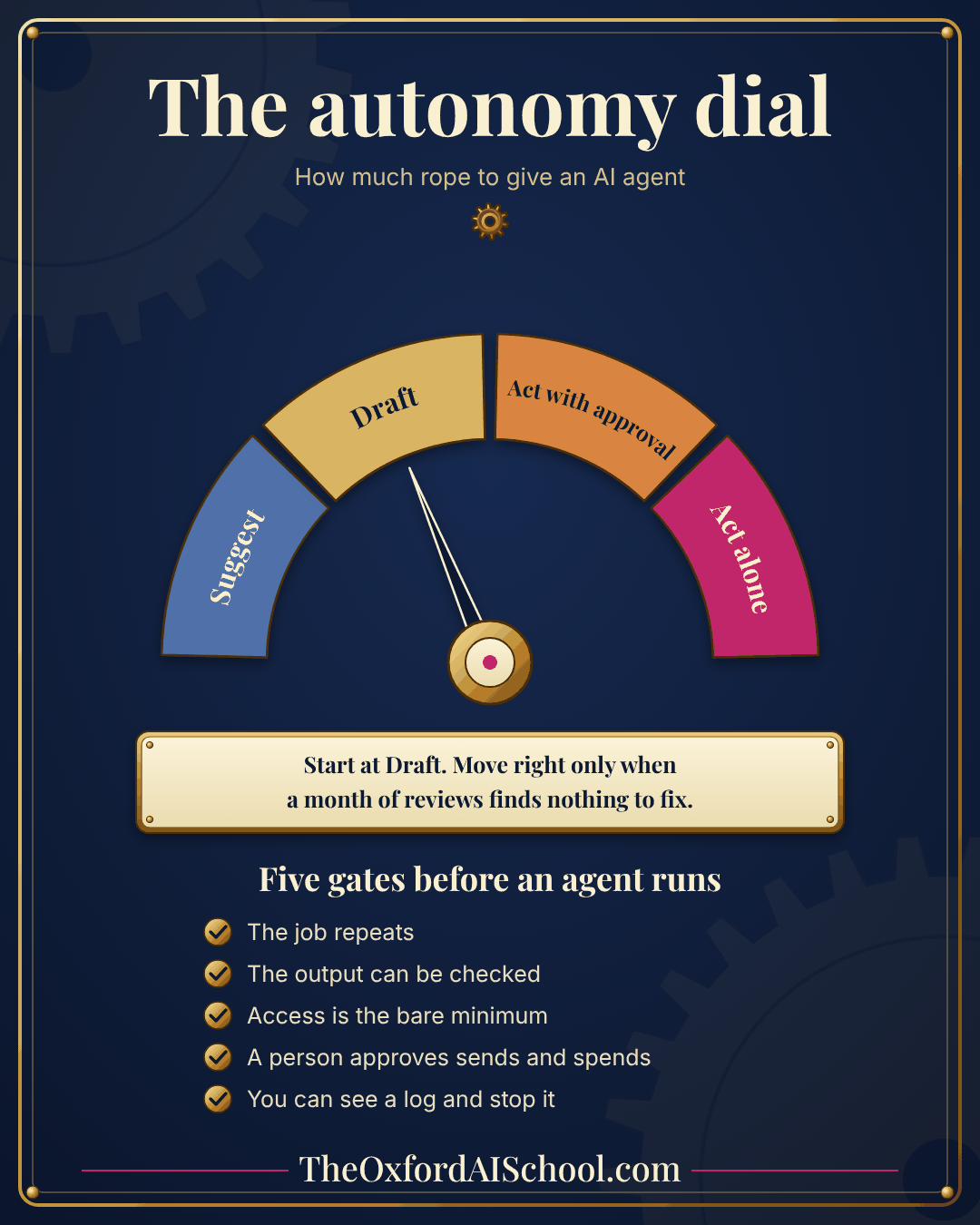
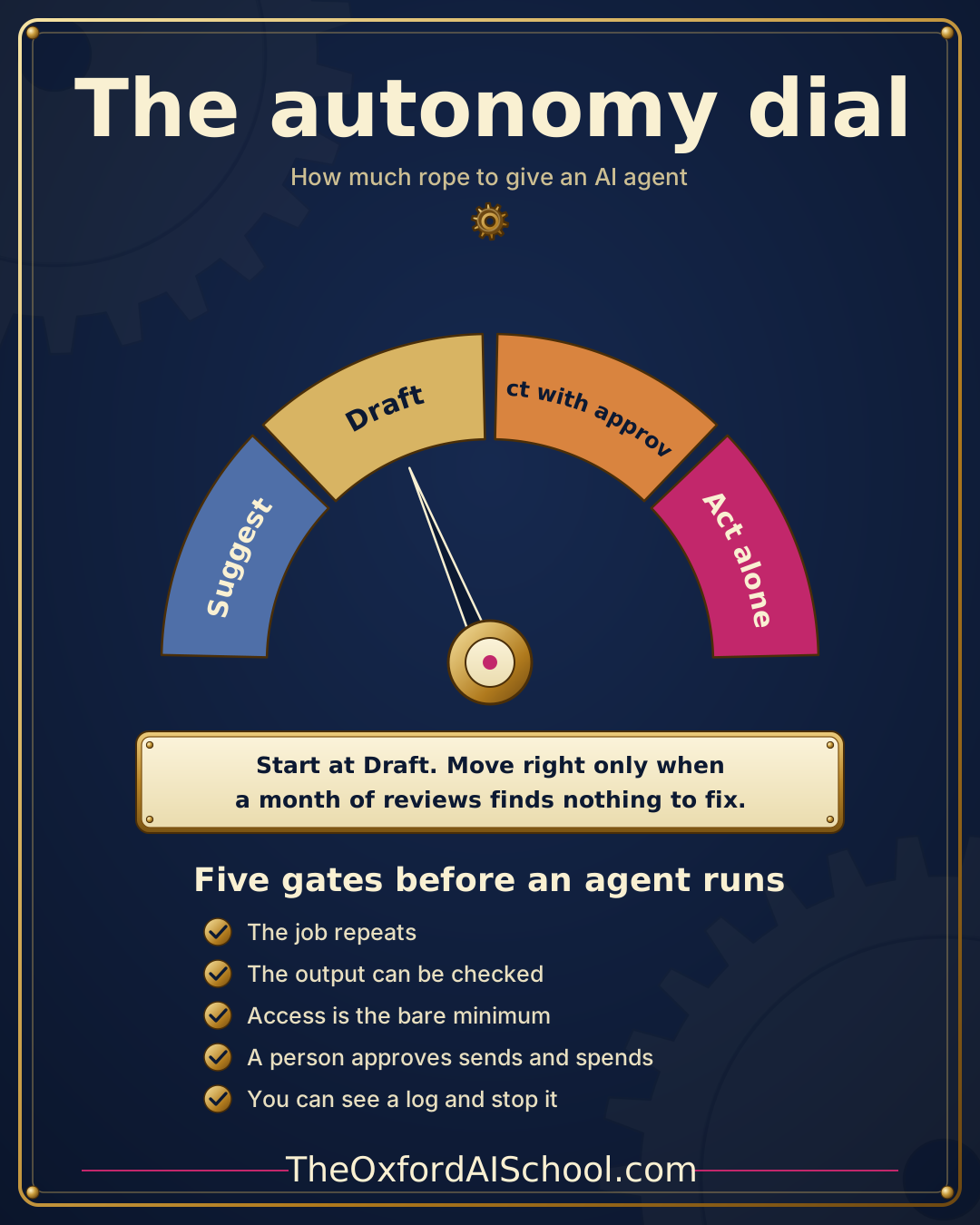
Less than you think, at first. Picture a dial with four settings: suggest, draft, act with approval and act alone. Start at draft, and move right only when a month of reviews finds nothing to fix.
| Setting | What the agent does | Example | Use it when |
|---|---|---|---|
| Suggest | Offers ideas and changes nothing | "These five invoices look overdue." | You are learning what it can see |
| Draft | Produces the work for a person to review | A drafted reminder email | The job repeats and the output can be checked |
| Act with approval | Takes the action once a person says yes | Sends the reminder after you click approve | Mistakes are cheap and easy to reverse |
| Act alone | Acts with no person in the loop | Files receipts into the right folder | The job is low-risk, long reviewed and easy to undo |
Most business agents should live at draft or approval for a long while, and some for ever. There is no medal for removing the human. The dial also applies job by job, so one agent can draft your reports and act alone on filing.
What are the five gates before an agent runs?
Five questions to answer yes to before any agent runs unattended: does the job repeat, can the output be checked, is access the bare minimum, does a person approve sends and spends, and can you see a log and stop it?
- The job repeats. One-off jobs rarely repay the setup time.
- The output can be checked. If you cannot tell a good result from a bad one in five minutes, you cannot supervise it.
- Access is the bare minimum. Give it the folder it needs, not the whole drive. In Claude Code, deny rules hold in every permission mode, so a rule that must never be broken belongs there.
- A person approves sends and spends. Emails to clients, payments and deletions wait for a human yes.
- You can see a log and stop it. Know what it did and be able to press stop. In Claude Code,
Eschalts it mid-action.
Anthropic’s best practices guide draws the same line between requests and enforcement. A rule in your instructions is something Claude usually follows. A deny rule or a hook is something Claude Code makes happen every time. For the few rules that cannot have exceptions, use the second kind.
What does the UK regulator say about AI agents?
The ICO has said agentic AI could make existing data protection problems worse and introduce new ones, and that organisations stay responsible for compliance. Its January 2026 Tech Futures report is early thinking, not formal guidance, and in October it opened a call for evidence.
On 8 October 2026 the ICO opened a six-week call for evidence on how organisations manage the data protection risks of agentic AI, with responses due by 20 November 2026. It says the answers will feed its guidance and its code of practice on AI and automated decision-making.
For a small business the practical reading is simple. Know which personal data an agent can reach, keep that set small and keep a person in the loop for anything that affects a customer. If you are unsure, ask your data protection lead or adviser. This page is general information, not legal advice.
How do you start with agentic AI in 30 days?
Pick one job in week one, build it at draft level in week two, compare it with a person’s work in week three and decide in week four. It fits around a normal job.
- Week 1: choose the job. Pick a weekly task that takes 20 to 60 minutes, repeats and can be checked. Write the six-line brief from How to use AI agents for work.
- Week 2: build at draft. Run it on a copy of the data. Read every result and note each mistake as you find it.
- Week 3: compare. Do the job yourself once and compare. Count the errors and the minutes saved.
- Week 4: decide. Keep it at draft, move it to approval or drop it. Write down why.
The tool matters less than the discipline. Claude Code can run this on your own files, and our Building Agents in Claude Code module builds a first agent live and schedules it to run unattended. If you are new to the tool, start with How to learn Claude Code.
How do you work out whether an agent is worth it?
Count the minutes saved per run, multiply by runs a month, then subtract the minutes you spend reviewing and fixing. If the number is not clearly positive after a month, drop it.
| Measure | How to count it |
|---|---|
| Minutes saved per run | Time the job by hand once, then time your review of the agent’s version. |
| Runs per month | How often the job really happens, not how often it should. |
| Review and fix time | Every minute spent checking, correcting or re-running. |
| Errors caught | Mistakes you found before anyone else did. |
| Errors missed | Mistakes that reached a client or colleague. Any of these means move down the dial. |
Gartner’s warning about escalating costs and unclear value is aimed at big programmes, but the arithmetic works for a one-person agent too. A tool that saves ten minutes and takes twelve to supervise is a very expensive pet.
The one-page infographic
A one-screen answer to how much rope to give an agent. Share it with whoever owns the risk.
Put the skills to work with us
Agents are easiest to learn by building one on a real job from your own week. Our three half-day modules take a team from first task to a scheduled agent. Book a free 15 minute call and tell me which job you would hand over first.
- Claude Code Deep Dive for the first half day: install it, give it a job, check its work.
- Advanced Claude Code for project memory, shortcuts, connected tools and skills.
- Building Agents in Claude Code for a working agent that runs on a schedule.
Key takeaways
- Agentic AI works towards a goal with tools, instead of only answering a question.
- Interest is high and scale is rare: about two in ten McKinsey respondents are scaling agents, and Gartner expects over 40% of projects to be cancelled by 2027.
- Start at Draft. Move up the dial only after a month of reviews finds nothing to fix.
- Five gates: the job repeats, output can be checked, access is minimal, a person approves sends and spends, and you can see a log and stop it.
- Count minutes saved against minutes spent reviewing. If the number is not clearly positive after a month, drop the agent.
Frequently asked questions
What is agentic AI?
Agentic AI is AI that works towards a goal on its own: it plans steps, uses tools such as files, email or a calendar, and reports back. A chatbot answers a question. An agent carries out a job within limits you set, so the limits matter more than the model.
What is the difference between agentic AI and generative AI?
Generative AI produces content when asked, such as text, images or code. Agentic AI uses a generative model as its brain and adds goals, tools and steps, so it can do a job rather than draft a single answer. Most agents are built on generative models.
What is an AI agent?
An AI agent is software that takes a goal, works out the steps, uses tools and reports back. In Claude Code, an agent takes a goal, tools and preferred methods, works out the steps itself and reports when it finishes. It can hand parts of a job to subagents.
How many UK businesses use agentic AI?
There is no reliable single figure. The government’s 2026 survey found 32% of UK businesses used at least one AI technology, and described agentic AI as less widely trusted than other technologies. Globally, McKinsey’s 2026 survey found about two in ten respondents scaling AI agents across their organisation.
Is agentic AI safe for business?
It can be, with limits. Give the agent the least access it needs, keep a person approving sends and spends, keep a log and test on copies first. The ICO says agentic AI could add to existing data protection problems and create new ones, so more freedom needs more checking, not less.
Where should a small business start with AI agents?
Start with one weekly job that takes 20 to 60 minutes, repeats and can be checked, such as a sales summary or meeting follow-up. Build it at draft level, review every result for a month and only then consider giving it more freedom.
Do I need Claude Code to use AI agents?
No. Several tools offer agents. Claude Code suits jobs on files on your own computer and can run work on a schedule. Whichever tool you choose, the discipline is the same: one job, a brief, a copy, a check and a person approving anything that leaves the building.
Can The Oxford AI School train my team to build agents?
Yes. Building Agents in Claude Code is a half-day module for up to eight people, virtual or in person, at £2,299 +VAT. You build a working agent on a real job, schedule it to run unattended and plan your next two. It follows the Claude Code Deep Dive and Advanced Claude Code modules.
More in How To Use Claude Code & Agents
Guides by Harry Lang for people who want Claude Code and AI agents doing real work, with no coding background needed.
Who can train my UK team in Claude Code?
Five routes compared, with costs and the questions to ask.
Who is the best Claude Code trainer in London and the UK?
A 12-point scorecard and a 30 minute test for any trainer.
How to learn Claude Code
A four-week plan for beginners, one small job a week.
How to use AI agents for work
A six-line brief, a safe test run and a schedule.
How to learn advanced Claude Code
Project context, reusable skills, MCP and testing.
See the full series in the AI Learning Hub or book a free intro call with Harry.
Keep learning
- How to use AI agents for work A six-line brief that keeps an agent useful and safe.
- AI agents vs chatbots The difference, with examples.
- Are AI agents safe for business? Risks and the sensible limits.
- What AI agents can do for small business Practical jobs for a small team.
- How to learn Claude Code A four-week plan for beginners.
- Who can train my UK team in Claude Code? Five routes for teams, compared.
Sources and further reading
- AI adoption survey report 2026: executive summary, GOV.UK Published 29 October 2026. 32% against 16%; agentic AI less widely trusted.
- The state of AI in 2026: On the road to ROI, McKinsey Published 25 August 2026. Nearly nine in ten use AI; about two in ten scaling agents.
- Gartner predicts over 40% of agentic AI projects will be cancelled by end of 2027 Published 25 June 2025. Includes the agent washing estimate.
- ICO tech futures: Agentic AI Published January 2026.
- ICO secures changes from leading AI developers as scrutiny extends to AI agents Published 8 October 2026. Call for evidence on agentic AI.
- ICO shares early views on agentic AI and data protection, Covington Law firm summary of the ICO report.
- Best practices for Claude Code, Anthropic documentation Deny rules, hooks and permission modes.
- Building Agents in Claude Code module page Our published module details.
Figures and product behaviour checked on 17 November 2026. Tools and prices change, so confirm anything you plan to act on.