Business AI field guide · Part 4 of 5
What are the top 3 AI implementation mistakes to avoid in 2026?
Three ways to make a promising pilot expensive. Three ways to avoid them.
The launch meeting goes well. Everybody likes the demonstration. There is a slide with an arrow pointing upwards. Six weeks later, the one person who knew how the prompt worked is on holiday. If this sounds familiar, the good news is that all three problems are fixable.
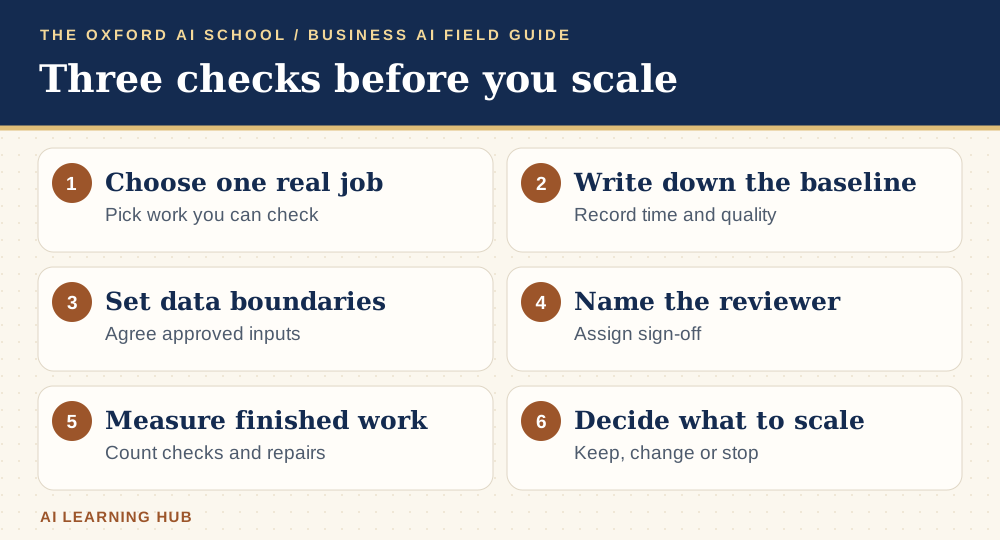
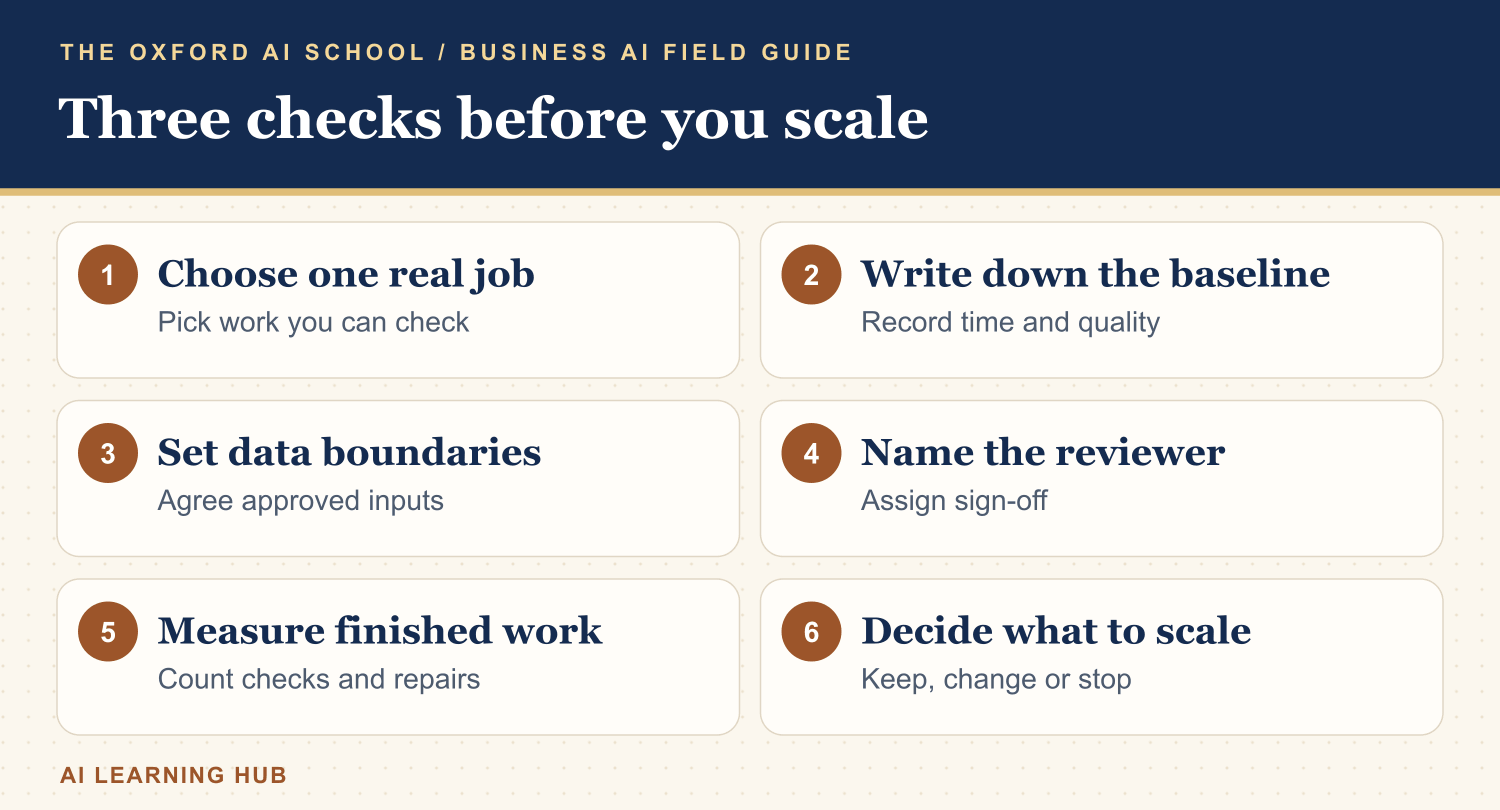
Read the infographic as text
- Choose one real job: Pick work you can check.
- Write down the baseline: Record time and quality.
- Set data boundaries: Agree approved inputs.
- Name the reviewer: Assign sign-off.
- Measure finished work: Count checks and repairs.
- Decide what to scale: Keep, change or stop.

1. Buying the tool before choosing the job
Start with a task you can describe in a sentence. “Prepare the first draft of a weekly supplier update from approved public sources” will do. Name the person who owns it and collect several examples of the current output. A licence gives somebody access. It does remarkably little to tell them what to do on Tuesday.
What to do this week. Ask the people doing the work where they lose time. Choose a job with a clear start and finish, a repeatable input and a result somebody can check. Record current effort, errors and turnaround before the pilot.
2. Leaving data rules and review to guesswork
Tell people which tool to use, what they may put into it and who checks the output. Write the rule in language that helps a colleague decide whether they can paste a particular file. Where personal data is involved, consult your organisation’s data protection lead and the ICO’s guidance.
What to do this week. Give the team a few examples of allowed and restricted inputs. Put one owner in charge of sign-off for customer-facing output. Practise on synthetic or public material first. The best time to discuss whether something can be sent is before somebody presses Send.
3. Scaling before measuring the finished work
The first draft may take thirty seconds. Count the checking, corrections, handover and the occasional hunt for a source that turns out to be a dead link. Compare the finished job with the old method on similar tasks. Ask a second person to run it without the pilot lead in the room.
What to do this week. Set a threshold for quality and total time before you test. Record issues and the work needed to fix them. Decide whether to keep the pilot, change it or stop. A small pilot you stop in time is a good result.
A four-week pilot you can run
| Week | Action | Evidence to keep |
|---|---|---|
| 1 | Choose a workflow and establish the baseline | Sample outputs and current effort |
| 2 | Agree approved inputs and practise | Rules and named reviewer |
| 3 | Run the workflow on ordinary work | Checked examples and errors |
| 4 | Review the results and hand it over | Total effort, quality and decision |
A sole trader can run the same pilot with a notebook. A larger team needs agreed ownership and a place for the evidence. See AI for Small Businesses in 10 Easy Steps and the AI Policy Workshop for the next step.
Keep learning: Business AI field guides
The five-part series
More from the AI Learning Hub
Sources and product notes
Official product information checked on . Examples and prompts are for practice. Access and controls can change by plan, platform and account.
Frequently asked questions
What should a small business implement first?
Choose one repeated job with clear inputs and an output a person can check. Start with an approved tool and a simple baseline.
How do I measure AI adoption?
Measure useful completed work, quality and total effort including review. Record how many colleagues can repeat the process without help.
When should a team automate the workflow?
When the manual pilot produces consistent results, has an owner and has a clear response for exceptions and errors.