The short answer
For most people in England, the best AI training to recommend is a free government-backed course first, followed by a live, hands-on session built on your own work. Leaders who want a credential should look at a business school programme. Technical career-changers should look at Skills Bootcamps, which are funded in England.
People ask for a recommendation the way they ask for a restaurant. "Somewhere good." Good for what? A first date and a stag do need different tables.
So here are five recommendations, by level. They are arranged as a ladder because that is how AI skills are built: each rung makes the next one possible, and people who skip to the top tend to come back down quickly.
What are the five levels of AI training?
AI training in England falls into five levels: awareness, foundations, applied skills, governance and automation. The infographic shows what each level covers, who it is for and a route I would recommend.
The AI training ladder
Five levels, what each one covers, and the best route in England for each.
Free: AI Skills Hub
90-minute team intro
Hands-on half-day
Policy workshop
Agent training Skills Bootcamps
Download the infographic as an image (PNG)
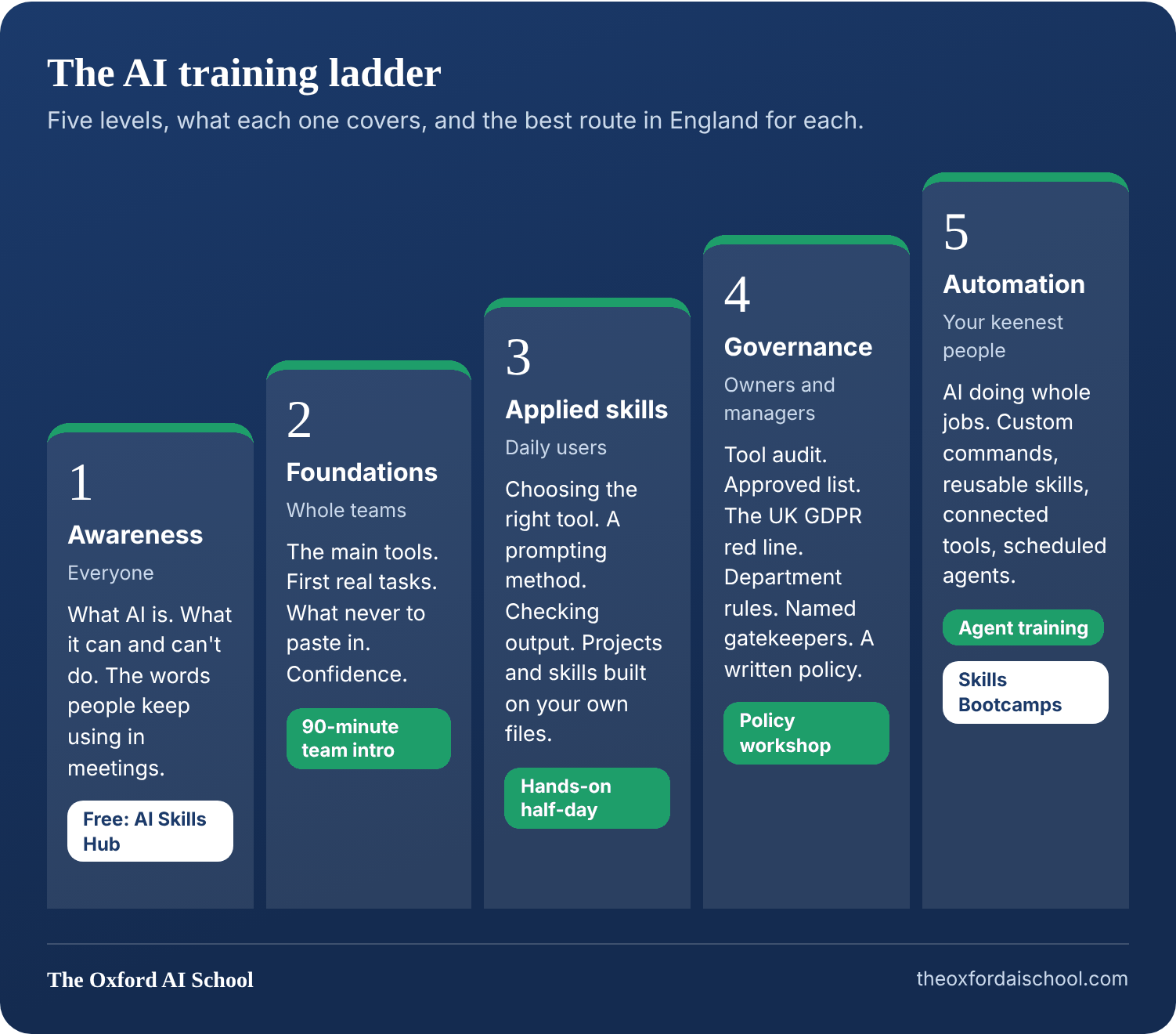
Level four sits where it does for a reason. You can write the rules earlier, and plenty of firms should. But people take a policy more seriously once they have used the tools enough to see why it exists.
Which AI training would I recommend at each level?
One recommendation per level, with a reason. Where the best answer is someone other than us, it says so.
Level 1: free courses on the AI Skills Hub
Start here, whoever you are. The government-backed AI Skills Hub collects free courses from firms including Google, Microsoft, Amazon and IBM. Some take under an hour. They will not show you how AI applies to your job, but they cost nothing and they remove the fear of the unknown, which is half the battle.
Level 2: a live 90-minute team introduction
Get the whole team in one room with one teacher. Everyone hears the same thing, tries the same tools and learns the same rules. Our Intro To AI for Teams does this for up to eight people. Any good local trainer offering a short live session would be a reasonable alternative. Pre-recorded video is not.
Level 3: a hands-on half-day on your own work
This is where the return shows up. A half-day in which people compare the main tools, learn a prompting method and build something from their own files. Our AI Basics Deep Dive is three and a half hours, about two thirds of it practical. If you only fund one level, fund this one.
Level 4: a one-day policy workshop
For owners, directors and whoever looks after data protection. You audit what is in use, agree what is allowed, set the red line on personal data and leave with a signed-off policy. See the AI Policy Workshop. Larger organisations with in-house legal teams may prefer to draft their own with outside review.
Level 5: agent training, or a Skills Bootcamp
Two different routes. For business users who want AI to handle whole jobs, short practical modules such as our Claude Code pathway fit well and need no coding. For people changing career into data or AI roles, a Skills Bootcamp is the better recommendation. They are government-funded, run in England, and last up to 16 weeks. Check what is on offer in your area, because provision varies by region.
And for senior leaders: if what you want is strategy, peers and a certificate with weight, look at executive programmes from LSE, Oxford Saïd, Imperial or London Business School. They are a different product from team training, and a good one.
Is AI training different in England from the rest of the UK?
The skills are identical. The funding and the official guidance differ, because skills policy is devolved. Skills Bootcamps and Skills England cover England, and the 2026 employer guide on AI upskilling from the Department for Work and Pensions and Skills England applies to England.
That guide is worth ten minutes of any employer's time. Its six tests for good training are that it should be practical, reachable, integrated, modular, expandable and sustainable. It favours short units of 30 to 90 minutes tied to real tasks. Read it before you sign anything long.
Scotland, Wales and Northern Ireland have their own skills bodies and funding schemes. Private training, including ours, is available across all four nations.
Where can you get AI training in each English region?
Everywhere, in practice. Live online delivery reaches any postcode, and in-person training is available in all nine English regions. We keep a guide for each.
- North East
- North West
- Yorkshire and the Humber
- East Midlands
- West Midlands
- East of England
- London
- South East
- South West
One warning from experience of the map. The quality of AI training has very little to do with geography and a great deal to do with the individual at the front of the room. A superb trainer in Carlisle beats a mediocre one in Shoreditch, whatever Shoreditch thinks.
How do you tell which level you are on?
Answer five questions honestly. Your level is the first one where the answer is no.
- Could everyone on the team explain what ChatGPT or Claude does? If not, level one.
- Has everyone used an AI tool for a real work task? If not, level two.
- Do most people use AI weekly, and check what it gives them? If not, level three.
- Is there a written rule on what can't be entered? If not, level four. Rather soon.
- Is AI completing any job from start to finish without hand-holding? If not, and you'd like it to, level five.
Most English businesses stall at question three. The government's 2026 AI adoption survey found that, among firms using AI, about 31% of staff use it on average. Two in three people at a typical "AI-using" company are still watching from the side.
What would I not recommend?
Three things, however well they are marketed.
- Anything promising to make you an "AI expert" in a weekend. You will be a person with a certificate and a weekend missing.
- Courses built on a single tool. Tools change by the month. The transferable skills are briefing and checking.
- Long programmes for a short problem. If the need is "write proposals faster", you do not need a 14-month qualification. You need an afternoon and some practice.
Key takeaways
- Recommend AI training by level: awareness, foundations, applied skills, governance, automation.
- Start with a free course on the government-backed AI Skills Hub.
- A hands-on half-day on your own work gives the best return for most teams.
- Skills Bootcamps and the DWP and Skills England guidance apply to England specifically.
- Find your level by the first of five questions you answer no to.
Want a recommendation for your team, specifically?
Book a free intro call, answer the five questions, and I will recommend a level and a route. Sometimes that route is a free course and a cup of tea.
Book a free intro callTake the free AI skills assessmentBest AI training in England: FAQ
Can you recommend the best AI training in England?
Yes, by level. Beginners should start with free courses on the government-backed AI Skills Hub. Teams should follow with a live, hands-on session on their own work. Leaders seeking a credential should consider business school programmes. Career-changers should look at government-funded Skills Bootcamps.
Is there free AI training in England?
Yes. The AI Skills Hub offers free courses from providers including Google, Microsoft, Amazon and IBM. Skills Bootcamps, which run in England, are government-funded and free for many learners, with employers contributing when they train their own staff.
What is the best AI course in England for a business team?
A live, practical session of 90 minutes to half a day for up to eight or ten people, built around the team's real tasks, covering tool choice, prompting, checking output and data protection. It should include follow-up. Generic video courses rarely change how teams work.
Are Skills Bootcamps available for AI?
Yes. Skills Bootcamps in England include digital, data and AI subjects. They last up to 16 weeks and are aimed at adults building technical or career-change skills. They suit individuals more than whole business teams wanting quick practical gains.
Is AI training in England different from Scotland or Wales?
The content is the same. Funding and official guidance differ because skills policy is devolved. Skills Bootcamps and Skills England apply to England. Scotland, Wales and Northern Ireland run their own schemes. Private trainers generally work across the whole UK.
How long does AI training take?
Awareness courses take under an hour to a few hours. A team introduction takes 90 minutes. A practical foundation takes half a day. A policy workshop takes a day. Technical bootcamps run for up to 16 weeks and university programmes for several weeks.
Where in England does The Oxford AI School train?
We are based in Witney, Oxfordshire, and deliver in person across all nine English regions as well as live online. Most sessions cost the same in either format. We also train teams in Scotland, Wales and Northern Ireland.
What AI Training Covers: the five-part series
What good AI training teaches, who it suits and how to choose, with an infographic in every guide. See the series in the AI Learning Hub.
- Part 1: What AI Training Is Best for Small Businesses?A half-day session mapped minute by minute
- Part 2: Best AI Training for My Business: How to ChooseSix common problems matched to the right session
- Part 3: What AI Training Is Available for Lawyers in the UK?Six routes compared, from SRA guidance to firm workshops
- Part 4: Who Is the Best AI Teacher for Oxford Businesses?Six signs of a good AI teacher and the local options
- Part 5: Recommend the Best AI Training in England (2026)Five recommendations, one for each level (you are here)
Related reading
- Best AI training and trainers in the UK, ranked
- What's the best AI training in the UK?
- Free government AI training
- Best AI courses for beginners in the UK
- AI courses for managers
- Best AI training for my business
Sources
- GOV.UK: Employer guide, What works for AI upskilling in the UK (DWP and Skills England, applies to England)
- GOV.UK: AI adoption survey report 2026, executive summary
- The Oxford AI School: programmes
Product features and plans change often. Facts on this page were checked on 15 November 2026.
Harry Lang runs The Oxford AI School in Witney, Oxfordshire, training UK teams to use Claude, ChatGPT, Copilot, Gemini and Perplexity on their real work. He wrote Learn To Fly With AI and co-curates the Marketing Unfiltered newsletter. The school is independent and is not part of the University of Oxford. Questions: Learn@TheOxfordAISchool.com.