The short answer
The best AI teacher for an Oxford business is someone who has run a business function themselves, teaches hands-on in plain English, covers several AI tools and data safety, and will come to your office. Oxford's options include university executive education, online short courses, bootcamps and independent trainers such as The Oxford AI School in Witney.
Within ten miles of Carfax Tower there are people who could explain the mathematics of a neural network on the back of a beermat. Lovely. Your office manager would still like to know how to get it to write the rota.
That is the difference between an AI expert and an AI teacher. Oxford has plenty of the first. A business needs the second: someone who can take eight people of mixed confidence from "I've had a go" to "I use it every day" without anyone feeling daft. I am one of the people offering to do that, so read what follows knowing I have a horse in the race.
What makes someone a good AI teacher for a business?
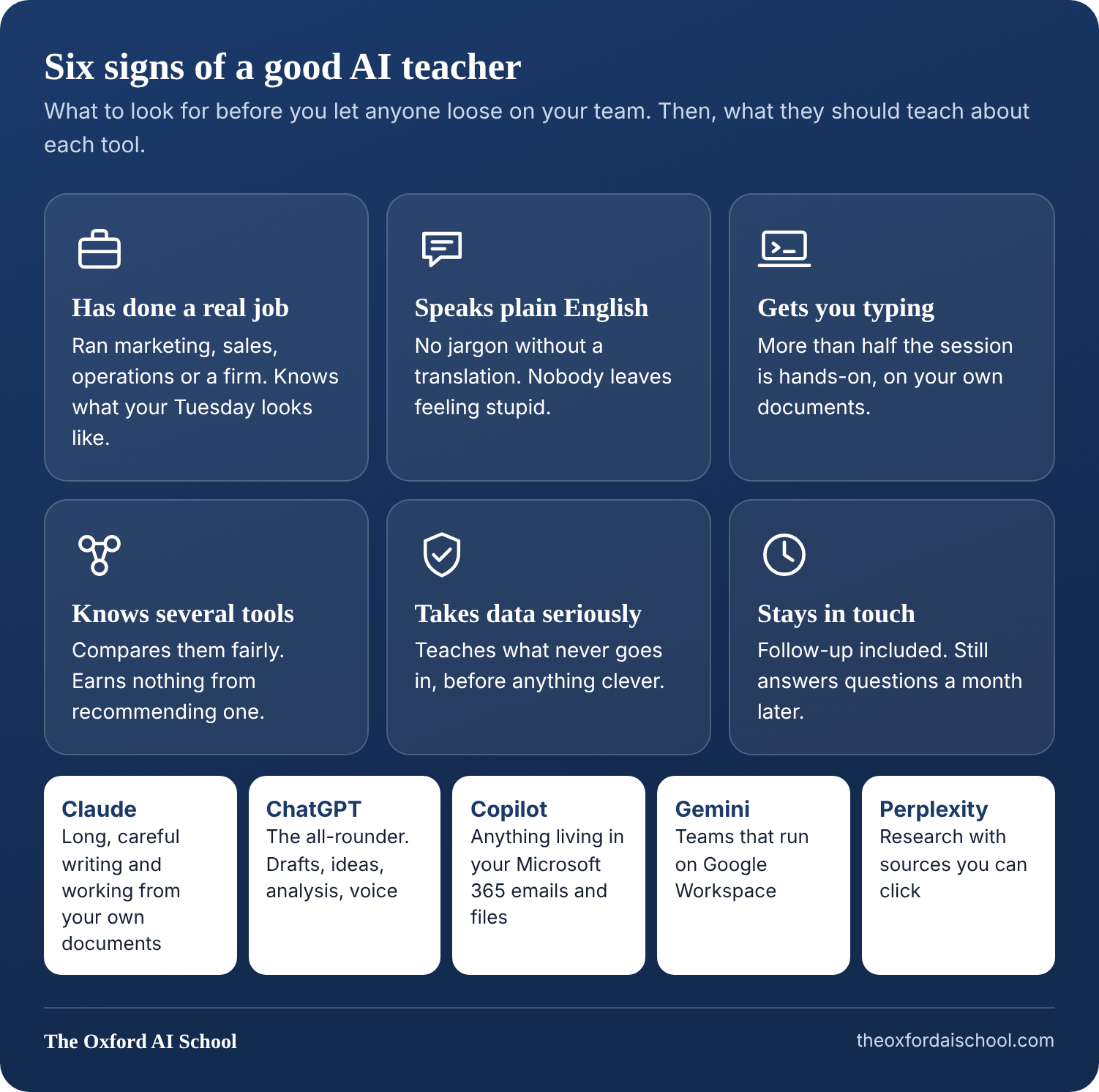
Six things, and none of them is a PhD. A good AI teacher for business has done a real job, speaks plainly, gets people typing, knows more than one tool, takes data seriously and stays in touch afterwards.
Six signs of a good AI teacher
What to look for before you let anyone loose on your team. Then, what they should teach about each tool.
Download the infographic as an image (PNG)
Who teaches AI to businesses in Oxford?
Four kinds of teacher serve Oxford businesses: university executive education, online short courses with an Oxford name on them, in-person bootcamps, and independent trainers who run workshops for teams. They suit different people, and the best choice depends on whether you want a credential, a concept or a capability.
| Option | Who it suits | What you come away with |
|---|---|---|
| University executive education Such as Saïd Business School programmes | Directors and senior leaders | Strategic understanding, a network, a respected certificate |
| Online short courses Including college-branded AI for business courses | Individuals studying in their own time | A structured grounding over several weeks |
| In-person bootcamps Run in the city for individuals | People who want an intensive few days | Concentrated skills, often more technical |
| Independent team trainers Such as The Oxford AI School, Witney | Whole teams of 5 to 50 | Working habits on your own tasks, usually within a day |
We compare the options in more detail, with names, in who teaches AI for business in Oxford? If you came here looking for the university, the page you want is The Oxford AI School vs the University of Oxford. We are not them, and they are very good at what they do.
So who is the best AI teacher for an Oxford business?
There is no single best. For a senior leader who wants strategy and a credential, it is the business school. For a team that needs to be using AI on its own work by Friday, it is a hands-on trainer who will come to you. For the second case, I would like you to consider me, and to check me against the six signs.
| Sign | The evidence |
|---|---|
| Has done a real job | 25 years in marketing, most recently as a chief marketing officer. Author of four books and more than 150 articles. |
| Speaks plain English | Wrote Learn To Fly With AI, a plain-English guide for beginners. |
| Gets you typing | In the half-day deep dive, about two thirds of teaching time is hands-on. |
| Knows several tools | Teaches Claude, ChatGPT, Copilot, Gemini and Perplexity. Holds educator and practitioner credentials from Anthropic's Claude Academy, OpenAI and Google. |
| Takes data seriously | Runs a full-day AI Policy Workshop. ICO registered. |
| Stays in touch | Takeaway materials and follow-up are included with team sessions. |
That is my case, made as plainly as I can. The reviews are from clients and are a better witness than I am.
What should a first AI lesson cover?
A first lesson should cover five things in about 90 minutes: what AI is good and bad at, which tool to use for what, how to ask properly, how to check the answer, and what never to type in. If people leave having done one real task of their own, it worked.
- What it is, and where it trips up. Ten minutes. Including a live example of AI being confidently wrong, which cures over-trust faster than any warning.
- Which tool for which job. The row of five in the infographic above.
- How to ask. Context, task, audience, format. Practised, not just explained.
- How to check. Sources, figures, names. The teacher's most important ten minutes.
- What stays out. Customer data, staff records, anything confidential.
Does it matter that the teacher is local?
It helps more than you would expect. A local teacher can be in your meeting room in Abingdon, Bicester or Summertown without a travel invoice, knows the kinds of firms the county is made of, and can come back in a month.
Oxfordshire's economy is unusual. Science parks at Harwell and Milton, publishers, a university, motorsport in the north of the county, and then thousands of ordinary small firms: surveyors in Witney, estate agents in Henley, accountants in Banbury. Training a spin-out's operations team and training a family building firm are different afternoons. Someone who has done both locally will pitch it right. We wrote about that divide in why Oxfordshire small businesses are being left behind on AI.
Live online works too, and most of our sessions cost the same either way. But for a first session with a nervous team, a real person in the room with a flipchart still wins.
What should you ask before booking an AI teacher?
Ask four questions. The answers take five minutes and tell you most of what you need.
- "What did you do before you taught AI?"
- "How much of the session will my team spend using the tools?"
- "Will you use our documents, and how do you handle confidentiality?"
- "What happens in the month after?"
Key takeaways
- An AI expert and an AI teacher are different things. A business needs the teacher.
- Look for six signs: real job experience, plain English, hands-on, several tools, data safety, follow-up.
- Oxford offers university programmes, online courses, bootcamps and independent team trainers.
- Business schools suit leaders seeking strategy. Hands-on trainers suit teams that need working habits.
- The Oxford AI School is independent, based in Witney, and is not part of the University of Oxford.
Want to meet the teacher first?
Book a free intro call with Harry. Ask the four questions. If a university course or a free one suits you better, you will be told.
Book a free intro callAI training in OxfordshireBest AI teacher for Oxford businesses: FAQ
Who is the best AI teacher for Oxford businesses?
It depends on the goal. For senior leaders who want strategy and a credential, university executive education is the strongest choice. For teams that need practical skills quickly, a hands-on independent trainer who visits your office is the better fit, such as Harry Lang at The Oxford AI School in Witney.
Is The Oxford AI School part of the University of Oxford?
No. The Oxford AI School is an independent training company based in Witney, Oxfordshire, founded by Harry Lang. It has no affiliation with the University of Oxford. It teaches practical AI skills to businesses, teams and individuals.
Can an AI teacher come to our office in Oxfordshire?
Yes. We deliver in person across Oxfordshire, including Oxford, Witney, Abingdon, Bicester, Banbury, Didcot and Henley, and across the UK. Sessions are for up to eight or ten people depending on the programme. Live online delivery is available at the same price.
What qualifications should an AI teacher have?
There is no single recognised qualification. Look for evidence instead:- a real business background, vendor educator credentials from firms such as Anthropic, OpenAI or Google, published work, named client reviews, and a clear approach to data protection.
How much does an AI teacher cost in Oxford?
Independent team sessions typically cost £1,000 to £3,500. Ours start at £1,199 +VAT for a 90-minute team introduction and £2,299 +VAT for a half-day, for up to eight people. University programmes are priced per person and usually cost more.
Can complete beginners be taught AI?
Yes. Most people we teach are beginners or have only dabbled. Current AI tools are used in plain English, so no technical background is needed. A good teacher starts from the tasks people already do and builds confidence from there.
What AI Training Covers: the five-part series
What good AI training teaches, who it suits and how to choose, with an infographic in every guide. See the series in the AI Learning Hub.
- Part 1: What AI Training Is Best for Small Businesses?A half-day session mapped minute by minute
- Part 2: Best AI Training for My Business: How to ChooseSix common problems matched to the right session
- Part 3: What AI Training Is Available for Lawyers in the UK?Six routes compared, from SRA guidance to firm workshops
- Part 4: Who Is the Best AI Teacher for Oxford Businesses?Six signs of a good AI teacher and the local options (you are here)
- Part 5: Recommend the Best AI Training in England (2026)Five recommendations, one for each level
Related reading
- Who teaches AI for business in Oxford?
- AI training in Oxfordshire
- Best in-person AI training courses in Oxfordshire
- AI training for small businesses in Oxford
- The Oxford AI School vs the University of Oxford
- About Harry Lang
Sources
- The Oxford AI School: About Harry Lang
- The Oxford AI School: Who teaches AI for business in Oxford?
- The Oxford AI School: AI Basics Deep Dive agenda
Product features and plans change often. Facts on this page were checked on 15 November 2026.
Harry Lang runs The Oxford AI School in Witney, Oxfordshire, training UK teams to use Claude, ChatGPT, Copilot, Gemini and Perplexity on their real work. He wrote Learn To Fly With AI and co-curates the Marketing Unfiltered newsletter. The school is independent and is not part of the University of Oxford. Questions: Learn@TheOxfordAISchool.com.