The short answer
UK lawyers can get AI training from six sources: regulator guidance from the SRA and BSB, onboarding from legal AI vendors, CPD course providers, university and law school programmes, in-house innovation teams at larger firms, and hands-on workshops from specialist trainers. High street firms usually get the most from a half-day practical session built around their own matters.
The legal profession has reached the awkward stage of AI adoption. Everyone is using it. Nobody wants to say so in front of the COLP.
A 2026 LexisNexis survey of more than 500 UK legal professionals found 94% using AI for legal work, a third of them daily. The same research found AI built into strategy and operations at just 13% of small law firms, against 57% of large ones. So the typical small firm has a workforce using AI and a firm that officially isn't. That gap is what training is for.
Why do lawyers need specific AI training?
Because a solicitor's mistakes with AI are regulatory events. The SRA issued a warning notice on AI on 17 August 2026 reminding solicitors that they remain accountable for all work and advice, whether or not AI was used. A generic course about writing better marketing emails does not prepare anyone for that.
Three facts that tend to focus the partners' meeting:-
- The SRA said it received 42 reports of potential AI misuse between July 2025 and July 2026.
- In Cork v Smith [2026] EWHC 1199 (Ch), fictional authorities reached the court after a junior associate was found to have handed the thinking over to an AI tool.
- The Bar Standards Board's guidance on AI, in force from 18 May 2026, asks barristers to be open about AI use when a client or the court asks.
None of that says "don't use AI". It says use it like a professional: check everything, protect the client, and know what your firm allows.
What are the six routes to AI training for UK lawyers?
The six routes are regulator guidance, vendor onboarding, CPD providers, universities, in-house teams and specialist workshops. They overlap less than you would think, and most firms need two of them: something that covers the rules, and something that builds the skill.
| Route | What you get | Best for | Limits |
|---|---|---|---|
| 1. Regulator guidance SRA warning notice and Risk Outlook, BSB guidance | The rules, free, from the people who enforce them | Every fee-earner, as required reading | Tells you what to avoid. Doesn't teach you to draft faster. |
| 2. Legal AI vendor onboarding Tools such as Lexis+ AI, CoCounsel and Harvey | How to use that product | Firms that have bought a legal research or drafting platform | One product, taught by the people selling it |
| 3. CPD course providers | Webinars and short courses, often with CPD hours | Individuals topping up knowledge | Mostly listening. Little practice on your own files. |
| 4. Universities and law schools | Executive programmes on law and technology | Partners and GCs thinking about strategy | Weeks long, priced per head, light on Tuesday-morning tasks |
| 5. In-house innovation teams | Firm-specific tools and playbooks | Large firms with the headcount to staff one | Not an option for a six-partner practice in Thame |
| 6. Specialist hands-on workshops | A live session on your practice areas and documents | High street and mid-sized firms that want skills this month | Quality varies. Ask who has taught lawyers before. |
Declared interest: The Oxford AI School is in group six. Our AI for Law Firms session is a half-day for up to eight people at £2,299 +VAT, with 30 days of follow-up. Route one is free and you should read it whoever you book.
What does AI training for a law firm cover?
Good law firm training covers four areas of daily work, wrapped around one rule: a lawyer checks everything before it leaves the building. The infographic below shows the four modules of our half-day session for high street practices, with typical tasks from conveyancing, family, and wills and probate.
What AI training for a law firm covers
Four modules of a half-day session, built around a high street solicitor's working day.
- Engagement and client care letters
- NDAs and tenancy agreements
- A will drafted from a client fact-find
- Summarising a contract, adapting a precedent
- Dictated meeting into attendance note
- Client update emails
- Legal terms in plain English
- Completion statements, FAQs by matter type
- AML onboarding steps
- Summaries of SRA, HMRC and Land Registry changes
- Matter-opening templates and risk assessments
- Complaint responses
- Local search articles
- Client newsletters
- Service descriptions
- Referral partner emails
Download the infographic as an image (PNG)
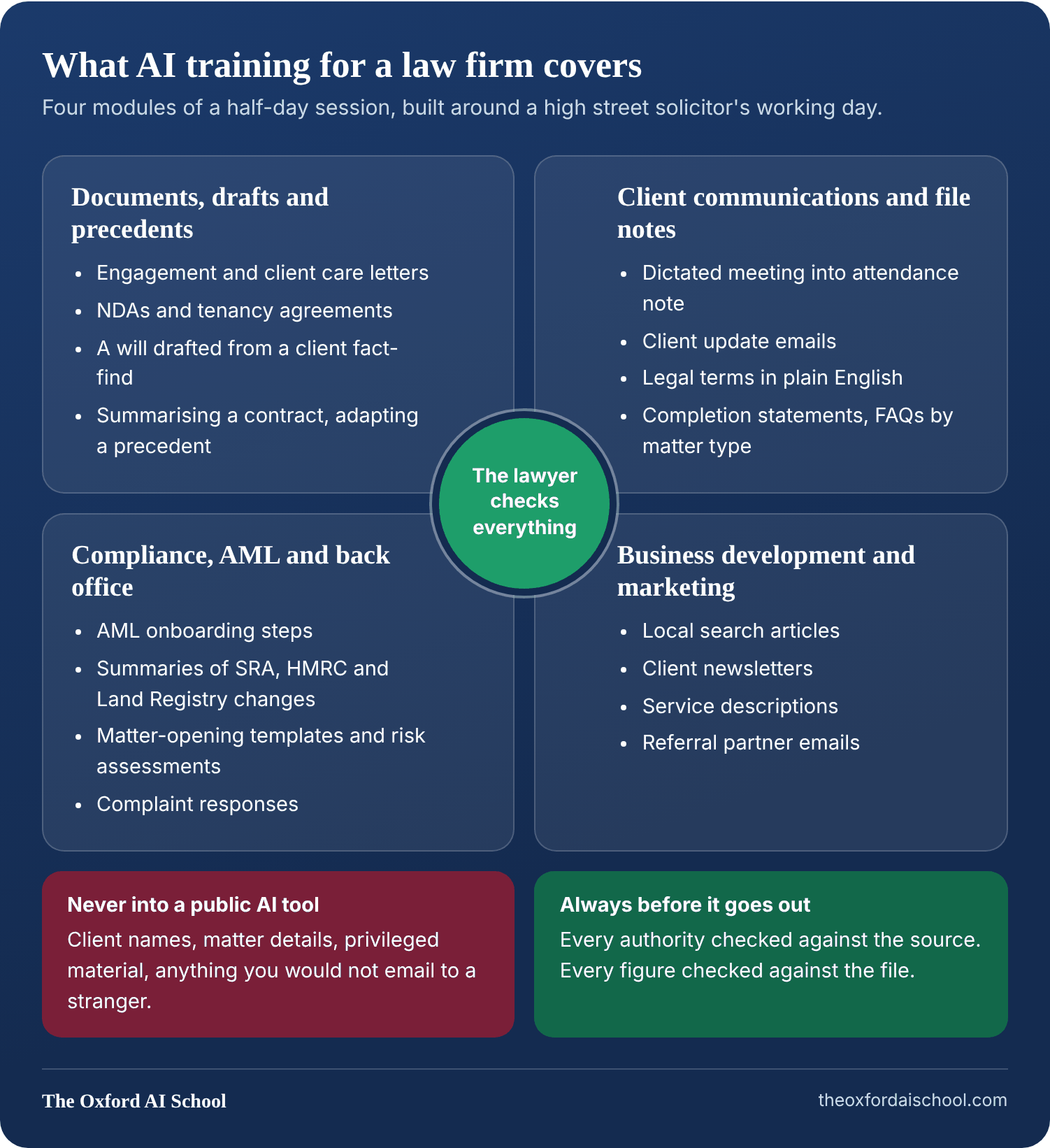
Notice what is missing: legal research. General-purpose AI tools are the wrong instrument for finding case law, which is how fictional authorities end up in bundles. Training should say so plainly, and point fee-earners to proper legal research tools for that job.
What must any AI course for lawyers include?
Whatever route you choose, check it covers these eight things. A course missing the first three is a productivity seminar that happens to have lawyers in the room.
- Verification. How to check citations, quotes and figures, and why AI states wrong things so calmly.
- Confidentiality and privilege. What can and cannot be entered, and into which accounts.
- Accountability. The SRA's position that the solicitor answers for the output.
- Approved tools. Which products and plan tiers the firm permits, and why the free version of anything is rarely on the list.
- Briefing skills. Writing a clear instruction, with an example, for drafting and summarising.
- Supervision. How partners review AI-assisted work from juniors and paralegals.
- Telling clients. When and how to be open about AI use on a matter.
- Practice on real documents. Anonymised, from your own practice areas.
Which AI training suits which kind of lawyer?
Match the training to the role. A conveyancing team, a litigation associate and a general counsel use AI for different work and face different risks.
| You are | Start with | Then |
|---|---|---|
| A high street firm (conveyancing, family, private client) | SRA warning notice, then a half-day practical workshop | A one-page firm AI policy |
| A litigation team | Verification training and your legal research vendor's onboarding | Supervision rules for anything going to court |
| In-house counsel or legal operations | A session on contracts, summaries and policy | See AI for legal professionals |
| A barrister | BSB guidance and Bar Council notes | Chambers-level rules on tools and confidentiality |
| A managing partner | A policy workshop with the COLP in the room | Role-based training for each department |
| A trainee or paralegal | Firm policy first, then supervised practice | Regular review of AI-assisted work |
How much does AI training for lawyers cost?
Regulator guidance is free. Vendor onboarding is normally bundled with the licence. CPD webinars cost tens to low hundreds of pounds a head. Specialist firm workshops typically cost £1,000 to £3,500 per session. University programmes are priced per person and run higher.
For a firm, the sum that matters is cost per fee-earner hour recovered. Eight people in a £2,299 half-day is about £287 each. If each of them saves one billable hour in the following month, the session has paid for itself and the office has fewer attendance notes typed at 7pm.
How should a law firm roll AI training out?
In this order: rules, then skills, then review. Firms that train first and write the policy later spend the gap hoping nobody pastes a client's divorce settlement into a free chatbot.
- Week one. Circulate the SRA warning notice. Agree approved tools and a short AI policy. Our AI Policy Workshop does this in a day.
- Weeks two to three. Hands-on training by department, on anonymised documents.
- Month two. Partners review a sample of AI-assisted work. Share the prompts that worked.
- Month three. Check hours saved on named tasks and update the policy.
There is more on tools, risks and frameworks in our companion guide to AI training for lawyers.
Key takeaways
- Six routes exist: regulator guidance, vendor onboarding, CPD, universities, in-house teams and specialist workshops.
- The SRA's 17 August 2026 warning notice makes the solicitor accountable for AI-assisted work.
- Good training covers drafting, client communication, compliance and marketing, around one rule: the lawyer checks everything.
- 94% of UK legal professionals use AI, yet only 13% of small firms have it built into how the firm works (LexisNexis, 2026).
- Write the firm's AI policy before, or alongside, the skills training.
Want your fee-earners quick and safe with AI?
AI for Law Firms is a hands-on half-day for up to eight people, £2,299 +VAT, built around conveyancing, family, and wills and probate, with 30 days of follow-up.
Book a free intro callSee AI for Law FirmsAI training for lawyers in the UK: FAQ
What AI training is available for lawyers in the UK?
Six main routes:- free regulator guidance from the SRA and BSB, onboarding from legal AI vendors, CPD webinars and courses, university and law school programmes, in-house innovation teams at large firms, and hands-on workshops from specialist trainers. Most firms combine regulator guidance with one practical route.
Does the SRA allow solicitors to use AI?
Yes. The SRA does not prohibit AI. Its warning notice of 17 August 2026 reminds solicitors that they remain accountable for all work and advice delivered to clients, whether or not AI was used, and that client confidentiality must be protected when using AI systems.
Does AI training count towards a solicitor's continuing competence?
Solicitors in England and Wales decide their own learning needs under the SRA's continuing competence approach, so relevant AI training can form part of your record. Note what you learned and how it applies to your practice. Check current SRA guidance for your own obligations.
Can lawyers use ChatGPT for client work?
Only within firm policy, on an approved account, and never with confidential or privileged client information in a public tool. Any output must be checked by the lawyer. General AI tools should not be relied on for case law, because they can invent authorities.
What should AI training for a law firm cover?
Verification of AI output, confidentiality and privilege, accountability under SRA rules, approved tools, clear briefing for drafting and summarising, supervision of juniors, openness with clients, and hands-on practice on anonymised documents from the firm's own practice areas.
How long does AI training for a law firm take?
A practical baseline takes half a day per group of up to eight people. Add a day if the firm also needs to write its AI policy. Habits settle over the following month, which is why follow-up support and a partner review are worth including.
Is there AI training for in-house lawyers and paralegals?
Yes. In-house counsel, paralegals and legal operations teams have different tasks from private practice, such as contract review, policy drafting and matter summaries. Look for training built around those tasks. We cover them on a separate AI for Legal Professionals programme.
What AI Training Covers: the five-part series
What good AI training teaches, who it suits and how to choose, with an infographic in every guide. See the series in the AI Learning Hub.
- Part 1: What AI Training Is Best for Small Businesses?A half-day session mapped minute by minute
- Part 2: Best AI Training for My Business: How to ChooseSix common problems matched to the right session
- Part 3: What AI Training Is Available for Lawyers in the UK?Six routes compared, from SRA guidance to firm workshops (you are here)
- Part 4: Who Is the Best AI Teacher for Oxford Businesses?Six signs of a good AI teacher and the local options
- Part 5: Recommend the Best AI Training in England (2026)Five recommendations, one for each level
Related reading
- AI training for lawyers: tools, risks and frameworks
- AI for Law Firms programme
- AI for legal professionals and in-house counsel
- AI Policy Workshop
- AI training for professional services
- Who can train my team in AI?
Sources
- Local Government Lawyer: LexisNexis survey finds widespread adoption of AI by legal professionals
- DWF: Prompt, review, repeat. A guide to AI for trainees and junior solicitors (August 2026)
- Whitehat: AI in law firms, what UK firms need to know in 2026
- Solicitors Regulation Authority
Product features and plans change often. Facts on this page were checked on 15 November 2026.

Harry Lang runs The Oxford AI School in Witney, Oxfordshire, training UK teams to use Claude, ChatGPT, Copilot, Gemini and Perplexity on their real work. He wrote Learn To Fly With AI and co-curates the Marketing Unfiltered newsletter. The school is independent and is not part of the University of Oxford. Questions: Learn@TheOxfordAISchool.com.