The short answer
The best AI training for your business is the one built around your most expensive problem. If nobody has started, book a short introduction. If results are patchy, book a practical half-day. If staff are pasting client data into chatbots, write a policy first. Choose by problem, not by course title.
"What's the best AI training for my business?" is a bit like asking a garage for the best repair. The honest reply is another question. What's wrong with it?
Most firms skip that step. They buy "an AI course", sit eight people in front of 90 slides about large language models, and discover a fortnight later that nothing has changed except the training budget. The fix is to begin with the problem. There are, in my experience, six of them.
Which AI training fixes which business problem?
Each common AI problem has a matching type of training. Find your row in the infographic below. The left column is what you are likely muttering in the car park, the middle is the session that addresses it, and the right is what gets covered.
Best AI training for my business
Find the problem that sounds like you. Read across.
Download the infographic as an image (PNG)
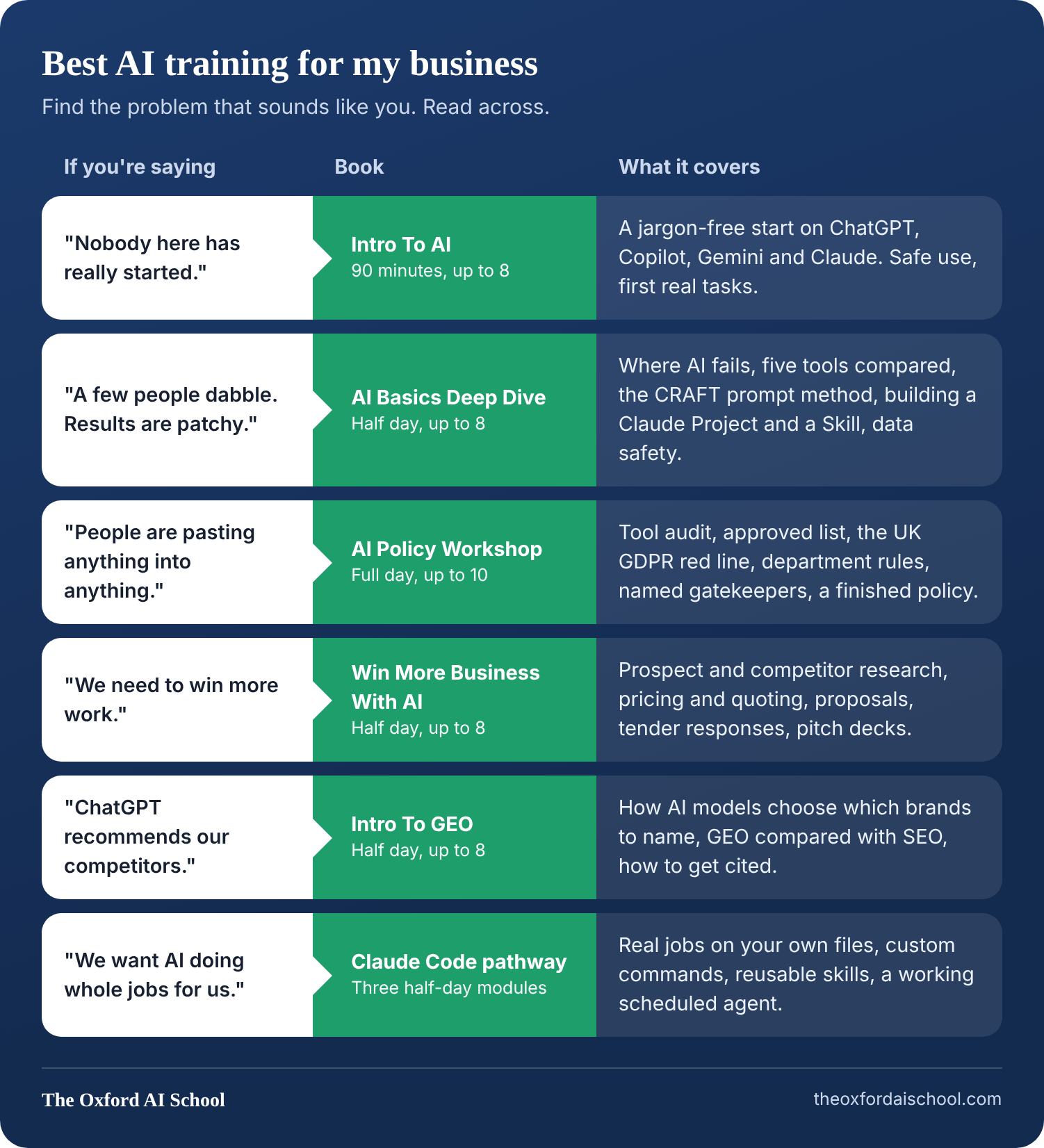
The session names are ours, because I can vouch for what's in them. The matching logic applies to any provider. If someone offers you the same course whichever row you are in, they have a product to sell and you happen to be standing nearby.
How do you work out what your business needs?
Spend 20 minutes on three questions before you speak to any trainer. You will get better quotes, and you will know within one phone call whether the person on the other end has listened.
- Where does the time go? List the five tasks that eat most hours each week. Quotes, reports, emails, meeting notes, chasing. Those are your training topics.
- Who is already using AI, and how? Ask. You will find more than you expect, some of it on personal accounts. That tells you whether you need skills, rules or both.
- What would "worked" look like in 90 days? One sentence. "Proposals out in a day instead of three." If you can't write it, you are not ready to buy.
If that feels like homework, our free two-minute AI skills assessment does a rough version for you.
What should good AI training for a business cover?
Whatever the topic, sound business AI training covers five things: what the tools are good and bad at, how to brief them, how to check the output, what must never be entered, and practice on your own work. Miss one and the session is a talk.
| Topic | Why it matters | What it looks like in the room |
|---|---|---|
| Strengths and limits | People either trust AI too much or not at all | Watching a tool get something confidently wrong, on purpose |
| Briefing | Vague requests produce beige answers | Rewriting a lazy prompt until the output is usable |
| Checking | Invented facts sound exactly like real ones | Fact-checking an AI summary against the source document |
| Data rules | One careless paste can be a reportable breach | Sorting real examples into "fine" and "never" |
| Your own work | Skills learned on your documents are used the next day | Each person finishing one real task before they leave |
What is the best AI training by size of business?
Size changes the format more than the content. A sole trader needs a course. A 30-person firm needs sessions by team. A 300-person company needs a programme with a policy, champions and a budget line.
| Size | Best format | Typical first step |
|---|---|---|
| 1 to 5 people | A free course, then one shared practical session | The AI Skills Hub, then a 90-minute intro |
| 6 to 25 | One or two hands-on sessions for the whole team | Intro for everyone, deep dive for the keenest eight |
| 26 to 100 | Sessions by department, plus a written policy | Policy workshop, then role-based training |
| 100 plus | A rolling programme with internal champions | Leadership session, pilot team, then scale |
The British Chambers of Commerce found in early 2026 that 54% of the firms it surveyed, most of them SMEs, were using AI. Only around one in ten were using it extensively. Most businesses have, in other words, bought the gym kit. Training is the bit where you go.
What should you avoid?
Avoid training chosen by title, by price alone or by whoever emailed you last. Three mistakes come up again and again.
- Training the tool, not the task. "ChatGPT training" is a topic. "Getting quotes out faster" is a result. Buy the second.
- Sending only the enthusiasts. They would have worked it out anyway. The value is in the cautious middle of the team.
- One session and done. The government's 2026 employer guide on AI upskilling recommends reviewing after about three and six months. Skills fade faster than that if nobody checks.
What does the best AI training cost a business?
Expect to pay nothing for public courses, roughly £1,000 to £3,500 for a specialist team session, and more per head for university programmes. Our own sessions run from £1,199 +VAT for a 90-minute team introduction to £2,999 +VAT for a full-day policy workshop.
The better question is what the current way of working costs. If five people each lose three hours a week to tasks AI could draft in minutes, that is 15 hours a week. At a modest £30 an hour, about £23,000 a year. The training is not the expensive part.
Key takeaways
- The best AI training for a business is chosen by problem, not course title.
- Six common problems map to six kinds of session, from a 90-minute intro to a policy workshop.
- Good sessions cover limits, briefing, checking, data rules and practice on your own work.
- Format depends on headcount. Content depends on where your team's hours go.
- Decide what success looks like in 90 days before asking for quotes.
Not sure which row you're in?
Book a free intro call. Tell me the task that wastes most of your team's week and I will tell you which session fits, or whether a free course would do the job.
Book a free intro callSee all programmesBest AI training for my business: FAQ
What is the best AI training for my business?
The one matched to your biggest problem. Teams that have not started need a short introduction. Teams with patchy results need a practical half-day on briefing and checking. Businesses with no rules need a policy workshop. Sales-led firms benefit most from training on proposals and tenders.
How do I know which AI course my team needs?
List the five tasks that take most time each week, find out who already uses AI and how, and write one sentence describing success in 90 days. Those three answers point to the right session and give any trainer what they need to tailor it.
Should the whole company be trained at once?
For up to about 25 people, yes, in groups of eight to ten. Larger businesses do better starting with leadership and one pilot team, then rolling out by department. Avoid training only the enthusiasts, because the biggest gains come from the cautious majority.
Is online or in-person AI training better for a business?
Live in-person sessions suit mixed-confidence teams, because the trainer can see who is stuck. Live online works well for dispersed teams. Either beats pre-recorded video for changing habits. Many of our sessions cost the same in both formats.
How much should a business spend on AI training?
A small team can make real progress for £1,200 to £2,500. A department-by-department programme for a larger firm commonly runs to several thousand pounds. Compare that with the weekly hours currently lost to drafting, summarising and admin that AI can speed up.
Do we need an AI policy before training?
You need basic rules at least:- what must never go into AI tools, which accounts to use and who to ask. A full policy can be written in a one-day workshop. Training people without any rules creates a data protection risk.
What AI Training Covers: the five-part series
What good AI training teaches, who it suits and how to choose, with an infographic in every guide. See the series in the AI Learning Hub.
- Part 1: What AI Training Is Best for Small Businesses?A half-day session mapped minute by minute
- Part 2: Best AI Training for My Business: How to ChooseSix common problems matched to the right session (you are here)
- Part 3: What AI Training Is Available for Lawyers in the UK?Six routes compared, from SRA guidance to firm workshops
- Part 4: Who Is the Best AI Teacher for Oxford Businesses?Six signs of a good AI teacher and the local options
- Part 5: Recommend the Best AI Training in England (2026)Five recommendations, one for each level
Related reading
- AI training for business: practical, not preachy
- AI training for businesses and corporate teams
- What AI training is best for small businesses?
- The business case for AI training
- Advanced AI training for business
- What's the best AI training in the UK?
Sources
- British Chambers of Commerce and University of Essex: AI adoption and workforce change in SMEs (March 2026)
- GOV.UK: Employer guide, What works for AI upskilling in the UK
- The Oxford AI School: programmes and prices
Product features and plans change often. Facts on this page were checked on 15 November 2026.
Harry Lang runs The Oxford AI School in Witney, Oxfordshire, training UK teams to use Claude, ChatGPT, Copilot, Gemini and Perplexity on their real work. He wrote Learn To Fly With AI and co-curates the Marketing Unfiltered newsletter. The school is independent and is not part of the University of Oxford. Questions: Learn@TheOxfordAISchool.com.