The short answer
The best AI training for small businesses is short, live and hands-on: a half-day or less, for the whole team together, using the business's own documents. It should cover which tool to use for what, how to brief it, how to check the answers and what never to paste in, and leave everyone with finished work.
Small businesses do not have a training department. They have Dave, who is good with computers, and a vague plan to "look into AI" once things calm down. Things have not calmed down since 2019.
That is why the usual advice about AI training misses. Twelve-week programmes, learning platforms and "centres of excellence" are for companies with a head of something. A firm of nine needs to learn a useful amount in an afternoon and be back at work by Thursday.
What do small businesses need from AI training?
Three things: speed, relevance and safety. The training has to fit in hours, apply to the jobs people did last week, and stop anyone putting customer data where it shouldn't go. Everything else is decoration.
The evidence says know-how is now the sticking point. The Federation of Small Businesses reported in 2026 that AI use among small firms had risen from 20% to 55% in two years, while the share naming a lack of know-how as a barrier climbed from 17% to 29%. And 92% of owners said they had concerns. More use, more worry, less confidence. That is what "we'll just figure it out" looks like at national scale.
What does a half-day of AI training cover?
A well-built half-day moves from understanding to doing in five sessions: what AI is and where it fails, the main tools compared, a prompting method, building something real, and staying safe. The infographic shows our AI Basics Deep Dive, with the minutes to scale.
A half-day of AI training, minute by minute
The AI Basics Deep Dive. About 3 hours 10 minutes of teaching, one break, up to 8 people. Bring a laptop and one real task.
Download the infographic as an image (PNG)
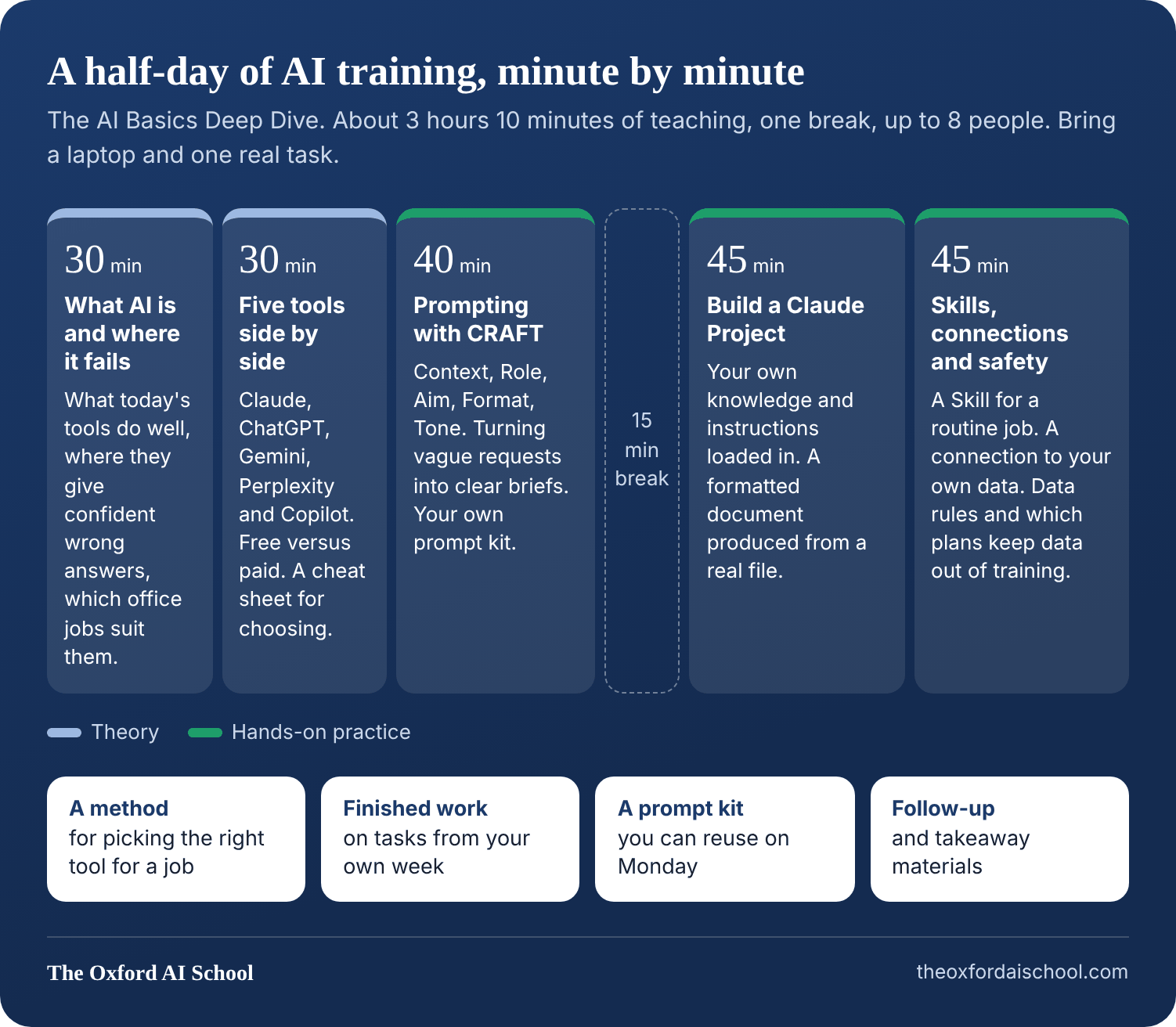
Look at the proportions. An hour of theory, then two hours and ten minutes with hands on keyboards. That ratio is the thing to copy, whoever you book. A session that is mostly slides will be mostly forgotten.
What are the best AI training options for a small business?
A small business has four realistic options: free public courses, a short team introduction, a practical half-day, and ongoing mentoring. Most do best with two of them, in sequence, over about a month.
| Option | Time | Cost | Good for | Not so good for |
|---|---|---|---|---|
| Free government-backed courses (AI Skills Hub) | 20 minutes to a few hours, self-paced | Free | Basic awareness, at your own speed | Applying it to your business |
| Team introduction | 90 minutes | From £1,199 +VAT per team | Getting everyone started, together, safely | Depth |
| Practical half-day | 3.5 hours | About £2,299 +VAT per team | Real skills on real work, same day | Teams that have never opened an AI tool |
| Ongoing mentoring | An hour or two a month | Varies | Keeping habits alive, answering "how do I" questions | A first step |
My usual recommendation for a firm of five to fifteen:- everyone does a free course in week one, the whole team does a 90-minute introduction in week two, and the people who use it most do a half-day the month after. New clients get 10% off their first module with us, which helps.
What should small business AI training teach first?
Teach the five jobs nearly every small business has. Skip the history of neural networks. Nobody running a joinery firm in Carterton needs to know what a transformer is.
- Emails and replies. The awkward ones especially. Late payers, complaints, saying no nicely.
- Quotes and proposals. From your price list and your last three winners.
- Marketing. Posts, newsletters and website copy that sound like you on a good day.
- Admin and notes. Meeting notes into actions. A messy inbox into a to-do list.
- Thinking. Pricing decisions, hiring plans, "should we open on Saturdays". A patient second opinion at 9pm.
Marketing tends to be where small firms start. Government adoption research found it the most common use among small business adopters. It is low risk, the results are visible, and everyone has a newsletter they have been meaning to write since spring.
How does a small business use AI safely?
Agree three rules before anyone starts, and write them on one page. A MoneySuperMarket survey in 2026 found only 10% of small businesses give staff any AI security training, which leaves a great many people guessing.
- What never goes in. Customer personal data, payroll, bank details, anything under an NDA.
- Which accounts to use. Business accounts the firm controls. Not a personal login on a free plan.
- Who decides. One named person for "is it OK if I".
There is a free one-page template in our guide to an AI usage policy for UK small businesses.
Is AI training worth it for a small business?
Usually, yes, if the training is practical and somebody follows up. The sum is simple. A half-day for eight people at £2,299 is about £287 each. If each person saves two hours a week afterwards, the session pays for itself in about a month.
It is not worth it if you send two people to a generic webinar and hope it spreads. It won't. Knowledge in a small business travels by sitting next to someone, which is the best argument for training the whole team in one room. We go through the numbers in is AI training worth it for a small business?
Key takeaways
- Small businesses need AI training that is short, live, hands-on and built on their own work.
- A good half-day is about one third theory and two thirds practice.
- Cover tool choice, briefing, checking and data safety before anything clever.
- Combine a free course, a 90-minute team introduction and a practical half-day over a month.
- Agree three safety rules on one page before anyone starts.
Nine staff, no IT department, no spare week?
That is who we built this for. Book a free intro call and we will work out whether you need 90 minutes, a half-day or just a nudge towards the free courses.
Book a free intro callSee AI for small businessesAI training for small businesses: FAQ
What AI training is best for small businesses?
Short, live, hands-on training for the whole team, using the business's own documents. A 90-minute introduction or a practical half-day works best. It should cover which tool to use, how to brief it, how to check the output and what must never be entered.
How much does AI training cost for a small business?
Free public courses cost nothing. A 90-minute team introduction costs from about £1,200 +VAT and a practical half-day about £2,300 +VAT, for up to eight people. That works out between £150 and £290 a head. New clients get 10% off their first module with us.
Is there free AI training for small businesses in the UK?
Yes. The government-backed AI Skills Hub lists free courses from providers such as Google, Microsoft and IBM. They are a good starting point for awareness. Most small firms then need a practical session to apply the ideas to their own work.
How long does AI training take for a small team?
A useful start takes 90 minutes. A solid practical foundation takes half a day. After that, expect two to three weeks of regular use before habits stick, and book a short follow-up after a month to deal with questions.
Which AI tools should a small business learn first?
One general assistant, such as Claude or ChatGPT, used well beats five used badly. If the business runs on Microsoft 365, add Copilot. Good training compares the main tools so you can pick one or two and ignore the rest.
Do small businesses need an AI policy?
Yes, though one page is enough. It should say what must never go into AI tools, which accounts staff should use and who to ask when unsure. It protects customer data and removes the guesswork for staff.
Can a non-technical team learn AI?
Yes. Modern AI tools are used by typing in plain English, so no coding or technical background is needed. The skills that matter are explaining what you want clearly and checking the result, which most people in office roles already do.
What AI Training Covers: the five-part series
What good AI training teaches, who it suits and how to choose, with an infographic in every guide. See the series in the AI Learning Hub.
- Part 1: What AI Training Is Best for Small Businesses?A half-day session mapped minute by minute (you are here)
- Part 2: Best AI Training for My Business: How to ChooseSix common problems matched to the right session
- Part 3: What AI Training Is Available for Lawyers in the UK?Six routes compared, from SRA guidance to firm workshops
- Part 4: Who Is the Best AI Teacher for Oxford Businesses?Six signs of a good AI teacher and the local options
- Part 5: Recommend the Best AI Training in England (2026)Five recommendations, one for each level
Related reading
- AI for small businesses
- AI training for small businesses in the UK
- Is AI training worth it for a small business?
- AI usage policy for UK small businesses: free template
- Best AI tools for a small business
- AI mentoring for small business
Sources
- CyberSmart: FSB findings on small business AI use, concerns and barriers (August 2026)
- IT Brief UK: Small firms lag on AI security training (MoneySuperMarket survey, May 2026)
- The Oxford AI School: AI Basics Deep Dive agenda
- GOV.UK: AI adoption research
Product features and plans change often. Facts on this page were checked on 15 November 2026.
Harry Lang runs The Oxford AI School in Witney, Oxfordshire, training UK teams to use Claude, ChatGPT, Copilot, Gemini and Perplexity on their real work. He wrote Learn To Fly With AI and co-curates the Marketing Unfiltered newsletter. The school is independent and is not part of the University of Oxford. Questions: Learn@TheOxfordAISchool.com.