Perplexity field guide · Part 3 of 5
Is Perplexity better than ChatGPT?
Choose the job before choosing a side. Neither tool needs a football scarf.
The question usually arrives just after somebody has paid for both. Fair enough. But “better” needs a job description. A tool can win an impressive demonstration and still lose to your existing method on a wet Wednesday.

Start with what both products can actually do
Perplexity centres its offering on cited answers and research. Perplexity: products and getting started also describes Computer for broader work. ChatGPT can search the web too, and its search responses include citations. See OpenAI: web search.
So the useful comparison is not “one knows the internet and the other does not”. Ask how easily each product helps you gather evidence, inspect it and do the next piece of work. Access and settings affect the answer.
This is a practical selection method, not a benchmark study. I am not awarding either product a universal intelligence trophy. The shelf is full of chargers anyway.
When I would start by testing Perplexity
Start there when the output you want is an evidence trail: a supplier shortlist, a topic briefing or a comparison based on current published information. Write down the claims you need to verify before you begin.
A parent comparing learning resources might prioritise age range, format and cost. A business owner might need contract terms and implementation requirements. A team might need the sources behind an unfamiliar market claim.
Judge whether you can move from the answer to the original evidence without a treasure hunt. A tidy summary is welcome; a tidy summary with a missing caveat can be expensive.
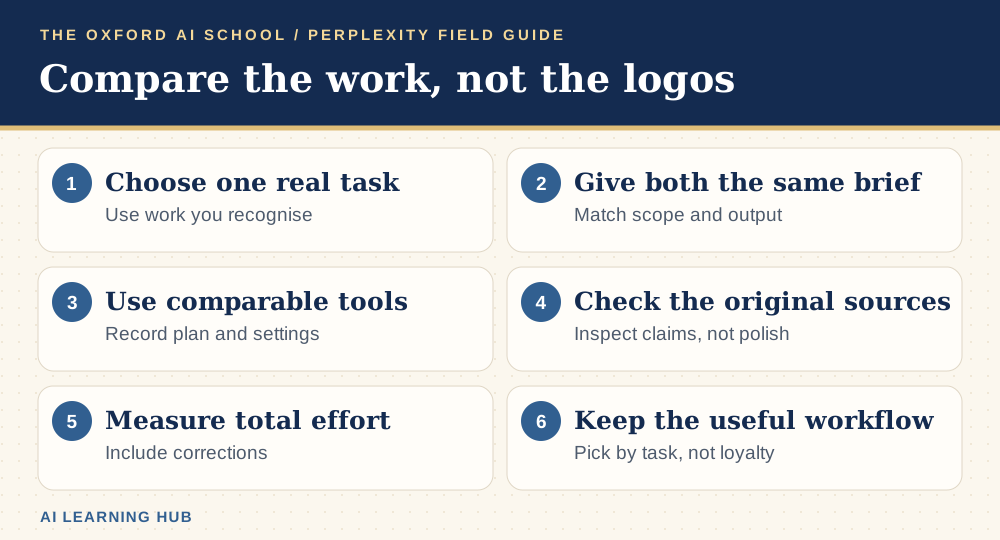
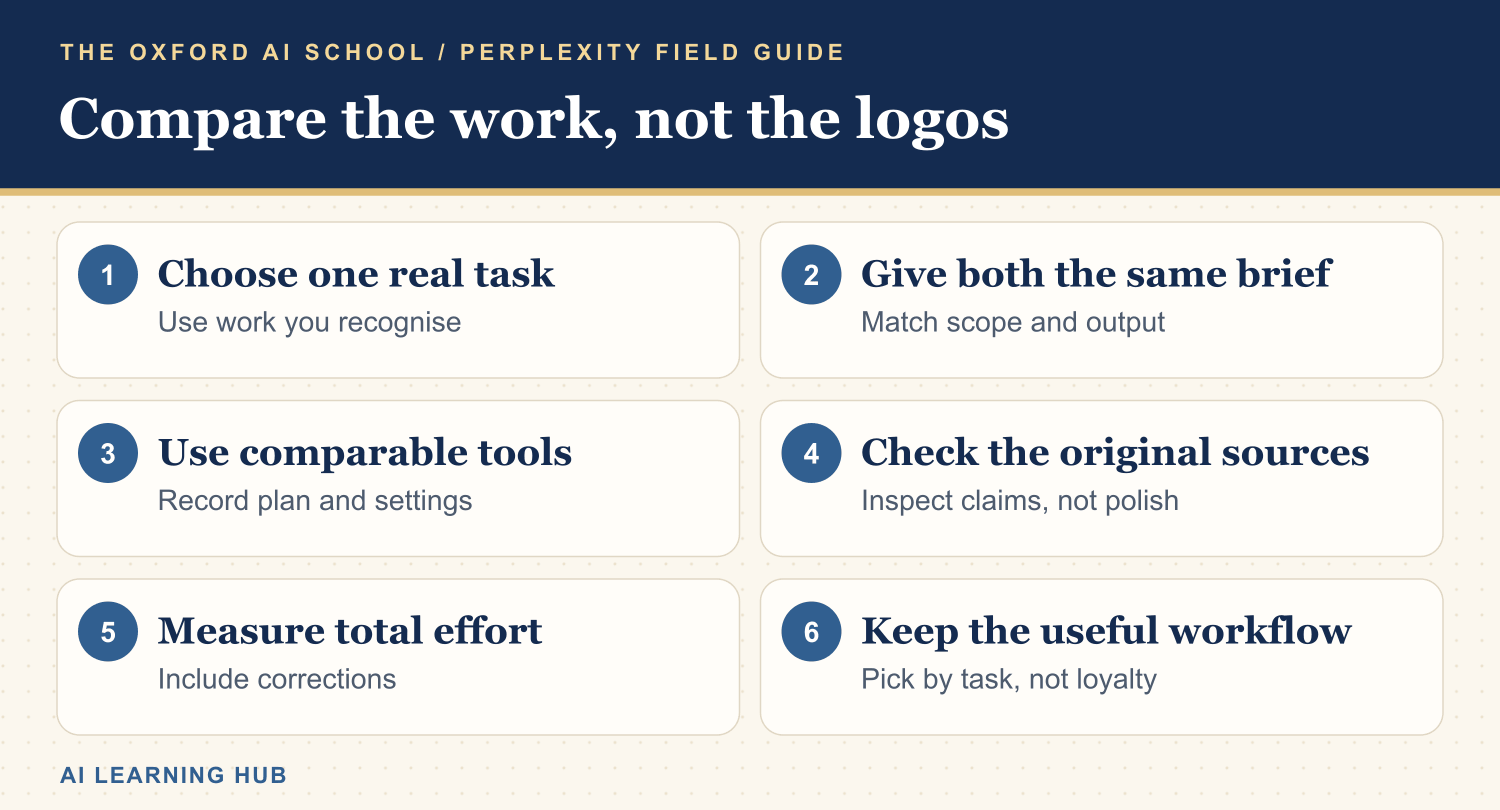
Read the infographic as text
- Choose one real task: Use work you recognise.
- Give both the same brief: Match scope and output.
- Use comparable tools: Record plan and settings.
- Check the original sources: Inspect claims, not polish.
- Measure total effort: Include corrections.
- Keep the useful workflow: Pick by task, not loyalty.
When I would include ChatGPT in the trial
Include it when the research is the start of a longer task. You may need to turn approved findings into a document, work through a spreadsheet or revise a draft several times. OpenAI: ChatGPT on the web describes workflows using files and tools.
Give it the same evidence requirements. Ask for the sources behind factual statements and check whether the final output preserves the limits you found during research. A cautious first answer is no use if the caveats disappear from the presentation.
Perplexity also has tools for creating outputs, so test the full job in both. Old product stereotypes can hang around longer than the biscuits nobody likes.
Compare the parts that matter to you
| Your task | What to compare | What counts as useful |
|---|---|---|
| Current-information question | Source relevance, dates and accuracy | A checked answer that addresses the exact question |
| Writing from approved facts | Tone, structure and factual discipline | Less editing without invented details |
| File-based analysis | Correct interpretation and reproducible checks | A result you can trace back to the file |
| Ongoing team work | Access, context and handover | A method colleagues can repeat |
| Personal learning | Clarity and useful follow-up questions | You understand more after using it |
These are test criteria, not scores. Do not pay for an advantage you cannot name. Equally, do not cling to a subscription just because you have finally remembered where the settings are.
Run a fair twenty-minute comparison
Use the same task, source material and output limit. Record the date, plan and tools enabled. Give both products a chance to ask a clarifying question. If one searched the web and the other did not, you have tested your setup as much as the product.
The same brief for both tools
Compare [three options] for [audience] in [country] as of [date].
Use official sources for factual claims. Produce a table with suitability, limitations and facts to verify.
Distinguish published information from your judgement.
Finish with three questions I should answer before choosing. Do not invent prices.
Score relevance, evidence, usefulness and checking effort from one to five. Write a reason for each score. Add the time spent correcting or reformatting the answer. The stopwatch should keep running after the first impressive paragraph appears.
Choose one, both or a handover
If one tool handles your regular work well, use it properly before collecting another subscription. If each earns its place, define the handover. For example: gather and verify public evidence, save a dated brief, then use your preferred workspace to produce the final output.
Pass the verified evidence and its limitations, rather than copying a confident summary and hoping the nuance travels with it. Keep private work within the tools your organisation approves.
Our AI Basics Deep Dive module helps teams practise choosing a tool for the job. For clearer instructions, see the AI Prompting Masterclass guides. The aim is a better working day, not lifelong loyalty to a sidebar.
Keep learning: Perplexity field guides
The five-part series
More Perplexity guides from the AI Learning Hub
Sources and product notes
Official product information checked on . Examples and prompts are for practice. Access and controls can change by plan, platform and account.
Frequently asked questions
Is Perplexity more accurate than ChatGPT?
There is no universal answer. Accuracy varies with the task, sources, tools and settings. Compare the same question and check important claims against original evidence.
Can ChatGPT search the internet?
Yes. ChatGPT offers web search with citations. Availability and tools can depend on your account and workspace settings.
Do I need paid accounts to compare them?
Start with the access you already have. Record the available tools and limits. If a missing paid feature matters, trial it deliberately rather than assuming an upgrade will improve everything.
Can I use Perplexity models instead of a separate ChatGPT account?
Access to a model inside another product does not provide the same interface, tools, memory or subscription benefits as the original product. Compare the complete workflow.
Which should a beginner choose?
Choose one familiar, low-risk task and test whichever tool is available. Learn to write a clear brief and check evidence before worrying about a permanent favourite.