Perplexity field guide · Part 4 of 5
Is Perplexity better than Claude?
A research question, a working document and a small outbreak of common sense.
Comparing AI tools without a task is a bit like comparing shoes without mentioning whether you are attending a wedding or climbing a hill. You can have a lengthy discussion. Your feet may still object.

Claude can search too
Claude offers web search with cited responses, as Anthropic: Claude web search explains. It also offers Research and connections to other sources in eligible plans. See Anthropic: Research and integrations for the official description.
Perplexity combines its answer engine with broader Computer workflows. That means this comparison is about how the products fit your work, rather than a neat division between “search” and “writing”.
A model available inside Perplexity is also not the same thing as the whole Claude product. The surrounding tools, context and account settings affect the experience. An engine and a car are related purchases. One is rather easier to park.
Give Perplexity a research job
A sensible trial is a public-source briefing: investigate a topic, identify the primary documents and flag where the evidence disagrees. See whether the source trail is easy to inspect and whether the answer stays within your scope.
A learner might want three different explanations of a concept and the original reading. A small business might investigate suppliers. An account team might prepare questions for a meeting using public company information.
The useful result is an evidence pack you can trust enough to work from. It should include unresolved questions. A research brief without uncertainty may simply have misplaced it.
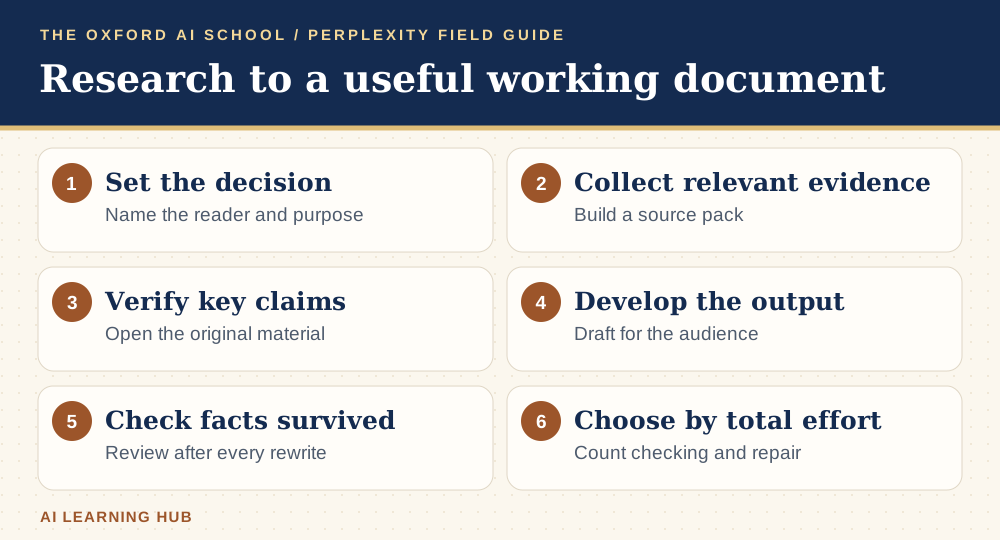
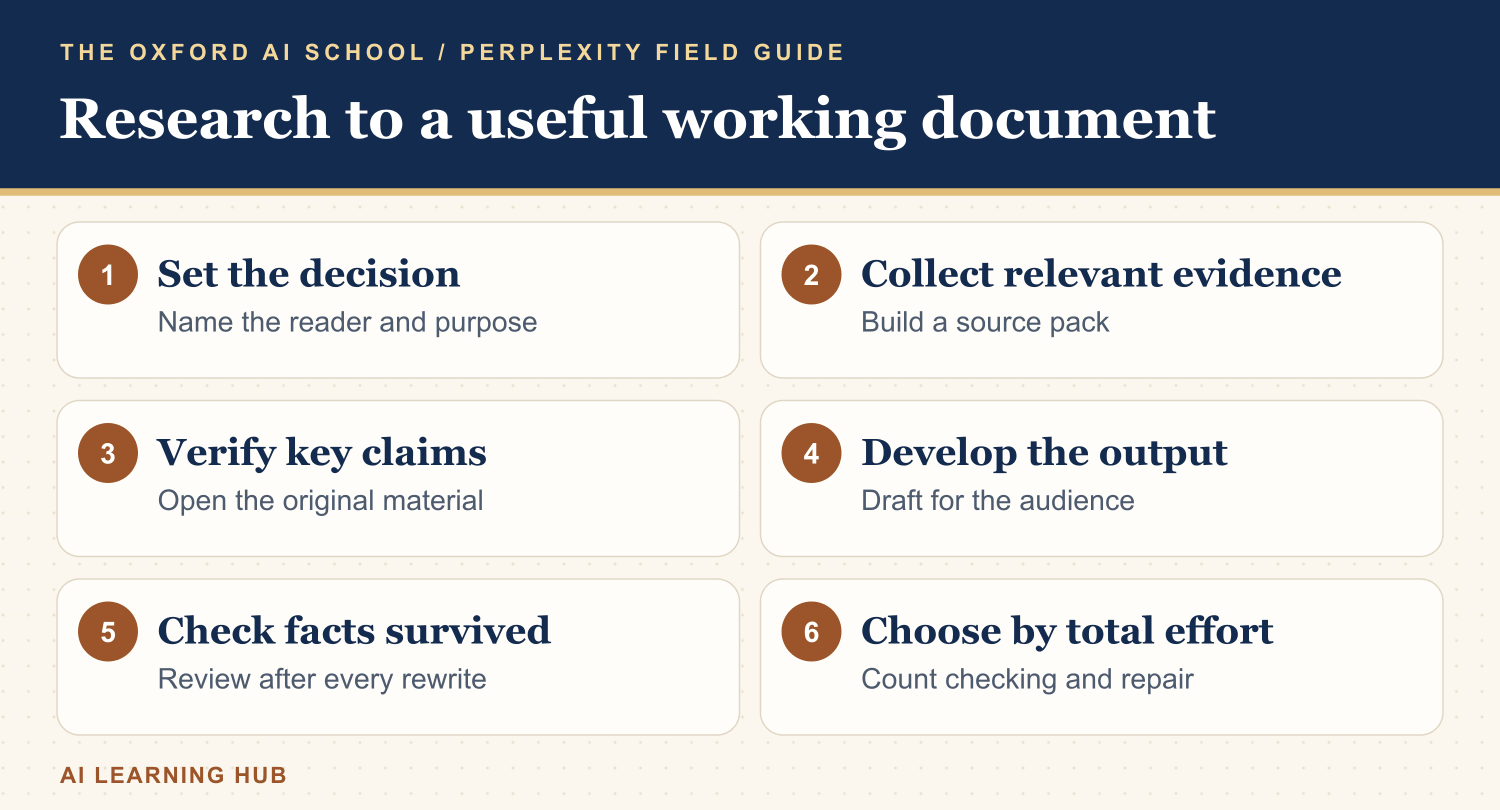
Read the infographic as text
- Set the decision: Name the reader and purpose.
- Collect relevant evidence: Build a source pack.
- Verify key claims: Open the original material.
- Develop the output: Draft for the audience.
- Check facts survived: Review after every rewrite.
- Choose by total effort: Count checking and repair.
Give Claude a development job
For the second part of the trial, take an approved evidence pack and ask for a working document. Try an argument, a proposal outline or a plain-English explanation. Judge structure, tone and how well the tool follows your constraints.
Ask for a revision that changes the audience while preserving the facts. Then ask which assumptions need your decision. This tests collaboration more usefully than requesting a splendid essay about an imaginary company.
Use the same task in Perplexity as well. These are suggested starting points for a trial, not a claim that only one product can do each job.
Compare the handover, not just the first answer
| Stage | Ask each tool to do this | Inspect this |
|---|---|---|
| Research | Find original sources and disagreements | Whether the citations support the claims |
| Understanding | Explain the issue to a newcomer | Whether definitions and limits remain clear |
| Drafting | Create a document from verified facts | Whether new unsupported claims appear |
| Revision | Adapt it for a second audience | Whether facts survive the rewrite |
| Handover | List decisions and unresolved questions | Whether somebody else can pick it up |
For an individual, convenience may decide it. For a team, repeatability matters too. Can a colleague understand the brief, access the approved sources and finish the job without a private tour of your thinking?
Use one brief and a fixed source pack
Keep the test small and the instructions identical. Record the tool, plan, date and enabled research features. If one product receives better material, you are comparing the shopping bags rather than the cooking.
A document-and-evidence test
Use only the approved facts in this source pack: [paste public material].
Write a 400-word briefing for [audience] about [decision].
Keep evidence separate from interpretation. Attribute important claims.
List missing information and do not fill it in.
Then suggest three improvements to the brief before rewriting it.
Check factual accuracy first, then clarity and tone. Count repair time, including the little corrections you normally dismiss because “it only takes a moment”. Twenty moments make a meeting.
Make the choice fit the reader
Students and individual learners: prioritise explanations you can test and sources you can read. Business owners: judge whether the finished work supports a real decision. Teams: agree permissions, source standards and who signs off the output.
If you use both products, carry over a checked brief with source links and limitations. Do not turn one tool's confident draft into the other tool's unquestioned evidence.
For the practical next step, read how to use Claude effectively and our Claude Projects guide. To practise tool selection with your team, explore AI Basics Deep Dive. Pick the method you will actually use on Monday.
Keep learning: Perplexity field guides
The five-part series
More Perplexity guides from the AI Learning Hub
Sources and product notes
Official product information checked on . Examples and prompts are for practice. Access and controls can change by plan, platform and account.
Frequently asked questions
Is Claude better than Perplexity for writing?
Test both with your own brief and approved source material. Compare factual discipline, structure, tone and revision effort. A preference for one writing style is not proof of universal superiority.
Can Claude provide web citations?
Yes. Claude can search the web and provide citations. Check the sources and your account’s available features.
Is using Claude through Perplexity the same as using Claude directly?
No. A model is one component of a product. The tools, context, interface and account features can differ even when a related model is used.
Should I transfer private files between tools?
Only where your organisation permits it. Check the data, the intended recipients and the relevant account settings before uploading or connecting work material.
How can a team choose fairly?
Use the same task, sources and constraints. Record accuracy, usefulness and total checking time. Include a handover test so the method works beyond one enthusiastic user.